Overview
Status Open
Updated @October 2, 2023 9:05 PM
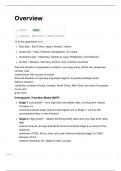
⅔ of the population is in...
East asia - East China, Japan, Koreas, Taiwan
South asia - India, Pakistan, Bangladesh, Sri Lanka
Southeast asia - Indonesia, Islands of Java, Philippines, and Malaysia
Europe - Monaco, Germany, France, over 4 dozen countries
Site and situation of population clusters: Low-lying areas, fertile soil, temperate
climate, near
ocean/rivers with access to ocean
Site and Situation of sparsely populated regions: Dry/wet/cold/high lands -
Sahara, Amazon
rainforest, northern Russia, Canada, North China, Mid China, too harsh for people
to live and
grow food
Demographic Transition Model (DMT):
Stage 1: Low growth - very high birth and death rates, no long term natural
increase, no
countries present today (some small regions are in Stage 1, such as the
uncontacted tribes in the Amazon)
Stage 2: High growth - rapidly declining death rates and very high birth rates,
high
natural increase, Europe and North America entered stage 2 as result of the
industrial
revolution (1750); Africa, Asia, and Latin America entered stage 2 in 1950
because of the
medical revolution (Ex: Nigeria, India, Congo)
Overview 1
, Stage 3: Moderate growth - rapid decline in birth rates, steady decline in
death rates,
natural increase is moderate, gap between CBR (crude birth rate) and CDR
(crude death
rate) is smaller; most European countries and North America transitioned to
stage 3,
during first half of twentieth century
Stage 4: Low growth - very low birth and death rates, no longer term increase,
possible
decrease in population, (ZPG) - zero population growth, the only population
change results from immigration (Ex: Canada)
Possible Stage 5: Decline, low CBR, increasing CDR, more elderly than young,
negative NIR (no increase in population), Russia had a negative NIR for past 50
years (Ex: japan, germany)
Epidemiologic Transition Model (ETM):
Stage 1: pestilence and famine is the biggest factor (high CDR), more parasitic
diseases
(Ex: black plague)
Stage 2: receding pandemics (rapidly declining CDR), industrial revolution
improved
medicine, nutrition, and sanitation (Ex: cholera pandemic in London)
Stage 3: Degenerative diseases (Moderately declining CDP), decrease in
death from
infectious disease, increase in chronic disorders associated with aging (Ex:
cardiovascular diseases, cancer)
Stage 4: Composed of delayed degenerative diseases (with a low but
increasing CDR),
deaths caused more by cardiovascular illnesses and cancer, these are usually
delayed because of modern medicine treatments
Possible stage 5: the evolution of viruses gain resistance against vaccines,
antibiotics
cause new strains of bacteria to form, diseases more common in poverty,
Overview 2
Status Open
Updated @October 2, 2023 9:05 PM
⅔ of the population is in...
East asia - East China, Japan, Koreas, Taiwan
South asia - India, Pakistan, Bangladesh, Sri Lanka
Southeast asia - Indonesia, Islands of Java, Philippines, and Malaysia
Europe - Monaco, Germany, France, over 4 dozen countries
Site and situation of population clusters: Low-lying areas, fertile soil, temperate
climate, near
ocean/rivers with access to ocean
Site and Situation of sparsely populated regions: Dry/wet/cold/high lands -
Sahara, Amazon
rainforest, northern Russia, Canada, North China, Mid China, too harsh for people
to live and
grow food
Demographic Transition Model (DMT):
Stage 1: Low growth - very high birth and death rates, no long term natural
increase, no
countries present today (some small regions are in Stage 1, such as the
uncontacted tribes in the Amazon)
Stage 2: High growth - rapidly declining death rates and very high birth rates,
high
natural increase, Europe and North America entered stage 2 as result of the
industrial
revolution (1750); Africa, Asia, and Latin America entered stage 2 in 1950
because of the
medical revolution (Ex: Nigeria, India, Congo)
Overview 1
, Stage 3: Moderate growth - rapid decline in birth rates, steady decline in
death rates,
natural increase is moderate, gap between CBR (crude birth rate) and CDR
(crude death
rate) is smaller; most European countries and North America transitioned to
stage 3,
during first half of twentieth century
Stage 4: Low growth - very low birth and death rates, no longer term increase,
possible
decrease in population, (ZPG) - zero population growth, the only population
change results from immigration (Ex: Canada)
Possible Stage 5: Decline, low CBR, increasing CDR, more elderly than young,
negative NIR (no increase in population), Russia had a negative NIR for past 50
years (Ex: japan, germany)
Epidemiologic Transition Model (ETM):
Stage 1: pestilence and famine is the biggest factor (high CDR), more parasitic
diseases
(Ex: black plague)
Stage 2: receding pandemics (rapidly declining CDR), industrial revolution
improved
medicine, nutrition, and sanitation (Ex: cholera pandemic in London)
Stage 3: Degenerative diseases (Moderately declining CDP), decrease in
death from
infectious disease, increase in chronic disorders associated with aging (Ex:
cardiovascular diseases, cancer)
Stage 4: Composed of delayed degenerative diseases (with a low but
increasing CDR),
deaths caused more by cardiovascular illnesses and cancer, these are usually
delayed because of modern medicine treatments
Possible stage 5: the evolution of viruses gain resistance against vaccines,
antibiotics
cause new strains of bacteria to form, diseases more common in poverty,
Overview 2