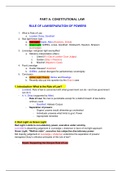
PART A: CONSTITUTIONAL LAW
RULE OF LAW/SEPARATION OF POWERS
1. What is Rule of Law:
a. Lovelad, Dicey, Goodhart
2. Red light/Green light
a. Red Light: Hayek, Atkin (Anisminic, Entick)
b. Green Light: Griffiths, Jones, Goodhart, Holdsworth, Heuston, Simpson
(Liversidge)
3. Liversidge- red/green light exemplified
a. Statutory interpretation (Allen)
i. Literal (R v City of London Court Judge),
ii. Golden (Grey v Pearson)
iii. Mischief (Heydon’s Case)
4. Post-Liversidge
a. Ouster Clauses? Anisminic
b. Griffiths: Judicial disregard for parliamentary sovereignty
5. Conclusion
a. Amber Light Theory: Harlow and Rawlings
b. Recently also put into question by the Evan’s case
1. Introduction- What is the Rule of Law?
- Loveland: Rule of law is concerned with what government can do—and how government
can do it.
- A. V. Dicey (supported by Allen)
- Rule of Law: No man is punishable except for a distinct breach of law before
ordinary couts
- Goodhart: Habeas Corpus
- Separation of powers:
- Organs’ powers would otherwise go unchecked
- Individuals unaware what limits to govt. Power
- Appropriate remedies
2. Red Light vs Green Light
Red Light: Limits to non-statutory power, executive under scrutiny
Lord Atkin’s dissenting judgement in Liversidge v Anderson in favor of red light approach
Green Light: “Welfare state”, executive has subjective discretionary power
Did majority judgement in Liversidge v Anderson undermine the separation of powers/
transgress Dicey’s orthodox principles of the rule of law?
- Hayek: Supporting the Diceyan Rule of Law
, a. Society’s interests= minimizing government power
b. Little governmental discretion
c. Courts should adopt a ‘red light’ approach towards the executive’s actions
- Exemplified in Entick v Carrington 1765:
- Camden CJ: Clear legal basis that justifies executive action
- ‘if it is law, it will be found it our books. If it is not to be found there, it is not law”
- Summary of Facts: Home Secretary empowered civil servants to raid private
premises without permission and seize everything there
- Entick ‘suffered in Goods’.
- He did not commit ‘a distinct breach of law’
- No basis of power
- Home Secretary: (1) public security threat (2) customs and tradition.
- Lord Camden: NO. If it is law it will be found.
Different Approach
Jones: the Welfare State
- Government should play an extensive role in the state’s economic and social affairs.
- Executory must be given a significant amount of discretionary powers
a. it is not feasible to operate a welfare estate with detailed legislative rules.
Impossible to predict every possible situation
- Green light approach when policing executive actions.
3. Liversidge v Anderson- Red Light/Green Light exemplified
Liverside v Anderson
Secretary of State had right to detain based on “reasonable cause of believe” (digressed from
its earlier formulation, sole requirement of being “satisfied” of its urgency)
- Majority decided reasonable cause completely laid in discretion of secretary of state
What is reasonable cause of belief? Statutory interpretation
Allen: Despite The Interpretation Act Acts, wide discretionary interpretational margin
- Literal: Atkin in Liversidge (also Esher in R v City of London Court Judge)
- limit the discretion of the courts by granting full legislative power to and upholding
sovereignty of parliament
- Golden: Lord Wnsleydale in Grey v Pearson
- consistency and sense “but no farther”, upholding parl. sovereignty
- Mischief: Heydon’s Case
- Interpretation remedies the issue (purpose) that parliament was trying to control
(Magor and Denning in St. Mellons R.D.C. v Newport Corporation: “filling in the
gaps [...] by opening it up to destructive analysis”)
, All purport to reaffirm the sovereignty of parliament, whether it be through a close analysis of the
words or the intention. But where does one draw the line between filling in the gaps and
interrupting the separation of powers?
Applying to the case
- Majority judgement by Viscount Maugham, reasonable cause: “left to his sole discretion
without appeal to a court” (1942: 220-221)
- Used mischief rule set out in the Heydon’s Case - the misc
- hief being fear of spies as a public policy concern (Bingham)
- Jones - Political justification - rule of law can be suspended during war to preserve
country’s existence as an independent state.
- Goodhart
- subjective judgement of ministers [expert], state depends on this
- Executive acted within its power
- Holdsworth
- Amendment (adding ‘reasonable’) does not grant the court power to
review that criteria
- Home Secretary is bound by these rules (good faith)
- Extensive reviewability by courts has hindered rational development of
administrative law
- Heuston and Simpson supports this judgement
This submission, however, ostensibly contradicts the Diceyan rule of law:
- Dissenting judgement by Lord Atkin:
- Literal approach: must give words natural meaning, even in war times
- Reasonable cause= objective fact to be proved and determined in the courts
- Reiterates importance of separation of powers, executive should not establish,
but execute rule of law, even in a time of war.
- Kemp Allen
- difference between “stretching and bursting”,
- Majority did not stretch but completely overstepped its boundaries
- Rights of individuals more crucial than war-time policies ending in
arbitrary imprisonment (contrast: Jones)
4. Post-Liversidge: Parliamentary sovereignty or rule of law?
Grifiths
- Judicial disregard for parliamentary sovereignty signifies green light
Ouster Clauses
- Parliament attempted to restricts traditional rule of law by ousting court jurisdiction
BUT
- Anisminic: Court overruled ouster clauses-- reaffirming red light
5. Conclusion
RULE OF LAW/SEPARATION OF POWERS
1. What is Rule of Law:
a. Lovelad, Dicey, Goodhart
2. Red light/Green light
a. Red Light: Hayek, Atkin (Anisminic, Entick)
b. Green Light: Griffiths, Jones, Goodhart, Holdsworth, Heuston, Simpson
(Liversidge)
3. Liversidge- red/green light exemplified
a. Statutory interpretation (Allen)
i. Literal (R v City of London Court Judge),
ii. Golden (Grey v Pearson)
iii. Mischief (Heydon’s Case)
4. Post-Liversidge
a. Ouster Clauses? Anisminic
b. Griffiths: Judicial disregard for parliamentary sovereignty
5. Conclusion
a. Amber Light Theory: Harlow and Rawlings
b. Recently also put into question by the Evan’s case
1. Introduction- What is the Rule of Law?
- Loveland: Rule of law is concerned with what government can do—and how government
can do it.
- A. V. Dicey (supported by Allen)
- Rule of Law: No man is punishable except for a distinct breach of law before
ordinary couts
- Goodhart: Habeas Corpus
- Separation of powers:
- Organs’ powers would otherwise go unchecked
- Individuals unaware what limits to govt. Power
- Appropriate remedies
2. Red Light vs Green Light
Red Light: Limits to non-statutory power, executive under scrutiny
Lord Atkin’s dissenting judgement in Liversidge v Anderson in favor of red light approach
Green Light: “Welfare state”, executive has subjective discretionary power
Did majority judgement in Liversidge v Anderson undermine the separation of powers/
transgress Dicey’s orthodox principles of the rule of law?
- Hayek: Supporting the Diceyan Rule of Law
, a. Society’s interests= minimizing government power
b. Little governmental discretion
c. Courts should adopt a ‘red light’ approach towards the executive’s actions
- Exemplified in Entick v Carrington 1765:
- Camden CJ: Clear legal basis that justifies executive action
- ‘if it is law, it will be found it our books. If it is not to be found there, it is not law”
- Summary of Facts: Home Secretary empowered civil servants to raid private
premises without permission and seize everything there
- Entick ‘suffered in Goods’.
- He did not commit ‘a distinct breach of law’
- No basis of power
- Home Secretary: (1) public security threat (2) customs and tradition.
- Lord Camden: NO. If it is law it will be found.
Different Approach
Jones: the Welfare State
- Government should play an extensive role in the state’s economic and social affairs.
- Executory must be given a significant amount of discretionary powers
a. it is not feasible to operate a welfare estate with detailed legislative rules.
Impossible to predict every possible situation
- Green light approach when policing executive actions.
3. Liversidge v Anderson- Red Light/Green Light exemplified
Liverside v Anderson
Secretary of State had right to detain based on “reasonable cause of believe” (digressed from
its earlier formulation, sole requirement of being “satisfied” of its urgency)
- Majority decided reasonable cause completely laid in discretion of secretary of state
What is reasonable cause of belief? Statutory interpretation
Allen: Despite The Interpretation Act Acts, wide discretionary interpretational margin
- Literal: Atkin in Liversidge (also Esher in R v City of London Court Judge)
- limit the discretion of the courts by granting full legislative power to and upholding
sovereignty of parliament
- Golden: Lord Wnsleydale in Grey v Pearson
- consistency and sense “but no farther”, upholding parl. sovereignty
- Mischief: Heydon’s Case
- Interpretation remedies the issue (purpose) that parliament was trying to control
(Magor and Denning in St. Mellons R.D.C. v Newport Corporation: “filling in the
gaps [...] by opening it up to destructive analysis”)
, All purport to reaffirm the sovereignty of parliament, whether it be through a close analysis of the
words or the intention. But where does one draw the line between filling in the gaps and
interrupting the separation of powers?
Applying to the case
- Majority judgement by Viscount Maugham, reasonable cause: “left to his sole discretion
without appeal to a court” (1942: 220-221)
- Used mischief rule set out in the Heydon’s Case - the misc
- hief being fear of spies as a public policy concern (Bingham)
- Jones - Political justification - rule of law can be suspended during war to preserve
country’s existence as an independent state.
- Goodhart
- subjective judgement of ministers [expert], state depends on this
- Executive acted within its power
- Holdsworth
- Amendment (adding ‘reasonable’) does not grant the court power to
review that criteria
- Home Secretary is bound by these rules (good faith)
- Extensive reviewability by courts has hindered rational development of
administrative law
- Heuston and Simpson supports this judgement
This submission, however, ostensibly contradicts the Diceyan rule of law:
- Dissenting judgement by Lord Atkin:
- Literal approach: must give words natural meaning, even in war times
- Reasonable cause= objective fact to be proved and determined in the courts
- Reiterates importance of separation of powers, executive should not establish,
but execute rule of law, even in a time of war.
- Kemp Allen
- difference between “stretching and bursting”,
- Majority did not stretch but completely overstepped its boundaries
- Rights of individuals more crucial than war-time policies ending in
arbitrary imprisonment (contrast: Jones)
4. Post-Liversidge: Parliamentary sovereignty or rule of law?
Grifiths
- Judicial disregard for parliamentary sovereignty signifies green light
Ouster Clauses
- Parliament attempted to restricts traditional rule of law by ousting court jurisdiction
BUT
- Anisminic: Court overruled ouster clauses-- reaffirming red light
5. Conclusion