Enzymes
explanation video
• Enzymes are proteins.
• They act as biological catalysts to speed up reactions without being used up.
• Catalysts : substances that increase rate of chemical reactions without being used up.
• Enzymes lower activation energy which is the energy needed to start a reaction.
• All enzymes' names end with "ase".
example: Maltose ---> Maltase
Lipase / Protease
• Enzymes can be ---> Intracellular [present in lysosomes / used in ATP production in the cell]
---> Extracellular [such as digestive enzymes]
• Each enzyme has a specific complementary shape.
*Explain how enzymes work.
1) They are proteins that act as biological catalysts.
2) They speed up reactions by lowering activation energy.
3) Bind with specific substrates, as the active site of the enzyme has a complementary shape to its
substrate.
4) Both the enzyme and substrate interact like lock and key, where the enzyme is the lock and the
substrate is key, forming an enzyme-substrate complex (ESC).
5) Releases products without being changed or used up.
6) They have specific temperatures and pH at which they work best (optimum). Other factors that
affect the rate at which enzymes work include concentration of enzymes, concentration of
substrate, and inhibitor presence.
----------------------------------------------------
► Enzymes can be builders or breakers.
► If an enzyme is partially denatured, the active site is no longer complementary to the substrate,
and there will be less enzyme-substrate complex production.
PAPER 6
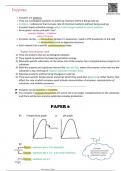
#1 Temperature graph vs pH graph
Steep slope
#2
Pepsin : optimum pH is 2 (in stomach) In enzyme
proteases experiments, the control
Trypsin : optimum pH is 7.5 - 8 (in small intestine) experiment is made by
using boiled enzymes.
Salivary : optimum pH is 7
amylase
Pancreatic : optimum pH is 8
New Section 1 Page 1
explanation video
• Enzymes are proteins.
• They act as biological catalysts to speed up reactions without being used up.
• Catalysts : substances that increase rate of chemical reactions without being used up.
• Enzymes lower activation energy which is the energy needed to start a reaction.
• All enzymes' names end with "ase".
example: Maltose ---> Maltase
Lipase / Protease
• Enzymes can be ---> Intracellular [present in lysosomes / used in ATP production in the cell]
---> Extracellular [such as digestive enzymes]
• Each enzyme has a specific complementary shape.
*Explain how enzymes work.
1) They are proteins that act as biological catalysts.
2) They speed up reactions by lowering activation energy.
3) Bind with specific substrates, as the active site of the enzyme has a complementary shape to its
substrate.
4) Both the enzyme and substrate interact like lock and key, where the enzyme is the lock and the
substrate is key, forming an enzyme-substrate complex (ESC).
5) Releases products without being changed or used up.
6) They have specific temperatures and pH at which they work best (optimum). Other factors that
affect the rate at which enzymes work include concentration of enzymes, concentration of
substrate, and inhibitor presence.
----------------------------------------------------
► Enzymes can be builders or breakers.
► If an enzyme is partially denatured, the active site is no longer complementary to the substrate,
and there will be less enzyme-substrate complex production.
PAPER 6
#1 Temperature graph vs pH graph
Steep slope
#2
Pepsin : optimum pH is 2 (in stomach) In enzyme
proteases experiments, the control
Trypsin : optimum pH is 7.5 - 8 (in small intestine) experiment is made by
using boiled enzymes.
Salivary : optimum pH is 7
amylase
Pancreatic : optimum pH is 8
New Section 1 Page 1