Summary work & performance course block 1
Hoofdstuk 1
Problems with applying theories
- Oversimplification. Situation in experiments is a reduction of reality. Better to look
at effect sizes.
- External validity. A lot of factors in real life may hinder the quality of the evidence.
Better to look at underlying things. Has the study been replicated for example. Most
of the participants are W.E.I.R.D participants: Western, Educated, Industrialized
country, Rich & Democrats.
- Contradictory Evidence. Studies often produce contradictory findings.
Phase 1 Problem phase!
First a checklist
1. Is it a psychological problem? Is it a behavior, for example?
2. Is the problem phrased in an applied way? The problem should call for a solution,
not just an explanation.
3. Is the problem concrete? It should not be too abstract or too vague.
4. Solvable. Do we estimate that the problem can be resolved? (scale, scope, ethics).
Once you have figured out if it is suitable? → Time to make the problem definition.
Key aspects of the problem definition
1. What is the problem?
2. Why is it a problem?
3. For whom is it a problem?
4. Potential causes for the problem?
5. Target group for the problem?
How do you start with writing such a problem definition?
- Assess the problem and the key aspects.
- Research facts and figures (brief scan literature, look carefully for source of
information).
- Interviews and observations, talking to different parties involved.
, Phase 2 The Analysis phase
Analysis phase: We try to find explanations for the problem you find in phase 1.
Three parts in this phase:
1. Outcome variable
2. Divergent phase
3. Convergent phase
Outcome variable
- What do we want to influence with our outcome variable? Specify outcome variable.
- Psychological variables (behavior and intentions, attitudes and cognitions,
emotions or affect).
- Requirements: Relevance (relevant to problem), Specificity, Continuity (the outcome
variable can increase and decrease).
- Also think about direction, Do you want the outcome variable to increase or
decrease.
- Also already think about measurement form.
Divergent phase
1. Aim to be complete. Generate as many explanations as possible.
2. Free association
- problem association
- concept association
- perspective taking).
3. Interviews and observations.
- Why interviews.
- Observation data.
- Surveys.
4. Social psychological literature.
- Topical strategy (Look for literature that directly relates to your problem).
- Conceptual strategy (Look for more general concepts relating to your problem).
- General theory strategy (Dive into general theories among behavior and behavior
change).
- Also try to find what moves the target group: a need assessment. How does the
target group perceive the problem themselves? What is the level of knowledge, skills
and resources in the target group? Which needs and capacities does the target
group express? What environmental factors play a role?
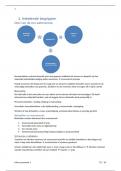
- Take into account the environment of an individual (see picture).
Hoofdstuk 1
Problems with applying theories
- Oversimplification. Situation in experiments is a reduction of reality. Better to look
at effect sizes.
- External validity. A lot of factors in real life may hinder the quality of the evidence.
Better to look at underlying things. Has the study been replicated for example. Most
of the participants are W.E.I.R.D participants: Western, Educated, Industrialized
country, Rich & Democrats.
- Contradictory Evidence. Studies often produce contradictory findings.
Phase 1 Problem phase!
First a checklist
1. Is it a psychological problem? Is it a behavior, for example?
2. Is the problem phrased in an applied way? The problem should call for a solution,
not just an explanation.
3. Is the problem concrete? It should not be too abstract or too vague.
4. Solvable. Do we estimate that the problem can be resolved? (scale, scope, ethics).
Once you have figured out if it is suitable? → Time to make the problem definition.
Key aspects of the problem definition
1. What is the problem?
2. Why is it a problem?
3. For whom is it a problem?
4. Potential causes for the problem?
5. Target group for the problem?
How do you start with writing such a problem definition?
- Assess the problem and the key aspects.
- Research facts and figures (brief scan literature, look carefully for source of
information).
- Interviews and observations, talking to different parties involved.
, Phase 2 The Analysis phase
Analysis phase: We try to find explanations for the problem you find in phase 1.
Three parts in this phase:
1. Outcome variable
2. Divergent phase
3. Convergent phase
Outcome variable
- What do we want to influence with our outcome variable? Specify outcome variable.
- Psychological variables (behavior and intentions, attitudes and cognitions,
emotions or affect).
- Requirements: Relevance (relevant to problem), Specificity, Continuity (the outcome
variable can increase and decrease).
- Also think about direction, Do you want the outcome variable to increase or
decrease.
- Also already think about measurement form.
Divergent phase
1. Aim to be complete. Generate as many explanations as possible.
2. Free association
- problem association
- concept association
- perspective taking).
3. Interviews and observations.
- Why interviews.
- Observation data.
- Surveys.
4. Social psychological literature.
- Topical strategy (Look for literature that directly relates to your problem).
- Conceptual strategy (Look for more general concepts relating to your problem).
- General theory strategy (Dive into general theories among behavior and behavior
change).
- Also try to find what moves the target group: a need assessment. How does the
target group perceive the problem themselves? What is the level of knowledge, skills
and resources in the target group? Which needs and capacities does the target
group express? What environmental factors play a role?
- Take into account the environment of an individual (see picture).