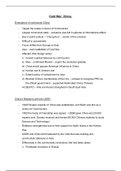
Cold War: China.
Emergence of communist China:
- Tipped the scales in favour of Communism
- Largest communist state – presence was felt in spheres of international affairs
- Has a world outlook – “Chung Kuo” – centre of the universe
- Difficult to subordinate
- Focus shifted from Europe to Asia
- Asia – main battlefield of Cold War
- Affected USA foreign policy:
i) Feared a global takeover by communism
ii) Mao – confirmed Marxist – export the revolution globally
iii) China would oppose American influence in China
iv) Korean war & Vietnam war
v) Extend policy of containment to Asia
vi) Blocked China’s membership of the Uno – refused to recognise PRC as
the official government – supported Nationalist China (Taiwan)
vii) SEATO – Anti-communist stronghold in South East Asia
China’s Relations with the USSR:
- 1949 Peoples republic of China was established, and Stalin saw this as a
victory for Communism
- 1950 the treaty of Friendship was signed – USSR gave China aid (20,000
experts sent, Soviets received and trained 80,000 Chinese students to study
Science and Technology)
- Relations strengthened due to their support for North Korea in the Korean
War.
- USSR and China felt threatened by the USA that was building anti-
communistic alliances in Asia
- Differences in the communistic revolutions that had taken place:
i) Proletariat revolution in Russia
, ii) The Chinese Communist party had built up its support – Mao had
developed his own ideas about Marx’s theories – Change focused on the
countryside therefore focus on the peasants rather than the urban
population
iii) Mao: believed that there was to be a continuous process of transformation
until a classless society was achieved
iv) Soviets: Believed that continued revolutionary action would destroy the
country and that transformation into a classless society would happen
gradually
v) Khrushchev: denounced radical features of Stalinism and proposed a
policy of “peaceful co-existence” therefore accepting other spheres of
influence and not push for a world revolution – China accused the USSR
of revising the ideas of Marx and Lenin.
- Disputes over territory along the long border between China and USSR
- China did not receive enough aid from the USSR – some non-communist
countries received more soviet aid than what China did (Egypt and India)
- USSR was critical of Mao’s great leap forward.
- China angry when USSR refused to supply her with nuclear weapons
- Both started openly competing for influence amongst Asia and Africa
- 1960 USSR withdrew its advisors from China and cancelled all aid
- China critical of Khrushchev’s handling of the Cuban missile Crisis (1962)
- Sino soviet Split
Sino Soviet Split:
- Stalin had treated Mao badly on his first visit (poor villa no facilities)
- Mao resented the high cost of the Treaty of Friendship – believed China was
exploited
Ideological differences:
- Mao criticised Khrushchev’s policies
i) Khrushchev had denounced Stalin as a bloodthirsty Tyrant
ii) Mao was constructing a dictatorship like Stalin’s – cult personality
iii) Ended Cominform
Emergence of communist China:
- Tipped the scales in favour of Communism
- Largest communist state – presence was felt in spheres of international affairs
- Has a world outlook – “Chung Kuo” – centre of the universe
- Difficult to subordinate
- Focus shifted from Europe to Asia
- Asia – main battlefield of Cold War
- Affected USA foreign policy:
i) Feared a global takeover by communism
ii) Mao – confirmed Marxist – export the revolution globally
iii) China would oppose American influence in China
iv) Korean war & Vietnam war
v) Extend policy of containment to Asia
vi) Blocked China’s membership of the Uno – refused to recognise PRC as
the official government – supported Nationalist China (Taiwan)
vii) SEATO – Anti-communist stronghold in South East Asia
China’s Relations with the USSR:
- 1949 Peoples republic of China was established, and Stalin saw this as a
victory for Communism
- 1950 the treaty of Friendship was signed – USSR gave China aid (20,000
experts sent, Soviets received and trained 80,000 Chinese students to study
Science and Technology)
- Relations strengthened due to their support for North Korea in the Korean
War.
- USSR and China felt threatened by the USA that was building anti-
communistic alliances in Asia
- Differences in the communistic revolutions that had taken place:
i) Proletariat revolution in Russia
, ii) The Chinese Communist party had built up its support – Mao had
developed his own ideas about Marx’s theories – Change focused on the
countryside therefore focus on the peasants rather than the urban
population
iii) Mao: believed that there was to be a continuous process of transformation
until a classless society was achieved
iv) Soviets: Believed that continued revolutionary action would destroy the
country and that transformation into a classless society would happen
gradually
v) Khrushchev: denounced radical features of Stalinism and proposed a
policy of “peaceful co-existence” therefore accepting other spheres of
influence and not push for a world revolution – China accused the USSR
of revising the ideas of Marx and Lenin.
- Disputes over territory along the long border between China and USSR
- China did not receive enough aid from the USSR – some non-communist
countries received more soviet aid than what China did (Egypt and India)
- USSR was critical of Mao’s great leap forward.
- China angry when USSR refused to supply her with nuclear weapons
- Both started openly competing for influence amongst Asia and Africa
- 1960 USSR withdrew its advisors from China and cancelled all aid
- China critical of Khrushchev’s handling of the Cuban missile Crisis (1962)
- Sino soviet Split
Sino Soviet Split:
- Stalin had treated Mao badly on his first visit (poor villa no facilities)
- Mao resented the high cost of the Treaty of Friendship – believed China was
exploited
Ideological differences:
- Mao criticised Khrushchev’s policies
i) Khrushchev had denounced Stalin as a bloodthirsty Tyrant
ii) Mao was constructing a dictatorship like Stalin’s – cult personality
iii) Ended Cominform