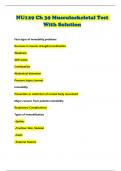
NU129 Ch 39 Musculoskeletal Test
With Solution
First signs of immobility problems
Decrease in muscle strength/coordination
Weakness
Stiff Joints
Constipation
Abdominal distention
Pressure Injury (severe)
Immobility
Prevention or restriction of normal body movement
Major concern from patients immobility
Respiratory Complications
Types of immobilization
•Splints
•Traction: Skin, Skeletal
•Casts
•External fixators
, Traction
Exertion of a pulling force
Countertraction
The weight pulling against the weight of traction; provided by body weight.
Increase by elevating foot of bed
Buck's traction
Knee immobility; widely used in the lower limb for femoral fractures, lower
backache, acetabular and hip fractures.
Russell's Traction
"Pulls" contracted muscles; elevate foot of bed with shock blocks to provide
countertraction; sling can be loosened for skin care; check popliteal pulse.
Place pillows under lower leg. Make sure heel is off the bed. Must not turn
from waist down. Lift patient, not leg, to provide assistance.
Head Halter traction
Traction for cervical spine disorders
Pelvic Traction
Traction used for sciatica, muscle spasms of the lower back, and minor
fractures of the lower spine. 4.5-9kg
Balanced Suspension Traction
Purpose: Realigns fractures of the femur; Uses pulley to create balanced
suspension by countertraction to the top of the thigh
Neurovascular Assessment (5 P's)
With Solution
First signs of immobility problems
Decrease in muscle strength/coordination
Weakness
Stiff Joints
Constipation
Abdominal distention
Pressure Injury (severe)
Immobility
Prevention or restriction of normal body movement
Major concern from patients immobility
Respiratory Complications
Types of immobilization
•Splints
•Traction: Skin, Skeletal
•Casts
•External fixators
, Traction
Exertion of a pulling force
Countertraction
The weight pulling against the weight of traction; provided by body weight.
Increase by elevating foot of bed
Buck's traction
Knee immobility; widely used in the lower limb for femoral fractures, lower
backache, acetabular and hip fractures.
Russell's Traction
"Pulls" contracted muscles; elevate foot of bed with shock blocks to provide
countertraction; sling can be loosened for skin care; check popliteal pulse.
Place pillows under lower leg. Make sure heel is off the bed. Must not turn
from waist down. Lift patient, not leg, to provide assistance.
Head Halter traction
Traction for cervical spine disorders
Pelvic Traction
Traction used for sciatica, muscle spasms of the lower back, and minor
fractures of the lower spine. 4.5-9kg
Balanced Suspension Traction
Purpose: Realigns fractures of the femur; Uses pulley to create balanced
suspension by countertraction to the top of the thigh
Neurovascular Assessment (5 P's)