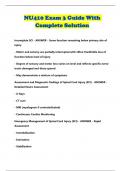
NU410 Exam 3 Guide With
Complete Solution
Incomplete SCI - ANSWER - Some function remaining below primary site of
injury
- Motor and sensory are partially interrupted with vlibre franklinble loss of
function below level of injury
- Degree of sensory and motor loss varies on level and reflects specific nerve
tracts damaged and those spared
- May demonstrate a mixture of symptoms
Assessment and Diagnostic Findings of Spinal Cord Injury (SCI) - ANSWER -
Detailed Neuro Assessment
- X-Rays
- CT scan
- MRI (myelogram if contraindicated)
- Continuous Cardiac Monitoring
Emergency Management of Spinal Cord Injury (SCI) - ANSWER - Rapid
Assessment
- Immobilization
- Extrication
- Stabilization
,- Transport
Medical Management (Acute Phase) of Spinal Cord Injury (SCI) - ANSWER -
Respiratory Therapy
- Diaphragmatic pacing
- Skeletal Fracture Reduction and Traction
- Surgical Management
- Pharmacologic Therapy
Care of client with Halo Device for Spinal Injury - ANSWER - Ensure that
wrench to release rods is attached to vest when using halo traction in the
event CPR is necessary
- Maintain body alignment and ensure cervical tong weights hang freely
- Monitor skin integrity by providing pin care and assessing skin under halo
fixation vest as appropriate
- Don't use halo device to turn or move a client
- If client goes home with a halo fixation device on, provide instruction on
pin and vest care
- Teach client signs of infection and skin breakdown
Halo Device Nursing Considerations - ANSWER - Ensure pulley is free of
knots, fraying and loosening every 8-12 hours
- Notify provider if patient experiences severe pain from muscle spasms
(unrelieved by meds or positioning)
- Assess neurovascular every hour for 24 hours
,- Provide pin care once a shift, 1-2 times a day
A nurse is preparing to discharge a client who has halo device and is
reviewing new prescriptions from the provider. The nurse should clarify
which of the following prescriptions with the provider?
a. Increase intake of fiber-rich foods
b. May place a small pillow under head when sleeping
c. May operate a motor vehicle when no longer taking analgesics
d. Take a tub bath instead of showers - ANSWER c. May operate a motor
vehicle when no longer taking analgesics
Complications of Spinal Cord Injury (SCI) - ANSWER - Spinal Shock
- Neurogenic Shock
- Autonomic Dysreflexia
Spinal Shock - ANSWER - Spinal cord's response to inflammation caused by
the SCI (secondary injury)
- A sudden loss of reflex activity below level of spinal injury
- Muscular flaccidity, lack of sensation and reflexes
- Client can have hypotension and bradycardia
- Reflexes that initial bowel and bladder function affected, bowel distension
and paralytic ileus occur
Spinal Shock Care - ANSWER - Keeping mean arterial pressure at least 85 mm
Hg can prevent further damage to spinal cord
, - NG tube
- Control of hypotension & bradycardia w/meds
Neurogenic Shock - ANSWER - Caused by loss of function of autonomic
nervous system
- Loss of communication with sympathetic nervous system cause
bradycardia, hypotension, dependent edema, loss of temperature regulation
- Massive venous pooling occurs because of peripheral vasodilation
(distributive shock)
- Paralyzed portions of body do not perspire
Neurogenic Shock Nursing Actions - ANSWER Treat adverse findings with
appropriate medications (vasopressors or atropine) and IV fluids
Autonomic Dysreflexia - ANSWER - Life-threatening HTN emergency
- Excessive uncontrolled sympathetic output caused by a stimulus
- Typically SCI above T6
- Seizures, cerebral hemorrhage, stroke, heart attack can result if not treated
Autonomic Dysreflexia S/S - ANSWER - Bradycardia, hypertension
- Anxiety, restlessness severe pounding H/A
- Nasal stuffiness/congestion
- Red blotches on skin
- Muscle spasms
- Flushed warm skin with profuse sweating above lesion and pale, cold, and
Complete Solution
Incomplete SCI - ANSWER - Some function remaining below primary site of
injury
- Motor and sensory are partially interrupted with vlibre franklinble loss of
function below level of injury
- Degree of sensory and motor loss varies on level and reflects specific nerve
tracts damaged and those spared
- May demonstrate a mixture of symptoms
Assessment and Diagnostic Findings of Spinal Cord Injury (SCI) - ANSWER -
Detailed Neuro Assessment
- X-Rays
- CT scan
- MRI (myelogram if contraindicated)
- Continuous Cardiac Monitoring
Emergency Management of Spinal Cord Injury (SCI) - ANSWER - Rapid
Assessment
- Immobilization
- Extrication
- Stabilization
,- Transport
Medical Management (Acute Phase) of Spinal Cord Injury (SCI) - ANSWER -
Respiratory Therapy
- Diaphragmatic pacing
- Skeletal Fracture Reduction and Traction
- Surgical Management
- Pharmacologic Therapy
Care of client with Halo Device for Spinal Injury - ANSWER - Ensure that
wrench to release rods is attached to vest when using halo traction in the
event CPR is necessary
- Maintain body alignment and ensure cervical tong weights hang freely
- Monitor skin integrity by providing pin care and assessing skin under halo
fixation vest as appropriate
- Don't use halo device to turn or move a client
- If client goes home with a halo fixation device on, provide instruction on
pin and vest care
- Teach client signs of infection and skin breakdown
Halo Device Nursing Considerations - ANSWER - Ensure pulley is free of
knots, fraying and loosening every 8-12 hours
- Notify provider if patient experiences severe pain from muscle spasms
(unrelieved by meds or positioning)
- Assess neurovascular every hour for 24 hours
,- Provide pin care once a shift, 1-2 times a day
A nurse is preparing to discharge a client who has halo device and is
reviewing new prescriptions from the provider. The nurse should clarify
which of the following prescriptions with the provider?
a. Increase intake of fiber-rich foods
b. May place a small pillow under head when sleeping
c. May operate a motor vehicle when no longer taking analgesics
d. Take a tub bath instead of showers - ANSWER c. May operate a motor
vehicle when no longer taking analgesics
Complications of Spinal Cord Injury (SCI) - ANSWER - Spinal Shock
- Neurogenic Shock
- Autonomic Dysreflexia
Spinal Shock - ANSWER - Spinal cord's response to inflammation caused by
the SCI (secondary injury)
- A sudden loss of reflex activity below level of spinal injury
- Muscular flaccidity, lack of sensation and reflexes
- Client can have hypotension and bradycardia
- Reflexes that initial bowel and bladder function affected, bowel distension
and paralytic ileus occur
Spinal Shock Care - ANSWER - Keeping mean arterial pressure at least 85 mm
Hg can prevent further damage to spinal cord
, - NG tube
- Control of hypotension & bradycardia w/meds
Neurogenic Shock - ANSWER - Caused by loss of function of autonomic
nervous system
- Loss of communication with sympathetic nervous system cause
bradycardia, hypotension, dependent edema, loss of temperature regulation
- Massive venous pooling occurs because of peripheral vasodilation
(distributive shock)
- Paralyzed portions of body do not perspire
Neurogenic Shock Nursing Actions - ANSWER Treat adverse findings with
appropriate medications (vasopressors or atropine) and IV fluids
Autonomic Dysreflexia - ANSWER - Life-threatening HTN emergency
- Excessive uncontrolled sympathetic output caused by a stimulus
- Typically SCI above T6
- Seizures, cerebral hemorrhage, stroke, heart attack can result if not treated
Autonomic Dysreflexia S/S - ANSWER - Bradycardia, hypertension
- Anxiety, restlessness severe pounding H/A
- Nasal stuffiness/congestion
- Red blotches on skin
- Muscle spasms
- Flushed warm skin with profuse sweating above lesion and pale, cold, and