Lecture 1 + 2: Setting the Stage: Issues, Challenges, and Opportunities + Strategy I: Using
Digital Technologies for Strategic Advantage
Changing Software Architecture - The Return of Lego
● IT is about business (process) architecture
● Focus on what, not how
● Flexibility, speed is king
● Modular design (ERP, Apps, SaaS, outsourcing etc.)
Changes in Strategy & Organization - Economies of Speed, Scope and Scale
● Speed: Cycle Time Reduction
● Disappearing Boundaries
○ Within firm: no more silos, globalization
○ Between firms: supply chain management, partnering
● Global Business Networks
○ Disaggregation, consolidation, focus on core
○ Virtual organizations, outsourcing
5 Levels of IT integration (potential benefits of IT)
● Evolutionary levels
○ Localized exploitation = automate an existing isolated task
○ Internal integration = link and integrate a number of tasks
● Revolutionary levels
○ Business process redesign = streamlining and reorganizing internal processes
○ Business network redesign = streamlining and reorganizing external processes (suppliers,
buyers etc.)
○ Business scope redefinition = most radical
Ranked from low to high in range of potential benefits and degree of business transformation
Trends and issues of Digital business
● ‘Business & IT alignment’ has been in the top three for circa 15 years (and we still cannot get this
right)
● Flexibility and business change are major issues
● Security and privacy issues are a (somewhat more recent) major concern
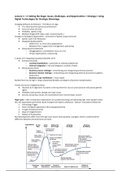
Hype-cycle = after introduction expectations are quickly becoming unrealistically high. Once people realize
this, the expectation (perceived value) changes from hype to disillusion - Many IT innovations follow this
1. Technology Trigger
2. Peak of Inflated Expectations (first disappointments)
3. Trough of Disillusionment
4. Slope of enlightenment
5. Plateau of Productivity
Real developments differ from the hype-cycle (more linear growth), managers need to understand the
difference between perceived and real value
,6 new ‘open’ areas of business due to IT
1. Open business models → draws on ideas from openness movements, like free software, open
content, open tools and standards (e.g. business model canvas)
2. Open departments → ”best of breed” applications for integrating isolated functions in single
department → integration and resource based planning
3. Open supply chains→ integrate/skip steps in the value chain (Porter) using IT (e.g. selling direct to
consumers via the internet, greatly reduces costs for all involved)
4. Open platforms→ software system which are based on open standards, such as published and fully
documented external application programming interfaces (APIs) that allow using the software to
function in other ways than the original programmer intended, without requiring modification of the
source code. Using these interfaces, a third party could integrate with the platform to add
functionality
5. Open innovation → mindset toward innovation that runs counter to the secrecy and silo mentality of
traditional corporate research labs; invite the best and brightest (e.g. Google academy)
6. Open partnerships → instead of traditional view of Porter’s five forces, focus on creating shared
value
1. Open business models
○ Business Model Canvas
2. Open departments
● From Islands to enterprise resource planning
○ Islands
■ Local efficiency
■ Functional (silo)
■ Best of breed, best system for specific isolated function in single
department
■ Silo does one thing particularly well
○ Enterprise Resource Planning (ERP)
■ Integration
■ Cross-functional (end-to-end)
■ Standardization, responsiveness, cost reduction (?)
■ Customize and install various modules from single vendor (Oracle, SAP)
● Enterprise Value Chain (Porter)
○ Support activities
■ Firm infrastructure
■ Human Resource management
■ Technology development
■ Procurement
○ Primary activities
■ Inbound logistics
■ Operations
■ Outbound logistics
■ Marketing and sales
■ Service
○ Goals:
■ Focus on important parts
■ Understand where ICT can add value or reduce costs
■ Benchmark to competitors, where do they do better
● Embrace and extend framework (map current IT applications)
○ Cultural & economic impact (high or low)
○ Ease of implementation (hard or easy)
3. Open supply chains
● Supply chain framework
○ Focuses on the links between all partners in a supply chain
○ IT can be used to integrate/ skip steps of the value chain
○ E.g. through direct sales to customers via the internet
, ○ E.g. using IT to manage supplies (volumes) reducing costs
4. Open platforms
● Owning the platform becoming more important - winner takes all
● Identify where IT can help in servicing customers across lifecycle
● Sometimes need to spend or partner with others in order to attract companies to the more
valuable part of their value proposition (Network effects)
● Cycle: requirements → Acquisition → Ownership → Replacement → etc.
● Network effects (Platforms)
5. Open innovation
● Free/ open source software = software that is free and whose code can be accessed and
potentially modified by anyone
● Sharing is a two-way street
○ Overlapping goals
○ Common competitor
○ Sharing is caring?
● From open to disruptive innovations
○ Sustaining strategy = bring a better product in an established market
○ Low-end disruption = address overserved customers with a lower-cost business
model
○ New-market disruption = compete against non-consumption
6. Open partnerships
● Coopetition (cooperative competition) = arrangement where companies interact with a
partial overlap of interests while simultaneously competing, creating more value together
than each alone
○ Stimulated by the reduction of coordination costs through IT
● Traditional perspective: external view
Digital Technologies for Strategic Advantage
Changing Software Architecture - The Return of Lego
● IT is about business (process) architecture
● Focus on what, not how
● Flexibility, speed is king
● Modular design (ERP, Apps, SaaS, outsourcing etc.)
Changes in Strategy & Organization - Economies of Speed, Scope and Scale
● Speed: Cycle Time Reduction
● Disappearing Boundaries
○ Within firm: no more silos, globalization
○ Between firms: supply chain management, partnering
● Global Business Networks
○ Disaggregation, consolidation, focus on core
○ Virtual organizations, outsourcing
5 Levels of IT integration (potential benefits of IT)
● Evolutionary levels
○ Localized exploitation = automate an existing isolated task
○ Internal integration = link and integrate a number of tasks
● Revolutionary levels
○ Business process redesign = streamlining and reorganizing internal processes
○ Business network redesign = streamlining and reorganizing external processes (suppliers,
buyers etc.)
○ Business scope redefinition = most radical
Ranked from low to high in range of potential benefits and degree of business transformation
Trends and issues of Digital business
● ‘Business & IT alignment’ has been in the top three for circa 15 years (and we still cannot get this
right)
● Flexibility and business change are major issues
● Security and privacy issues are a (somewhat more recent) major concern
Hype-cycle = after introduction expectations are quickly becoming unrealistically high. Once people realize
this, the expectation (perceived value) changes from hype to disillusion - Many IT innovations follow this
1. Technology Trigger
2. Peak of Inflated Expectations (first disappointments)
3. Trough of Disillusionment
4. Slope of enlightenment
5. Plateau of Productivity
Real developments differ from the hype-cycle (more linear growth), managers need to understand the
difference between perceived and real value
,6 new ‘open’ areas of business due to IT
1. Open business models → draws on ideas from openness movements, like free software, open
content, open tools and standards (e.g. business model canvas)
2. Open departments → ”best of breed” applications for integrating isolated functions in single
department → integration and resource based planning
3. Open supply chains→ integrate/skip steps in the value chain (Porter) using IT (e.g. selling direct to
consumers via the internet, greatly reduces costs for all involved)
4. Open platforms→ software system which are based on open standards, such as published and fully
documented external application programming interfaces (APIs) that allow using the software to
function in other ways than the original programmer intended, without requiring modification of the
source code. Using these interfaces, a third party could integrate with the platform to add
functionality
5. Open innovation → mindset toward innovation that runs counter to the secrecy and silo mentality of
traditional corporate research labs; invite the best and brightest (e.g. Google academy)
6. Open partnerships → instead of traditional view of Porter’s five forces, focus on creating shared
value
1. Open business models
○ Business Model Canvas
2. Open departments
● From Islands to enterprise resource planning
○ Islands
■ Local efficiency
■ Functional (silo)
■ Best of breed, best system for specific isolated function in single
department
■ Silo does one thing particularly well
○ Enterprise Resource Planning (ERP)
■ Integration
■ Cross-functional (end-to-end)
■ Standardization, responsiveness, cost reduction (?)
■ Customize and install various modules from single vendor (Oracle, SAP)
● Enterprise Value Chain (Porter)
○ Support activities
■ Firm infrastructure
■ Human Resource management
■ Technology development
■ Procurement
○ Primary activities
■ Inbound logistics
■ Operations
■ Outbound logistics
■ Marketing and sales
■ Service
○ Goals:
■ Focus on important parts
■ Understand where ICT can add value or reduce costs
■ Benchmark to competitors, where do they do better
● Embrace and extend framework (map current IT applications)
○ Cultural & economic impact (high or low)
○ Ease of implementation (hard or easy)
3. Open supply chains
● Supply chain framework
○ Focuses on the links between all partners in a supply chain
○ IT can be used to integrate/ skip steps of the value chain
○ E.g. through direct sales to customers via the internet
, ○ E.g. using IT to manage supplies (volumes) reducing costs
4. Open platforms
● Owning the platform becoming more important - winner takes all
● Identify where IT can help in servicing customers across lifecycle
● Sometimes need to spend or partner with others in order to attract companies to the more
valuable part of their value proposition (Network effects)
● Cycle: requirements → Acquisition → Ownership → Replacement → etc.
● Network effects (Platforms)
5. Open innovation
● Free/ open source software = software that is free and whose code can be accessed and
potentially modified by anyone
● Sharing is a two-way street
○ Overlapping goals
○ Common competitor
○ Sharing is caring?
● From open to disruptive innovations
○ Sustaining strategy = bring a better product in an established market
○ Low-end disruption = address overserved customers with a lower-cost business
model
○ New-market disruption = compete against non-consumption
6. Open partnerships
● Coopetition (cooperative competition) = arrangement where companies interact with a
partial overlap of interests while simultaneously competing, creating more value together
than each alone
○ Stimulated by the reduction of coordination costs through IT
● Traditional perspective: external view