6. VERTICAL AXIS
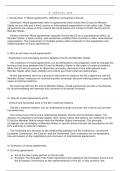
I. Introduction Mixed agreements: Definition and parties involved
- Definition: Mixed agreements refer to agreements that involve the EU and its Member
States on one side and a third country or international organization on the other side. These
agreements are unique as they require the participation and consent of both the EU and its
Member States.
- Parties involved: Mixed agreements typically involve the EU as a supranational entity, its
Member States, a third country, and sometimes multiple third countries or other international
organizations. The involvement of multiple parties adds complexity to the negotiation and
implementation of these agreements.
II. Why do we have mixed agreements?
- Pragmatism and managing tensions between the EU and Member States
- The existence of mixed agreements can be attributed to the pragmatic need to manage the
tensions that arise between the EU and its Member States in the realm of external relations.
While the EU aims to pursue its objectives and policy demands at the international level,
Member States often seek visibility and control over their external relationships.
- Mixed agreements serve as a practical instrument to balance the EU's objectives and the
Member States' insistence on maintaining their sovereign decision-making powers in specific
areas of external relations.
- By involving both the EU and its Member States, mixed agreements provide a mechanism
for accommodating the interests and concerns of all parties involved.
III. How do mixed agreements work?
- Vertical and horizontal axes in the EU's external relations
- The EU's external relations can be understood through two axes: the vertical axis and the
horizontal axis.
- The vertical axis refers to the relationship between the EU and its Member States. The
division of competence principle applies here, which means that powers not conferred on the
EU by the Member States remain with the Member States themselves. This principle
recognizes the sovereignty of Member States in specific areas and sets the boundaries for the
EU's authority in external relations.
- The horizontal axis pertains to the relationship between the EU institutions, namely the
European Commission, the Council, and the Parliament. Each institution has its designated
role and powers in the negotiation and conclusion of international agreements.
IV. Scenarios of mixed agreements
A. EU-only agreements
► EU as the sole treaty partner on the EU side
► Example: The EU-Japan Free Trade Agreement was signed by the European Council and
the European Commission as the representatives of the EU. In this scenario, the
, agreement solely involves the EU as a party without the direct participation of Member
States.
o Legal basis
o Competence
o Art 3 TFEU areas of exlusive competence (priori competence)
o Art 207 __> substantive lgela basisi
o Procedural lega;l basis fo th specific action: concluding trade agreement: 218
o Exclusivity for MS: if not delegation or emporermet through art 2(1) only EU can
act
► TCA agreement: trade and cooperation agreement more than just trade
o Mixed agreements can take a long time to enter into force
Trade need a legal basis: exlcusive competence on trade; legal basis for trade: art 207
- conclusion art 218
B. Bilateral mixed agreements
- EU and Member States on one side, and one other state on the other side
- Bilateral mixed agreements typically focus on areas such as trade, investment, or
political cooperation.
- Example: The EU-Canada trade agreement involved the EU, all Member States, and
Canada as the third country. These agreements require the unanimous consent of all
Member States, highlighting the collective decision-making process.
o Mixed agreement: trade deal
o 207(substantive) + 218(procedural)
C. Plurilateral/multilateral mixed agreements
- EU and Member States on one side, and multiple other states or international organizations
on the other side
- These agreements involve multiple parties and are often concluded within the framework of
international organizations or institutions.
- Example: The World Trade Organization (WTO) agreements involve the EU, all Member
States, and numerous other WTO members. The EU and its Member States collectively
negotiate and participate in these plurilateral/multilateral agreements.
V. Internal-External principle and conflicts
- Principle of parallelism between internal and external treaty-making powers
- The EU operates under the principle of parallelism, which seeks to maintain consistency
between the internal and external exercise of treaty-making powers. This principle ensures
that the EU's external actions align with its internal legal framework.
- However, conflicts can arise between the
I. Introduction Mixed agreements: Definition and parties involved
- Definition: Mixed agreements refer to agreements that involve the EU and its Member
States on one side and a third country or international organization on the other side. These
agreements are unique as they require the participation and consent of both the EU and its
Member States.
- Parties involved: Mixed agreements typically involve the EU as a supranational entity, its
Member States, a third country, and sometimes multiple third countries or other international
organizations. The involvement of multiple parties adds complexity to the negotiation and
implementation of these agreements.
II. Why do we have mixed agreements?
- Pragmatism and managing tensions between the EU and Member States
- The existence of mixed agreements can be attributed to the pragmatic need to manage the
tensions that arise between the EU and its Member States in the realm of external relations.
While the EU aims to pursue its objectives and policy demands at the international level,
Member States often seek visibility and control over their external relationships.
- Mixed agreements serve as a practical instrument to balance the EU's objectives and the
Member States' insistence on maintaining their sovereign decision-making powers in specific
areas of external relations.
- By involving both the EU and its Member States, mixed agreements provide a mechanism
for accommodating the interests and concerns of all parties involved.
III. How do mixed agreements work?
- Vertical and horizontal axes in the EU's external relations
- The EU's external relations can be understood through two axes: the vertical axis and the
horizontal axis.
- The vertical axis refers to the relationship between the EU and its Member States. The
division of competence principle applies here, which means that powers not conferred on the
EU by the Member States remain with the Member States themselves. This principle
recognizes the sovereignty of Member States in specific areas and sets the boundaries for the
EU's authority in external relations.
- The horizontal axis pertains to the relationship between the EU institutions, namely the
European Commission, the Council, and the Parliament. Each institution has its designated
role and powers in the negotiation and conclusion of international agreements.
IV. Scenarios of mixed agreements
A. EU-only agreements
► EU as the sole treaty partner on the EU side
► Example: The EU-Japan Free Trade Agreement was signed by the European Council and
the European Commission as the representatives of the EU. In this scenario, the
, agreement solely involves the EU as a party without the direct participation of Member
States.
o Legal basis
o Competence
o Art 3 TFEU areas of exlusive competence (priori competence)
o Art 207 __> substantive lgela basisi
o Procedural lega;l basis fo th specific action: concluding trade agreement: 218
o Exclusivity for MS: if not delegation or emporermet through art 2(1) only EU can
act
► TCA agreement: trade and cooperation agreement more than just trade
o Mixed agreements can take a long time to enter into force
Trade need a legal basis: exlcusive competence on trade; legal basis for trade: art 207
- conclusion art 218
B. Bilateral mixed agreements
- EU and Member States on one side, and one other state on the other side
- Bilateral mixed agreements typically focus on areas such as trade, investment, or
political cooperation.
- Example: The EU-Canada trade agreement involved the EU, all Member States, and
Canada as the third country. These agreements require the unanimous consent of all
Member States, highlighting the collective decision-making process.
o Mixed agreement: trade deal
o 207(substantive) + 218(procedural)
C. Plurilateral/multilateral mixed agreements
- EU and Member States on one side, and multiple other states or international organizations
on the other side
- These agreements involve multiple parties and are often concluded within the framework of
international organizations or institutions.
- Example: The World Trade Organization (WTO) agreements involve the EU, all Member
States, and numerous other WTO members. The EU and its Member States collectively
negotiate and participate in these plurilateral/multilateral agreements.
V. Internal-External principle and conflicts
- Principle of parallelism between internal and external treaty-making powers
- The EU operates under the principle of parallelism, which seeks to maintain consistency
between the internal and external exercise of treaty-making powers. This principle ensures
that the EU's external actions align with its internal legal framework.
- However, conflicts can arise between the