
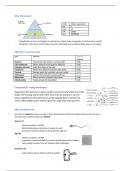
SB1a Microscopes
Units Metric equivalent
cm 1
mm 10
μm 10000
nm 10000000
- Magnification is how much bigger or zoomed in an object looks compared to its actual size in real life
- Resolution is the clarity of the image- how close two things can be without being seen as one object
SB1b Plant and animal cells
part function plant /
animal
Nucleus Control the cells actions- contains DNA both
Cell membrane Allows substances through by diffusion both
Cellulose cell wall Holds the shape of the cell plant
Cytoplasm Where the chemical reactions take place both
Vacuole Storage space for nutrients- glucose, water plant
Chloroplast Contain chlorophyll for photosynthesis plant
Ribosomes Where protein synthesis takes place both
Mitochondria Create energy for respiration both
Core practical – Using microscopes
Stage keeps the specimen in place and flat, coarse focusing wheel moves the
stage, fine focusing wheel used to fine focus into the specimen, use low
power objective lens first then move up the magnification if needed, the
mirror reflects light back to see the specimen, stage clips hold specimen.
SB1c Specialised cells
Sex cells are haploid so have one copy of each chromosome meaning the zygote will have the two set of
chromosomes needed and become diploid.
Sperm cell
- Nucleus contains ½ of DNA
- Mitochondria above tail to give it energy to swim
- Acrosome contains enzymes to break into the egg cell
Egg cell
- Nucleus contains ½ of DNA
- Cytoplasm contains nutrients for growth and development of embryo
- Jelly coating to protect the cell, hardens after fertilisation
Root hair cell
- Large surface area to absorb nutrients quicker
, - No chloroplasts
Intestinal Villi
- Absorb nutrients
- Large surface area
- 1 cell thick = quick diffusion
- Good blood supply
Ciliated epithelial cells
- In the lining of the oviduct
- Cells transport egg cells to the uterus
- Hair-like cilia
- Brush substances along
SB1d Inside bacteria
Bacteria are prokaryotic so they do not have a nucleus or chromosome. They have a large
loop of chromosomal DNA and a smaller loop of plasmid DNA. They also do not have
mitochondria or chloroplasts.
Bacteria usually have – flagellum, plasmids, chromosomal DNA, cell membrane, cytoplasm,
slime coat, cell wall, ribosomes.
SB1e Enzymes and nutrition
Enzymes are biological catalysts that speed up breakdown and
synthesis reactions – increase the rate of reaction
Enzyme Where found Reaction catalysed
Amylase Saliva and small intestine Breaking down starch to sugars
Catalase Most cells, especially liver cells Breaking down hydrogen peroxide made in cell
reactions to water and oxygen
Starch synthase Plant Synthesis of starch from glucose
DNA polymerase Nucleus Synthesis of DNA from its monomers
SB1f Food tests
Biuret test – protein
- Potassium hydroxide + copper sulfate
- If protein is present - purple
- No protein - pale blue
Emulsion test – lipids
- Ethanol
- If lipids are present- cloudy
- No lipids - clear
Benedict’s test – simple sugars (glucose)
- Benedict’s solution
- If glucose if present - orange
, - No glucose- blue
Test for starch
- Iodine
- If starch is present- dark blue/black
- No starch- yellow-brown
A calorimeter can be used to find the energy within food by burning food and the
thermal energy being transferred to the water increasing the water temperature.
Core Practical – Testing foods
Investigate the use of chemical reagents to identify proteins, lipids, glucose and starch. Test with a selection of
foods to identify a presence of these substances.
SB1g Enzyme Action
This is where the active
site denatures due to a
limiting factor so the
active site is no longer
complementary for the
substrate therefore it
doesn’t fit.
Enzymes are folded into complex
shapes allowing smaller molecules
to fit into them. This area where
the molecules fit is the active site.
In the lock and key hypothesis, the
shape of the active site matches
the shape of its substrate
molecules making it specific.
SB1h Enzyme activity
Temperature
, When the temperature increases the kinetic energy being released also increases. This allows the substrate to
have more collisions with the active site of the enzyme. This means the rate of reaction will go up.
If you keep increasing the temperature, it will reach its optimum temperature. After
that point, the rate of reaction starts to fall. This is because the active site has become denatured and has
changed shape. This means it is no longer complementary to the substrate so the substrate cannot fit.
Therefore, the rate of reaction will go down.
pH
Every enzyme has an optimal range. The enzyme denatures above and below the optimal range and the active
sit changes shape. This means it is no longer complementary to the substrate and it cannot fit. This means the
rate of reaction will go down.
Enzymes work more slowly when the temperature is below the
optimum as there is not enough kinetic energy meaning there are less collisions between the active site and
the substrate.
Concentration
When the concentration goes up so does the rate of reaction. The number of collisions between the active site
and the substrate also increases. At the optimal concentration, the rate of reaction goes up.
The active site is occupied, so the rate of reaction plateaus and stays the same. At this point another limiting
factor needs to change for the rate of reaction to stop increasing e.g temperature or pH.
Core practical – pH and enzymes
Investigate the optimum pH of enzymes. Use the enzyme amylase to time the breakdown of starch, the faster
the time, the more suited the pH to the enzyme. Use iodine to test when the starch has been broken down.
Units Metric equivalent
cm 1
mm 10
μm 10000
nm 10000000
- Magnification is how much bigger or zoomed in an object looks compared to its actual size in real life
- Resolution is the clarity of the image- how close two things can be without being seen as one object
SB1b Plant and animal cells
part function plant /
animal
Nucleus Control the cells actions- contains DNA both
Cell membrane Allows substances through by diffusion both
Cellulose cell wall Holds the shape of the cell plant
Cytoplasm Where the chemical reactions take place both
Vacuole Storage space for nutrients- glucose, water plant
Chloroplast Contain chlorophyll for photosynthesis plant
Ribosomes Where protein synthesis takes place both
Mitochondria Create energy for respiration both
Core practical – Using microscopes
Stage keeps the specimen in place and flat, coarse focusing wheel moves the
stage, fine focusing wheel used to fine focus into the specimen, use low
power objective lens first then move up the magnification if needed, the
mirror reflects light back to see the specimen, stage clips hold specimen.
SB1c Specialised cells
Sex cells are haploid so have one copy of each chromosome meaning the zygote will have the two set of
chromosomes needed and become diploid.
Sperm cell
- Nucleus contains ½ of DNA
- Mitochondria above tail to give it energy to swim
- Acrosome contains enzymes to break into the egg cell
Egg cell
- Nucleus contains ½ of DNA
- Cytoplasm contains nutrients for growth and development of embryo
- Jelly coating to protect the cell, hardens after fertilisation
Root hair cell
- Large surface area to absorb nutrients quicker
, - No chloroplasts
Intestinal Villi
- Absorb nutrients
- Large surface area
- 1 cell thick = quick diffusion
- Good blood supply
Ciliated epithelial cells
- In the lining of the oviduct
- Cells transport egg cells to the uterus
- Hair-like cilia
- Brush substances along
SB1d Inside bacteria
Bacteria are prokaryotic so they do not have a nucleus or chromosome. They have a large
loop of chromosomal DNA and a smaller loop of plasmid DNA. They also do not have
mitochondria or chloroplasts.
Bacteria usually have – flagellum, plasmids, chromosomal DNA, cell membrane, cytoplasm,
slime coat, cell wall, ribosomes.
SB1e Enzymes and nutrition
Enzymes are biological catalysts that speed up breakdown and
synthesis reactions – increase the rate of reaction
Enzyme Where found Reaction catalysed
Amylase Saliva and small intestine Breaking down starch to sugars
Catalase Most cells, especially liver cells Breaking down hydrogen peroxide made in cell
reactions to water and oxygen
Starch synthase Plant Synthesis of starch from glucose
DNA polymerase Nucleus Synthesis of DNA from its monomers
SB1f Food tests
Biuret test – protein
- Potassium hydroxide + copper sulfate
- If protein is present - purple
- No protein - pale blue
Emulsion test – lipids
- Ethanol
- If lipids are present- cloudy
- No lipids - clear
Benedict’s test – simple sugars (glucose)
- Benedict’s solution
- If glucose if present - orange
, - No glucose- blue
Test for starch
- Iodine
- If starch is present- dark blue/black
- No starch- yellow-brown
A calorimeter can be used to find the energy within food by burning food and the
thermal energy being transferred to the water increasing the water temperature.
Core Practical – Testing foods
Investigate the use of chemical reagents to identify proteins, lipids, glucose and starch. Test with a selection of
foods to identify a presence of these substances.
SB1g Enzyme Action
This is where the active
site denatures due to a
limiting factor so the
active site is no longer
complementary for the
substrate therefore it
doesn’t fit.
Enzymes are folded into complex
shapes allowing smaller molecules
to fit into them. This area where
the molecules fit is the active site.
In the lock and key hypothesis, the
shape of the active site matches
the shape of its substrate
molecules making it specific.
SB1h Enzyme activity
Temperature
, When the temperature increases the kinetic energy being released also increases. This allows the substrate to
have more collisions with the active site of the enzyme. This means the rate of reaction will go up.
If you keep increasing the temperature, it will reach its optimum temperature. After
that point, the rate of reaction starts to fall. This is because the active site has become denatured and has
changed shape. This means it is no longer complementary to the substrate so the substrate cannot fit.
Therefore, the rate of reaction will go down.
pH
Every enzyme has an optimal range. The enzyme denatures above and below the optimal range and the active
sit changes shape. This means it is no longer complementary to the substrate and it cannot fit. This means the
rate of reaction will go down.
Enzymes work more slowly when the temperature is below the
optimum as there is not enough kinetic energy meaning there are less collisions between the active site and
the substrate.
Concentration
When the concentration goes up so does the rate of reaction. The number of collisions between the active site
and the substrate also increases. At the optimal concentration, the rate of reaction goes up.
The active site is occupied, so the rate of reaction plateaus and stays the same. At this point another limiting
factor needs to change for the rate of reaction to stop increasing e.g temperature or pH.
Core practical – pH and enzymes
Investigate the optimum pH of enzymes. Use the enzyme amylase to time the breakdown of starch, the faster
the time, the more suited the pH to the enzyme. Use iodine to test when the starch has been broken down.


