
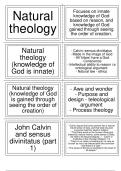
Focuses on innate
Natural knowledge of God
based on reason, and
knowledge of God
theology gained through seeing
the order of creation.
Natural - Calvin; sensus divinitatus
- Made in the image of God
theology - All 'tribes' have a God
- Conscience
(knowledge of - Intellectual ability to reason i.e
ontological argument
God is innate) - Natural law - ethics
Natural theology - Awe and wonder
(knowledge of God - Purpose and
is gained through design - teleological
seeing the order of argument
creation) - Process theology
John Calvin - Calvin argued that every person has a natural
inbuilt sense of God, and that God ensured
everyone had this 'seed of religion'
- "That there exists in the human minds and
and sensus indeed by natural instinct, some sense of Deity,
we hold to be beyond dispute..." - Calvin in
Institutes of the Christian Religion 1:3
divinitatus (part - "There is no nation so barbarous, no race so
brutish as not to be imbued with the conviction
that there is a God."
1) - "The sense of divinity is inscribed in the heart of
all people."
, John Calvin - Calvin claims that no one will be able to say on
Judgement Day that they were entirely ignorant
of the presence of God. This would be a
and sensus 'pretending ignorance.'
- We know that God is the creator, and we know
that we owe this God worship, but beyond this
divinitatus (part we do not know very much
- We certainly cannot know by ordinary human
insight that Jesus Christ is his son - this kind of
2) knowledge is revealed (principally in the Bible)
rather than natural.
Catholicism - "The desire for God is written in the
human, because man is created by God
and innate and for God..." - Catechism of the CC
- We have this innate knowledge
because we are made in God's image
- For Catholics God is known through
knowledge both natural and revealed methods
Conscience - feelings of
3 examples guilt, when we do
something wrong
of the sense Aesthetics - awe and
wonder in the world
of the divine Intellect - that we can
reason to believe in God
Duplex - Means 'the two-fold knowledge of God'
- Distinction of knowing God as the
creator and God as the redeemer
Cognito - God as the creator, we can see this in
the order and design of the world
- "The heavens are telling the glory of
Domini
God; and the firmament proclaims of his
handiwork," - Psalm 19:1


