Key:
Bold: direct quotation from the introduction
Green: Points for
Red: Points against
Pink Highlight: Critic names
Yellow Highlight: ‘Mrs Dalloway’ quotations
Blue Highlight: major themes in the novel
Green Highlight: link to ‘Their Eyes Were Watching God’ and quotations from the novel
Orange Highlight: Context
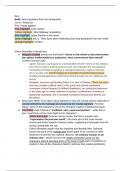
Elaine Showalter’s introduction:
● Margaret Drabble pointed out that Woolf “chose on the whole to describe women
less gifted, intellectually less audacious, more conventional than herself”
(London Society Lady)
- Agree: Clarissa is portrayed as unremarkable herself in terms of her intellect
(she mirrors Sally’s political opinions) and she embodies the stereotypical
housewife archetype (engaging in sewing/needlework), highly conformist –
this is at odds with Woolf’s legacy as a member of the Bloomsbury group
(intellectual liberalists/non-conformists) Woolf thought her too “glittering and
tinsely”
- Disagree: everyone (particularly Peter) is in awe of Clarissa (“there she was”),
she read complex political works in her youth and actively combatted
convention (hatred towards Dr William Bradshaw), her conformist behaviour
in her older age is merely reflective of society’s confinement of women to
patriarchal standards, she is revealed to possess homosexual desires just
like Woolf
● Wool uses “MRS” in her title to draw attention to how her central woman character is
socially defined by her marriage and masked by her marital signature. Feminist
theory: name of the husband is one of the strongest insignia of patriarchal power.
● Paul Bailey calls Clarissa a “snobbish, vain, repressed lesbian” – while this is
true, could there not be more depth to her character?
- Gilbert and Gubar (feminist critics) counter that she is a queen who
“regenerates the post-war world”: the entire plot of the novel centres
around and drives towards Clarissa's party, a gathering of all people from all
society uniting after the war
- Elaine Showalter argues that this idealised and liberated Mrs. Dalloway
misses the point of the realistic lens Woolf opted for (in contrast to other
Modernist novels like the mythical Ulysses) “an ordinary woman on an
ordinary day”. Woolf uncovers the depths (“beautiful caves”) of her
characters without elevating them to the level of myth (lack of mythicism is
evident in how all the characters failed to achieve their earliest ambitions).
Bold: direct quotation from the introduction
Green: Points for
Red: Points against
Pink Highlight: Critic names
Yellow Highlight: ‘Mrs Dalloway’ quotations
Blue Highlight: major themes in the novel
Green Highlight: link to ‘Their Eyes Were Watching God’ and quotations from the novel
Orange Highlight: Context
Elaine Showalter’s introduction:
● Margaret Drabble pointed out that Woolf “chose on the whole to describe women
less gifted, intellectually less audacious, more conventional than herself”
(London Society Lady)
- Agree: Clarissa is portrayed as unremarkable herself in terms of her intellect
(she mirrors Sally’s political opinions) and she embodies the stereotypical
housewife archetype (engaging in sewing/needlework), highly conformist –
this is at odds with Woolf’s legacy as a member of the Bloomsbury group
(intellectual liberalists/non-conformists) Woolf thought her too “glittering and
tinsely”
- Disagree: everyone (particularly Peter) is in awe of Clarissa (“there she was”),
she read complex political works in her youth and actively combatted
convention (hatred towards Dr William Bradshaw), her conformist behaviour
in her older age is merely reflective of society’s confinement of women to
patriarchal standards, she is revealed to possess homosexual desires just
like Woolf
● Wool uses “MRS” in her title to draw attention to how her central woman character is
socially defined by her marriage and masked by her marital signature. Feminist
theory: name of the husband is one of the strongest insignia of patriarchal power.
● Paul Bailey calls Clarissa a “snobbish, vain, repressed lesbian” – while this is
true, could there not be more depth to her character?
- Gilbert and Gubar (feminist critics) counter that she is a queen who
“regenerates the post-war world”: the entire plot of the novel centres
around and drives towards Clarissa's party, a gathering of all people from all
society uniting after the war
- Elaine Showalter argues that this idealised and liberated Mrs. Dalloway
misses the point of the realistic lens Woolf opted for (in contrast to other
Modernist novels like the mythical Ulysses) “an ordinary woman on an
ordinary day”. Woolf uncovers the depths (“beautiful caves”) of her
characters without elevating them to the level of myth (lack of mythicism is
evident in how all the characters failed to achieve their earliest ambitions).