14.5- Animal Responses
• Coordination happens through cell signalling. Nervous and hormonal system require a chemical
that needs to be transferred between cells (neurotransmitter or hormone) Plants rely on
hormones alone.
The Nervous System
Central Nervous System- brain and spinal cord
Peripheral Nervous System- all the neurones that connect the CNS to the rest of the body
(sensory and motor)
The peripheral nervous system is divided into the Somatic nervous system and the autonomic
nervous system.
Somatic nervous system- under conscious control, e.g. muscle movement. Carries impulses to
muscles
Autonomic nervous system- constantly under unconscious control. e.g. heart beat, digestion.
Carries nervous impulses to glands and cardiac muscle
The autonomic nervous system is divided into sympathetic and parasympathetic motor systems
Sympathetic- ght or ight
Parasympathetic- rest and digest- calms body down
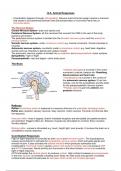
The Brain
• Medulla oblongata is involved in ne motor
movement, posture, balance etc. Breathing,
blood pressure and heart rate
• Hypothalamus is involved in the control of
the autonomic nervous system. It has two
centres, one for the sympathetic and the other
for the parasympathetic nervous system
• Pituitary gland is split into anterior and
posterior sections
Re exes
Re ex= involuntary action in response to a sensory stimulus of a potentially damaging nature.
Re ex arc= receptor, sensory neurone, relay neurone, motor neurone. The brain is informed after
the response.
Knee jerk re ex- knee is tapped, stretch mediated receptors are stimulated and patella tendons
are stretched. Triggers re ex arc. Extensor muscles are stimulated to contract, exor muscles
forcibly relaxed.
Blinking re ex- cornea is stimulated e.g. touch, bright light, loud sounds. It involves the brain so is
considered a cranial response.
Coordinated Responses
Fight or ight response is controlled by both neural and hormonal system. The hypothalamus
causes neural branch to activate the sympathetic nervous system which activates glands and
smooth muscle. It also activates the adrenal medulla which produces adrenaline and
noradrenaline. Hormonal system causes anterior and posterior pituitary gland to produce CRF
and ACTH hormones. Neural activity and hormones in the blood stream combine to constitute
ght or ight response.
ACTH stimulates the adrenal glands to produce cortisol. High cortisol increases gluconeogenesis
in the liver, lipolysis is increased, breaking down lipids into fatty acids and glycerol. Increased
cortisol levels causes the pancreas to decrease insulin levels and increase glucagon.
fi flfl
flfl fl fl fi fl fl fi fl
• Coordination happens through cell signalling. Nervous and hormonal system require a chemical
that needs to be transferred between cells (neurotransmitter or hormone) Plants rely on
hormones alone.
The Nervous System
Central Nervous System- brain and spinal cord
Peripheral Nervous System- all the neurones that connect the CNS to the rest of the body
(sensory and motor)
The peripheral nervous system is divided into the Somatic nervous system and the autonomic
nervous system.
Somatic nervous system- under conscious control, e.g. muscle movement. Carries impulses to
muscles
Autonomic nervous system- constantly under unconscious control. e.g. heart beat, digestion.
Carries nervous impulses to glands and cardiac muscle
The autonomic nervous system is divided into sympathetic and parasympathetic motor systems
Sympathetic- ght or ight
Parasympathetic- rest and digest- calms body down
The Brain
• Medulla oblongata is involved in ne motor
movement, posture, balance etc. Breathing,
blood pressure and heart rate
• Hypothalamus is involved in the control of
the autonomic nervous system. It has two
centres, one for the sympathetic and the other
for the parasympathetic nervous system
• Pituitary gland is split into anterior and
posterior sections
Re exes
Re ex= involuntary action in response to a sensory stimulus of a potentially damaging nature.
Re ex arc= receptor, sensory neurone, relay neurone, motor neurone. The brain is informed after
the response.
Knee jerk re ex- knee is tapped, stretch mediated receptors are stimulated and patella tendons
are stretched. Triggers re ex arc. Extensor muscles are stimulated to contract, exor muscles
forcibly relaxed.
Blinking re ex- cornea is stimulated e.g. touch, bright light, loud sounds. It involves the brain so is
considered a cranial response.
Coordinated Responses
Fight or ight response is controlled by both neural and hormonal system. The hypothalamus
causes neural branch to activate the sympathetic nervous system which activates glands and
smooth muscle. It also activates the adrenal medulla which produces adrenaline and
noradrenaline. Hormonal system causes anterior and posterior pituitary gland to produce CRF
and ACTH hormones. Neural activity and hormones in the blood stream combine to constitute
ght or ight response.
ACTH stimulates the adrenal glands to produce cortisol. High cortisol increases gluconeogenesis
in the liver, lipolysis is increased, breaking down lipids into fatty acids and glycerol. Increased
cortisol levels causes the pancreas to decrease insulin levels and increase glucagon.
fi flfl
flfl fl fl fi fl fl fi fl