Nervous Transmission
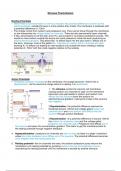
Resting Potentials
• When there is no transmission of nervous impulse, the potential di erence is known as the
resting potential- outside the axon is more positive than inside. The membrane is polarised with
a potential di erence of -70mV
• The charge comes from sodium and potassium ions. They cannot travel through the membrane
so are transported via voltage gated ion channels. There are also permanently open channels.
• 3 Na+ are pumped out of the axon and 2 K+ are pumped in via sodium-potassium pumps. This
results in more sodium outside the axons and more potassium inside the axon producing an
electrochemical gradient. This allows Na+ to di use back into the axon and k+ di use out of
the axon. However, most of the gated Na+ channels are closed, but K+ channels are open
allowing K+ to di use out leading to more positive ions outside the axon creating a resting
potential of -70mV with the inside negative relative to the outside.
Action Potentials
• Temporary reversal of charges on the membrane, the charge becomes +40mV, this is
depolarisation. As the neurone’s charge returns to resting, it is repolarised.
1. The stimulus excites the neurone cell membrane,
causing sodium ion channels to open so the membrane
becomes more permeable to sodium and sodium ions
di use into the neurone down the sodium ion
electrochemical gradient, making the inside of the neurone
less negative.
2.Depolarisation- the potential di erence reaches the
threshold (around -55mV) and voltage gated sodium ion
channels open and more sodium ions di use into the
neurone through positive feedback.
3.Repolarisation- at a potential di erence of around +30mV,
the sodium ion channels close and the voltage gated
potassium ion channels open. Potassium ions di use out of
the neurone and down the concentration gradient. This starts to get the membrane back to
the resting potential through negative feedback.
4. Hyperpolarisation- potassium ion channels are slow to close so there is a slight ‘overshoot’
where too many potassium ions di use out of the neurone. The potential di erence becomes
more negative than the resting potential.
5. Resting potential- the ion channels are reset, the sodium-potassium pump returns the
membrane to its resting potential by pumping sodium ions out and potassium ions in,
maintaining the resting potential until the membrane is excited by another stimulus.
ff
ff ff ffff ff ff ff ff ff ff ff
Resting Potentials
• When there is no transmission of nervous impulse, the potential di erence is known as the
resting potential- outside the axon is more positive than inside. The membrane is polarised with
a potential di erence of -70mV
• The charge comes from sodium and potassium ions. They cannot travel through the membrane
so are transported via voltage gated ion channels. There are also permanently open channels.
• 3 Na+ are pumped out of the axon and 2 K+ are pumped in via sodium-potassium pumps. This
results in more sodium outside the axons and more potassium inside the axon producing an
electrochemical gradient. This allows Na+ to di use back into the axon and k+ di use out of
the axon. However, most of the gated Na+ channels are closed, but K+ channels are open
allowing K+ to di use out leading to more positive ions outside the axon creating a resting
potential of -70mV with the inside negative relative to the outside.
Action Potentials
• Temporary reversal of charges on the membrane, the charge becomes +40mV, this is
depolarisation. As the neurone’s charge returns to resting, it is repolarised.
1. The stimulus excites the neurone cell membrane,
causing sodium ion channels to open so the membrane
becomes more permeable to sodium and sodium ions
di use into the neurone down the sodium ion
electrochemical gradient, making the inside of the neurone
less negative.
2.Depolarisation- the potential di erence reaches the
threshold (around -55mV) and voltage gated sodium ion
channels open and more sodium ions di use into the
neurone through positive feedback.
3.Repolarisation- at a potential di erence of around +30mV,
the sodium ion channels close and the voltage gated
potassium ion channels open. Potassium ions di use out of
the neurone and down the concentration gradient. This starts to get the membrane back to
the resting potential through negative feedback.
4. Hyperpolarisation- potassium ion channels are slow to close so there is a slight ‘overshoot’
where too many potassium ions di use out of the neurone. The potential di erence becomes
more negative than the resting potential.
5. Resting potential- the ion channels are reset, the sodium-potassium pump returns the
membrane to its resting potential by pumping sodium ions out and potassium ions in,
maintaining the resting potential until the membrane is excited by another stimulus.
ff
ff ff ffff ff ff ff ff ff ff ff