

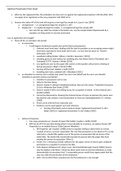
Adverse Possession Flow Chart
1. Who has the registered title, the Limitation Act does not run against the registered proprietor s96 LRA 2002. APor
can apply to be registered as the new proprietor LRA 2002 Sch 6
2. Anyone who takes AP of the land will acquire a new legal fee simple in it: Leach v Jay [1878]
a. Unregistered 2 x unregistered legal fee simples (1 x AP)
b. Registered 1 x registered legal fee simple, 1 x unregistered legal fee simple (AP)
i. Gen rule the og/ older fee simple is the better one, any fee simple holder dispossessed by a
squatter can bring action to recover possession
Can an application be brought?
3. Show AP for an unbroken 10y period
a. In possession
i. A suff degree of physical custody and control (factual possession)
1. claimant must have been ‘dealing with the land in question as an occupying owner might
have been expected to have dealt with it and… no-one else has done so” Powell v
McFarlane [1979]
2. woodland cutting timber: Wilson v Martin’s Executors [1993]]
3. shooting game on land useless for anything else: Red House Farms (Thorndon) Ltd v
Catchpole [1977], Heaney v Kirkby [2016]
4. any significant user by the paper title owner or third parties will prevent a finding of
factual possession: Bligh v Martin [1986]
5. Fencing off the land: Seddon v Smith [1877]
6. Installing own locks: Lambeth LBC v Blackburn [2001]
b. an intention to exercise such custody and control on one's own behalf and for one's own benefit
(intention to possess/animus possidendi)
1. intention to possession not to own
2. Only for the time being
3. Doesn’t matter if claimant mistakenly believes they are the owner: Prudential Assurance
Co Ltd v Waterloo Real Estate [1999]
4. Doesn’t matter if APor was willing to pay for occupation if asked: J A Pye (Oxford) Ltd v
Graham [2003]
5. Cannot be disproved by showing the claimant know of some sp purpose the owner uses
the land for and conduct is not inconsistent w/ that use: Buckinghamshire CC v Moran
[1989]
6. Proof can be inferred from claimants acts
7. Evidence can be used against such and inference
a. Fencing off property only to keep in sheep: Inglewood Investment Co Ltd v
Baker [2002] cf. Inglewood Investment Co Ltd v Baker [2002]
c. Adverse Possession
i. Can enjoy possession w/ consent of paper title holder: Hughes v Griffin [1969]
ii. Will not be AP if for any time during which it was referable to a tenancy, an express licence (BP
Properties) or an implied licence (Colin Dawson Windows)
1. BP Properties Ltd v Buckler [1988] wrote to squatter willing to allow them to remian,
created a licence, sq never responded, The rule that possession is not adverse if it can be
referred to a lawful title applies even if the person in possession did not know of the
lawful title. The lawful title would still preclude the person with the paper title from
evicting the person in possession. Dilion LJ
2. Smith v Ors v Molymeux [2016] sufficient for the paper owner of land to give unilateral
permission to a squatter to preserve his title
3. Colin Dawson Windows Ltd v King's Lynn, West Norfolk Borough Council [2005]: licence
may be implied, only where “there has been some overt act by the landowner or some
demonstrable circumstance that “a reasonable person would have appreciated that the
user was with the permission of the landowner.”
4. Zarb v Parry [2012] Mere acquiescence by the landowner is not enough
1. Who has the registered title, the Limitation Act does not run against the registered proprietor s96 LRA 2002. APor
can apply to be registered as the new proprietor LRA 2002 Sch 6
2. Anyone who takes AP of the land will acquire a new legal fee simple in it: Leach v Jay [1878]
a. Unregistered 2 x unregistered legal fee simples (1 x AP)
b. Registered 1 x registered legal fee simple, 1 x unregistered legal fee simple (AP)
i. Gen rule the og/ older fee simple is the better one, any fee simple holder dispossessed by a
squatter can bring action to recover possession
Can an application be brought?
3. Show AP for an unbroken 10y period
a. In possession
i. A suff degree of physical custody and control (factual possession)
1. claimant must have been ‘dealing with the land in question as an occupying owner might
have been expected to have dealt with it and… no-one else has done so” Powell v
McFarlane [1979]
2. woodland cutting timber: Wilson v Martin’s Executors [1993]]
3. shooting game on land useless for anything else: Red House Farms (Thorndon) Ltd v
Catchpole [1977], Heaney v Kirkby [2016]
4. any significant user by the paper title owner or third parties will prevent a finding of
factual possession: Bligh v Martin [1986]
5. Fencing off the land: Seddon v Smith [1877]
6. Installing own locks: Lambeth LBC v Blackburn [2001]
b. an intention to exercise such custody and control on one's own behalf and for one's own benefit
(intention to possess/animus possidendi)
1. intention to possession not to own
2. Only for the time being
3. Doesn’t matter if claimant mistakenly believes they are the owner: Prudential Assurance
Co Ltd v Waterloo Real Estate [1999]
4. Doesn’t matter if APor was willing to pay for occupation if asked: J A Pye (Oxford) Ltd v
Graham [2003]
5. Cannot be disproved by showing the claimant know of some sp purpose the owner uses
the land for and conduct is not inconsistent w/ that use: Buckinghamshire CC v Moran
[1989]
6. Proof can be inferred from claimants acts
7. Evidence can be used against such and inference
a. Fencing off property only to keep in sheep: Inglewood Investment Co Ltd v
Baker [2002] cf. Inglewood Investment Co Ltd v Baker [2002]
c. Adverse Possession
i. Can enjoy possession w/ consent of paper title holder: Hughes v Griffin [1969]
ii. Will not be AP if for any time during which it was referable to a tenancy, an express licence (BP
Properties) or an implied licence (Colin Dawson Windows)
1. BP Properties Ltd v Buckler [1988] wrote to squatter willing to allow them to remian,
created a licence, sq never responded, The rule that possession is not adverse if it can be
referred to a lawful title applies even if the person in possession did not know of the
lawful title. The lawful title would still preclude the person with the paper title from
evicting the person in possession. Dilion LJ
2. Smith v Ors v Molymeux [2016] sufficient for the paper owner of land to give unilateral
permission to a squatter to preserve his title
3. Colin Dawson Windows Ltd v King's Lynn, West Norfolk Borough Council [2005]: licence
may be implied, only where “there has been some overt act by the landowner or some
demonstrable circumstance that “a reasonable person would have appreciated that the
user was with the permission of the landowner.”
4. Zarb v Parry [2012] Mere acquiescence by the landowner is not enough


