Persuasive communication reader
summary
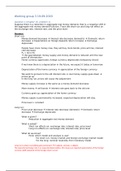
Chapter 3 Mental processes and beliefs
The information-processing paradigm (McGuire): readers must successively:
1. Pay attention to the message
2. Comprehend the messa ge
3. Accept the message
Each subprocess must be completed before the next subprocess can begin.
This paradigm explains why persuasive texts are often unsuccessful in achieving the intended effect.
Whether comprehension is necessary for persuasion depends on the way in which the target group
determines its position.
The target group may decide to accept or reject the promoted standpoint on the basis of:
- Careful evaluation of the arguments supporting it = systematic processing
- Applying relatively simple rules of thumb = heuristic processing
- Emotions evoked by the message processing = experiential processing
Paying attention to a message can be compared to exploring an object exploratory behaviour
The interest/deprivation model (I/D model) (Litman): used to describe various determinants of
curiosity:
- Curiosity out of deprivation: the phenomenon that we will actively seek out of information if
we are aware that we do not have specific knowledge
A process aimed at finding important, meaningful information that will reinforce our
sense of understanding and control
Curiosity out of deprivation mainly intends to eliminate an unpleasant feeling which may
occur after taking a decision, for instance
Example: the answer to a complex question, a valuable fact
- Curiosity out of interest: the need to hear or learn something new
People do not feel that they lack relevant knowledge, but they will start looking for
information which they expect will entertain them in a aesthetically pleasant manner
Curiosity out of interest is more driven by a sense of boredom than curiosity out of
deprivation
Litman makes a distinction between wanting and liking:
- You can eat because you are hungry (deprivation/wanting)
- You can eat because you expect to a nice taste sensation (interest/liking)
These systems are independent.
See table 3.1 on page 38
1
,2
, Reading a persuasive text can have two reasons:
1. The text may contain information that readers are looking for
Example: people may read the manifesto of a political party because they are considering
to vote for this party in the next election = this illustrates curiosity out of deprivation
2. Readers can read a persuasive text because they want to acquire new knowledge out of
interest
The manifesto will face strong competition in the form of news items, editorials and
columns
The most important requirement for a text to be interesting is that the information it contains is
new, since information similar to what the reader already know is uninteresting. (Wright)
However, things only get interesting if the new information fits what you already know.
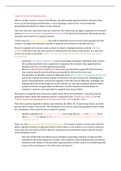
Hidi and Renniger distinguish four phases in the development of individual interests:
1. Interest evoked by unexpected, surprising information, by personal relevance or
identification with a person or by intensity of the message (triggered situational interest).
If this interest continues, the individual enters:
2. Maintained situational interest: this may be the precursor of an:
3. Emerging individual interest, causing the person to acquire knowledge about the topic and
develop a positive feeling towards it these factors make it more likely that the individual
will again pay attention to information about this object of interest
4. A fully developed individual interest which primarily differs from the 3rd stage in terms of
the amount of knowledge acquired and the positive feelings evoked by the object
Hidi and Renniger state that the development of a specific interest is the result of an interaction
between knowledge and feeling: in the first stage (triggered situational interest) feelings are
particularly important. If the individual’s interest develops, knowledge becomes more important.
Texts are interesting when they contain new information. this new information must be surprising
and suit the reader’s prior knowledge about and personal relatedness. such texts will draw the
attention of the readers. whether these texts will also be persuasive depends on the next
subprocesses:
- Comprehension
- Acceptance
Dual process models, distinguishing two types of acceptance process:
1. The elaboration likelihood model (ELM) Petty and Cacioppo
2. The heuristic-systematic model (HSM) Chaiken, Liberman & Eagly
The two models strongly resemble each other on many points.
The principle underlying both model sis that people want to have the right attitudes.
They believe it is important that their evaluation of objects or behaviors is correct
The dual process model state that an opinion about the correctness of a message may be
the result of two types of acceptance process
The safest way to adopt a correct attitude is careful consideration of all relevant
arguments
3
summary
Chapter 3 Mental processes and beliefs
The information-processing paradigm (McGuire): readers must successively:
1. Pay attention to the message
2. Comprehend the messa ge
3. Accept the message
Each subprocess must be completed before the next subprocess can begin.
This paradigm explains why persuasive texts are often unsuccessful in achieving the intended effect.
Whether comprehension is necessary for persuasion depends on the way in which the target group
determines its position.
The target group may decide to accept or reject the promoted standpoint on the basis of:
- Careful evaluation of the arguments supporting it = systematic processing
- Applying relatively simple rules of thumb = heuristic processing
- Emotions evoked by the message processing = experiential processing
Paying attention to a message can be compared to exploring an object exploratory behaviour
The interest/deprivation model (I/D model) (Litman): used to describe various determinants of
curiosity:
- Curiosity out of deprivation: the phenomenon that we will actively seek out of information if
we are aware that we do not have specific knowledge
A process aimed at finding important, meaningful information that will reinforce our
sense of understanding and control
Curiosity out of deprivation mainly intends to eliminate an unpleasant feeling which may
occur after taking a decision, for instance
Example: the answer to a complex question, a valuable fact
- Curiosity out of interest: the need to hear or learn something new
People do not feel that they lack relevant knowledge, but they will start looking for
information which they expect will entertain them in a aesthetically pleasant manner
Curiosity out of interest is more driven by a sense of boredom than curiosity out of
deprivation
Litman makes a distinction between wanting and liking:
- You can eat because you are hungry (deprivation/wanting)
- You can eat because you expect to a nice taste sensation (interest/liking)
These systems are independent.
See table 3.1 on page 38
1
,2
, Reading a persuasive text can have two reasons:
1. The text may contain information that readers are looking for
Example: people may read the manifesto of a political party because they are considering
to vote for this party in the next election = this illustrates curiosity out of deprivation
2. Readers can read a persuasive text because they want to acquire new knowledge out of
interest
The manifesto will face strong competition in the form of news items, editorials and
columns
The most important requirement for a text to be interesting is that the information it contains is
new, since information similar to what the reader already know is uninteresting. (Wright)
However, things only get interesting if the new information fits what you already know.
Hidi and Renniger distinguish four phases in the development of individual interests:
1. Interest evoked by unexpected, surprising information, by personal relevance or
identification with a person or by intensity of the message (triggered situational interest).
If this interest continues, the individual enters:
2. Maintained situational interest: this may be the precursor of an:
3. Emerging individual interest, causing the person to acquire knowledge about the topic and
develop a positive feeling towards it these factors make it more likely that the individual
will again pay attention to information about this object of interest
4. A fully developed individual interest which primarily differs from the 3rd stage in terms of
the amount of knowledge acquired and the positive feelings evoked by the object
Hidi and Renniger state that the development of a specific interest is the result of an interaction
between knowledge and feeling: in the first stage (triggered situational interest) feelings are
particularly important. If the individual’s interest develops, knowledge becomes more important.
Texts are interesting when they contain new information. this new information must be surprising
and suit the reader’s prior knowledge about and personal relatedness. such texts will draw the
attention of the readers. whether these texts will also be persuasive depends on the next
subprocesses:
- Comprehension
- Acceptance
Dual process models, distinguishing two types of acceptance process:
1. The elaboration likelihood model (ELM) Petty and Cacioppo
2. The heuristic-systematic model (HSM) Chaiken, Liberman & Eagly
The two models strongly resemble each other on many points.
The principle underlying both model sis that people want to have the right attitudes.
They believe it is important that their evaluation of objects or behaviors is correct
The dual process model state that an opinion about the correctness of a message may be
the result of two types of acceptance process
The safest way to adopt a correct attitude is careful consideration of all relevant
arguments
3