

The Human Musculoskeletal System
The musculoskeletal system provides form, stability, and movement to the human body.
It consists of bones, muscles, tendons, ligaments, joints, cartilage, and other multiple
connective tissues. The function of connective tissue is to support and bind tissues and
organs together essentially filling up the space between them, it contains two main
components which are collagen and elastic fibers.
The function of the bones is to protect the body's organs and also support the body's
weight allowing a person to move.
Bones in the Human Skeleton
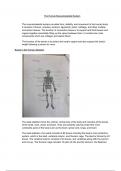
The axial skeleton forms the vertical, central axis of the body and includes all the bones
of the head, neck, chest, and back. They are primarily used to protect the more
vulnerable parts of the body such as the brain, spinal cord, lungs, and heart.
The axial skeleton of an adult consists of 80 bones including the body's main protective
system, which is the skull, vertebral column, and thoracic cage. The skull is formed by 22
bones. The vertebral column consists of 24 bones, and vertebrae along with the sacrum
and coccyx. The thoracic cage includes 12 pairs of ribs and the sternum, the flattened
,bone of the anterior chest. The appendicular skeleton includes all bones of the upper
and lower limbs, also the bones that attach each limb to the axial skeleton. There are
126 bones in the appendicular skeleton of an adult.
Flat bones: Flat bones are a type of bone that are thin, flattened, and usually curved.
They are found in the skull, ribs, sternum, and scapula. The primary function of flat
bones is to provide protection for internal organs, such as the brain, lungs, and heart.
Additionally, they provide a large surface area for muscle attachment, allowing for
movement of the body. Structurally, flat bones are composed of a thin layer of compact
bone that is surrounded by a layer of spongy bone. The spongy bone is filled with red
marrow, which is responsible for the production of red and white blood cells. The
compact bone provides strength and stability, while the spongy bone provides
cushioning and shock absorption.
Long bone: Long bones are a type of bone that are found in the arms and legs of
humans and other animals. They are composed of two main parts: the diaphysis, which
is the shaft of the bone, and the epiphysis, which is the ends of the bone. The diaphysis
is composed of a hard outer layer of cortical bone, which provides strength and
protection, and an inner layer of spongy bone, which contains red bone marrow and is
responsible for producing red and white blood cells. The epiphyses are made up of a
thin layer of cortical bone and contain yellow bone marrow, which is responsible for
producing fat cells. Long bones have a variety of functions, including providing support
and structure for the body, allowing for movement, and protecting organs.
, Short bones: Short bones are a type of bone that are typically found in the hands, feet,
wrists, and ankles. These bones are characterized by their short, cuboidal shape, and
are composed of a spongy interior surrounded by a thin layer of compact bone. Short
bones provide stability and flexibility to the body and are essential for movement and
balance. They also provide protection for the underlying soft tissue and act as a shock
absorber for the body. The structure of short bones allows them to withstand the
pressure of daily activities, such as walking, running, and jumping. Additionally, the
spongy interior of these bones contains red bone marrow, which is responsible for the
production of red blood cells. Therefore, short bones are essential for the maintenance
of healthy blood cells and overall body health.
Irregular bones: Irregular bones are bones that do not have a regular, symmetrical
shape. They are found in areas of the body where strength and support are needed,
such as the vertebrae of the spine and the bones of the face. They have a complex
structure that allows them to absorb shock and resist forces from multiple directions. The
internal structure of irregular bones consists of spongy bone, compact bone, and a thin
layer of connective tissue. The spongy bone provides strength and flexibility, while the
compact bone gives the bones rigidity and support. The connective tissue helps to bind
the bones together and helps to cushion the bones from shocks and impacts. Irregular
The musculoskeletal system provides form, stability, and movement to the human body.
It consists of bones, muscles, tendons, ligaments, joints, cartilage, and other multiple
connective tissues. The function of connective tissue is to support and bind tissues and
organs together essentially filling up the space between them, it contains two main
components which are collagen and elastic fibers.
The function of the bones is to protect the body's organs and also support the body's
weight allowing a person to move.
Bones in the Human Skeleton
The axial skeleton forms the vertical, central axis of the body and includes all the bones
of the head, neck, chest, and back. They are primarily used to protect the more
vulnerable parts of the body such as the brain, spinal cord, lungs, and heart.
The axial skeleton of an adult consists of 80 bones including the body's main protective
system, which is the skull, vertebral column, and thoracic cage. The skull is formed by 22
bones. The vertebral column consists of 24 bones, and vertebrae along with the sacrum
and coccyx. The thoracic cage includes 12 pairs of ribs and the sternum, the flattened
,bone of the anterior chest. The appendicular skeleton includes all bones of the upper
and lower limbs, also the bones that attach each limb to the axial skeleton. There are
126 bones in the appendicular skeleton of an adult.
Flat bones: Flat bones are a type of bone that are thin, flattened, and usually curved.
They are found in the skull, ribs, sternum, and scapula. The primary function of flat
bones is to provide protection for internal organs, such as the brain, lungs, and heart.
Additionally, they provide a large surface area for muscle attachment, allowing for
movement of the body. Structurally, flat bones are composed of a thin layer of compact
bone that is surrounded by a layer of spongy bone. The spongy bone is filled with red
marrow, which is responsible for the production of red and white blood cells. The
compact bone provides strength and stability, while the spongy bone provides
cushioning and shock absorption.
Long bone: Long bones are a type of bone that are found in the arms and legs of
humans and other animals. They are composed of two main parts: the diaphysis, which
is the shaft of the bone, and the epiphysis, which is the ends of the bone. The diaphysis
is composed of a hard outer layer of cortical bone, which provides strength and
protection, and an inner layer of spongy bone, which contains red bone marrow and is
responsible for producing red and white blood cells. The epiphyses are made up of a
thin layer of cortical bone and contain yellow bone marrow, which is responsible for
producing fat cells. Long bones have a variety of functions, including providing support
and structure for the body, allowing for movement, and protecting organs.
, Short bones: Short bones are a type of bone that are typically found in the hands, feet,
wrists, and ankles. These bones are characterized by their short, cuboidal shape, and
are composed of a spongy interior surrounded by a thin layer of compact bone. Short
bones provide stability and flexibility to the body and are essential for movement and
balance. They also provide protection for the underlying soft tissue and act as a shock
absorber for the body. The structure of short bones allows them to withstand the
pressure of daily activities, such as walking, running, and jumping. Additionally, the
spongy interior of these bones contains red bone marrow, which is responsible for the
production of red blood cells. Therefore, short bones are essential for the maintenance
of healthy blood cells and overall body health.
Irregular bones: Irregular bones are bones that do not have a regular, symmetrical
shape. They are found in areas of the body where strength and support are needed,
such as the vertebrae of the spine and the bones of the face. They have a complex
structure that allows them to absorb shock and resist forces from multiple directions. The
internal structure of irregular bones consists of spongy bone, compact bone, and a thin
layer of connective tissue. The spongy bone provides strength and flexibility, while the
compact bone gives the bones rigidity and support. The connective tissue helps to bind
the bones together and helps to cushion the bones from shocks and impacts. Irregular


