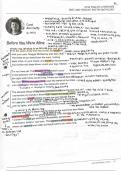
- Born in Soho in 1757 to a lower-middle-class family
- He was a champion of social justice and believed that individuals had the right to
question authority and rebel against them
- He condemned those who wield power
- He often used metaphorical and ambiguous symbolism to conceal his betterment
towards wider social structures. Perhaps for his protection
- He came from a family of Dissenters who had been taught to question authority from an
early age
- He was never an atheist but had a hatred of organised religion in all forms and remained
deeply suspicious of the church
- He despised those who used religion as a weapon
- During ‘The Age of Reason’, religious matters became challenged as logic, science and
intellect became the preoccupation
- He despised the Industrial Revolution as it further exemplified the class divide as it
introduced the Bourgeoisie and the Proletariat
- Working conditions were terrible- mass migration to urban areas resulted in cramped
working conditions, exploitation and a lack of Unions
- Blake was sympathetic to the French and American revolutions
- Believed in John Locke and Jean-Jacques Rousseau’s philosophies (“man is born free
but everywhere he is in chains”, tabula, being that children are blank slates)
- Women and children were preferred in factory work as they were the scapegoats for
lower wages
- Prostitution was common for women of lower classes as there were limited means to
make a living
- Blake uses the child as a device to represent the sacred nature of innocence, but society
rendered them victims of fallen childhoods
- In the Augustan era (1700-1745), women and children were seen as unfit subjects for
poetry so Blake may have been rebelling against this
- He had a quest for truth and an attraction to the supernatural power of imagination
- Indulgence in pleasure and sensuality
- Some of his themes also fall under the gothic genre
- Such as isolation and loneliness, wild landscapes (could link to Wordsworth and Keats
too), ruined or grotesque buildings, darkness, sex and sexuality, crime, lawlessness,
abuse and power
- He was a champion of social justice and believed that individuals had the right to
question authority and rebel against them
- He condemned those who wield power
- He often used metaphorical and ambiguous symbolism to conceal his betterment
towards wider social structures. Perhaps for his protection
- He came from a family of Dissenters who had been taught to question authority from an
early age
- He was never an atheist but had a hatred of organised religion in all forms and remained
deeply suspicious of the church
- He despised those who used religion as a weapon
- During ‘The Age of Reason’, religious matters became challenged as logic, science and
intellect became the preoccupation
- He despised the Industrial Revolution as it further exemplified the class divide as it
introduced the Bourgeoisie and the Proletariat
- Working conditions were terrible- mass migration to urban areas resulted in cramped
working conditions, exploitation and a lack of Unions
- Blake was sympathetic to the French and American revolutions
- Believed in John Locke and Jean-Jacques Rousseau’s philosophies (“man is born free
but everywhere he is in chains”, tabula, being that children are blank slates)
- Women and children were preferred in factory work as they were the scapegoats for
lower wages
- Prostitution was common for women of lower classes as there were limited means to
make a living
- Blake uses the child as a device to represent the sacred nature of innocence, but society
rendered them victims of fallen childhoods
- In the Augustan era (1700-1745), women and children were seen as unfit subjects for
poetry so Blake may have been rebelling against this
- He had a quest for truth and an attraction to the supernatural power of imagination
- Indulgence in pleasure and sensuality
- Some of his themes also fall under the gothic genre
- Such as isolation and loneliness, wild landscapes (could link to Wordsworth and Keats
too), ruined or grotesque buildings, darkness, sex and sexuality, crime, lawlessness,
abuse and power