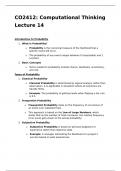
CO2412: Computational Thinking
Lecture 14
Introduction to Probability
1. What is Probability?
o Probability is the numerical measure of the likelihood that a
specific event will occur.
o The probability of any event ranges between 0 (impossible) and 1
(certain).
2. Basic Concepts
o Terms related to probability include chance, likelihood, uncertainty,
and risk.
Types of Probability
1. Classical Probability
o Classical Probability is determined by logical analysis rather than
observation. It is applicable in situations where all outcomes are
equally likely.
o Example: The probability of getting heads when flipping a fair coin
is 0.5.
2. Frequentist Probability
o Frequentist Probability relies on the frequency of occurrence of
an event over repeated trials.
o This approach is based on the Law of Large Numbers, which
states that as the number of trials increases, the relative frequency
of an event gets closer to the actual probability.
3. Subjective Probability
o Subjective Probability is based on personal judgment or
experience rather than objective data.
o Example: A manager estimating the likelihood of a project’s
success based on past experiences.
Lecture 14
Introduction to Probability
1. What is Probability?
o Probability is the numerical measure of the likelihood that a
specific event will occur.
o The probability of any event ranges between 0 (impossible) and 1
(certain).
2. Basic Concepts
o Terms related to probability include chance, likelihood, uncertainty,
and risk.
Types of Probability
1. Classical Probability
o Classical Probability is determined by logical analysis rather than
observation. It is applicable in situations where all outcomes are
equally likely.
o Example: The probability of getting heads when flipping a fair coin
is 0.5.
2. Frequentist Probability
o Frequentist Probability relies on the frequency of occurrence of
an event over repeated trials.
o This approach is based on the Law of Large Numbers, which
states that as the number of trials increases, the relative frequency
of an event gets closer to the actual probability.
3. Subjective Probability
o Subjective Probability is based on personal judgment or
experience rather than objective data.
o Example: A manager estimating the likelihood of a project’s
success based on past experiences.