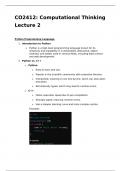
CO2412: Computational Thinking
Lecture 2
Python Programming Language
1. Introduction to Python
o Python is a high-level programming language known for its
simplicity and readability. It is interpreted, interactive, object-
oriented, and widely used in various fields, including data science
and web development.
2. Python vs. C++
o Python:
o Easy to learn and use.
o Popular in the scientific community with extensive libraries.
o Interpreted, meaning it runs line-by-line, which can slow down
execution.
o Not statically typed, which may lead to runtime errors.
o C++:
o Faster execution speed due to pre-compilation.
o Strongly typed, reducing runtime errors.
o Has a steeper learning curve and more complex syntax.
Example:
, 3. Anaconda Navigator
o Anaconda Navigator is an integrated development environment (IDE)
that simplifies Python package management and deployment. It
includes tools like Jupyter Notebook, making it easier to work with
Python.
Python Basics
1. Indentation
o Python uses indentation to define blocks of code, making it
mandatory for the structure of the code. This ensures code
readability and enforces a clean, organized format.
Example:
2. Variables and Data Types
o Variables in Python are dynamically typed, meaning they are
created upon assignment and can change types. Python supports
various data types, including strings, integers, floats, and more.
3. Data Types in Python
o Text Type: str
o Numeric Types: int, float, complex
o Sequence Types: list, tuple, range
o Mapping Type: dict
o Set Types: set, frozenset
o Boolean Type: bool
o Binary Types: bytes, bytearray, memoryview
o None Type: NoneType
Lecture 2
Python Programming Language
1. Introduction to Python
o Python is a high-level programming language known for its
simplicity and readability. It is interpreted, interactive, object-
oriented, and widely used in various fields, including data science
and web development.
2. Python vs. C++
o Python:
o Easy to learn and use.
o Popular in the scientific community with extensive libraries.
o Interpreted, meaning it runs line-by-line, which can slow down
execution.
o Not statically typed, which may lead to runtime errors.
o C++:
o Faster execution speed due to pre-compilation.
o Strongly typed, reducing runtime errors.
o Has a steeper learning curve and more complex syntax.
Example:
, 3. Anaconda Navigator
o Anaconda Navigator is an integrated development environment (IDE)
that simplifies Python package management and deployment. It
includes tools like Jupyter Notebook, making it easier to work with
Python.
Python Basics
1. Indentation
o Python uses indentation to define blocks of code, making it
mandatory for the structure of the code. This ensures code
readability and enforces a clean, organized format.
Example:
2. Variables and Data Types
o Variables in Python are dynamically typed, meaning they are
created upon assignment and can change types. Python supports
various data types, including strings, integers, floats, and more.
3. Data Types in Python
o Text Type: str
o Numeric Types: int, float, complex
o Sequence Types: list, tuple, range
o Mapping Type: dict
o Set Types: set, frozenset
o Boolean Type: bool
o Binary Types: bytes, bytearray, memoryview
o None Type: NoneType