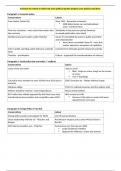
Evaluate the extent to which the main political parties disagree over policies and ideas.
Paragraph 1: Economic policy
Conservatives Labour
Free market, laissez-fair Since 1945 - Keynesian economics
2008 bailed banks out and nationalised
some - Northern Rock
Post-war consensus - more state intervention into Similarities in the post-war period (however
the economy increased polarisation since then)
Neoliberal economic policy under Thatcher Clause IV committed the party to public ownership
and nationalisation
New Labour rescinded Clause IV - more free
marker approach, acceptance of capitalism
Cuts to public spending under Osbourne austerity Investment to stimulate growth instead of austerity
2010
Thatcher - privatisation Corbyn - supported the renationalisation of railways
Paragraph 2: Social policy (law and order // welfare)
Conservatives Labour
'party of law and order' 'soft on crime'
Blair: 'tough on crime, tough on the causes
of crime'
911 77 bombings
Cut police force numbers by over 20,000 since 2010 due to 2005 Terrorism act - 90days without charge
austerity
Noblesse oblige 1945-51: national insurance and the welfare state
Welfare should be minimal - learnt dependence Means tested welfare
BUT whilst they initially opposed the NHS they have since NHS created in 1948
introduced private providers and competition since 2010 Starma £1.5bn plan to create 2mil more
appointments every year
Paragraph 3: Foreign Policy (+ the EU)
Conservatives Labour
Strong defence policy and support for NATO Lots of internal division
Close relationship with the US - Thatcher and Anti Nuclear weapon policy under Michael Foot in
Reagan the 80s
2021 the Eurosceptics won - Thatcher Controversy over the Iraq war 2003
Large backbench rebellion
Opposed by Miliband, Corbyn and Starmer
Paragraph 1: Economic policy
Conservatives Labour
Free market, laissez-fair Since 1945 - Keynesian economics
2008 bailed banks out and nationalised
some - Northern Rock
Post-war consensus - more state intervention into Similarities in the post-war period (however
the economy increased polarisation since then)
Neoliberal economic policy under Thatcher Clause IV committed the party to public ownership
and nationalisation
New Labour rescinded Clause IV - more free
marker approach, acceptance of capitalism
Cuts to public spending under Osbourne austerity Investment to stimulate growth instead of austerity
2010
Thatcher - privatisation Corbyn - supported the renationalisation of railways
Paragraph 2: Social policy (law and order // welfare)
Conservatives Labour
'party of law and order' 'soft on crime'
Blair: 'tough on crime, tough on the causes
of crime'
911 77 bombings
Cut police force numbers by over 20,000 since 2010 due to 2005 Terrorism act - 90days without charge
austerity
Noblesse oblige 1945-51: national insurance and the welfare state
Welfare should be minimal - learnt dependence Means tested welfare
BUT whilst they initially opposed the NHS they have since NHS created in 1948
introduced private providers and competition since 2010 Starma £1.5bn plan to create 2mil more
appointments every year
Paragraph 3: Foreign Policy (+ the EU)
Conservatives Labour
Strong defence policy and support for NATO Lots of internal division
Close relationship with the US - Thatcher and Anti Nuclear weapon policy under Michael Foot in
Reagan the 80s
2021 the Eurosceptics won - Thatcher Controversy over the Iraq war 2003
Large backbench rebellion
Opposed by Miliband, Corbyn and Starmer