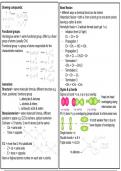
Drawing compounds: Bond fission
= different ways a chemical bond can be broken
Heterolytic fission = both e- from a bond go to one atom (anion)
leaving a cation & anion
Homolytic fission = 2 radicals formed (each get 1 e-)
Functional groups: - Initiation (from UV light)
Homologous series = same functional group, differ by a fixed Cl2 → Cl• + Cl•
group of atoms (usually CH2) - Propagation 1
Functional group = a group of atoms responsible for the Cl• + CH4 → HCl + •CH3
characteristic reactions - Propagation 2
•CH3 + Cl2 → CH3Cl + Cl•
- Termination 1
•CH3 + Cl• →CH3Cl
- Termination 2
Cl• + Cl• → Cl2
- Termination 3
Isomerism: •CH3 + •CH3 →C2H6
Structural = same molecular formula, different structure e.g. Sigma & pi bonds
chain, positional, functional group Sigma (σ) bond = s-s, s-p or p-p overlap:
⤷ aldehydes & ketones Head-on-head
⤷ alcohols & ethers overlapping along
⤷ carboxylic acids & esters internuclear axis
Stereoisomerism = same molecular formula, different Pi (π) bond = p-p overlapping perpendicular to internuclear axis
position in space e.g. E/Z & cis/trans, optical isomerism
π bond weaker than σ due to
Cis/trans = 2 H atoms, 2 non-H atoms (but the same)
lower degree of overlapping
- Cis = same side
- Trans = opposite Single bonds = σ
Double bonds = σ & π
E/Z = more than 2 H’s substituted Triple bonds = σ & 2π
- Z = cis = same side
- E = trans = opposite In alkenes →
Atom w/ highest atomic number on each side = priority
, Alkanes Catalytic converters
CnH2n+2 = thin metal catalyst coating to ↑ SA and ↓ metal used
Crude oil Remove CO & NO from vehicle exhausts:
Crude oil = mixture of 1. 2NO → N2 + O2
hydrocarbons 2. O2 + 2CO → 2CO2
∴ 2NO + 2CO → N2 + 2CO2
It is separated into Biofuels
useful fuels using their Biodiesel - made by refining renewable fats and oils
BPT’s by fractional Bioethanol - made by fermentation
distillation. Biogas - made / released when organic waste breaks down
- carbon neutral - absorb CO2 as they grow, equivalent to the
amount of CO2 released when they are burnt
- Biodiesel & biogas can ↓ waste going to landfill (waste can
be used to produce them)
- Biofuel provides money for less developed countries -
- Cracking = smaller hydrocarbons are in higher demand space to grow the crops required
than larger ones, therefore larger ones are broken down into
a smaller alkane and alkene.
- Reforming of alkanes = straight chain alkanes are more
likely to explode, rather than combust, inside the engine.
This is known as knocking and makes the combustion less
efficient. To reduce this, straight chain alkanes are reformed
into branched alkanes & cycloalkanes using a platinum
catalyst.
Combustion
Complete = burnt in excess oxygen forming CO 2 & H2O
Incomplete = burnt in limited oxygen forming CO or C & H 2O
Car exhaust fumes include toxic gases:
- CO binds well to haemoglobin which ∴ can’t bind O2 & CO2
- NO & NO2 dissolve in water → acid rain
- Soot (C) causes respiratory problems
= different ways a chemical bond can be broken
Heterolytic fission = both e- from a bond go to one atom (anion)
leaving a cation & anion
Homolytic fission = 2 radicals formed (each get 1 e-)
Functional groups: - Initiation (from UV light)
Homologous series = same functional group, differ by a fixed Cl2 → Cl• + Cl•
group of atoms (usually CH2) - Propagation 1
Functional group = a group of atoms responsible for the Cl• + CH4 → HCl + •CH3
characteristic reactions - Propagation 2
•CH3 + Cl2 → CH3Cl + Cl•
- Termination 1
•CH3 + Cl• →CH3Cl
- Termination 2
Cl• + Cl• → Cl2
- Termination 3
Isomerism: •CH3 + •CH3 →C2H6
Structural = same molecular formula, different structure e.g. Sigma & pi bonds
chain, positional, functional group Sigma (σ) bond = s-s, s-p or p-p overlap:
⤷ aldehydes & ketones Head-on-head
⤷ alcohols & ethers overlapping along
⤷ carboxylic acids & esters internuclear axis
Stereoisomerism = same molecular formula, different Pi (π) bond = p-p overlapping perpendicular to internuclear axis
position in space e.g. E/Z & cis/trans, optical isomerism
π bond weaker than σ due to
Cis/trans = 2 H atoms, 2 non-H atoms (but the same)
lower degree of overlapping
- Cis = same side
- Trans = opposite Single bonds = σ
Double bonds = σ & π
E/Z = more than 2 H’s substituted Triple bonds = σ & 2π
- Z = cis = same side
- E = trans = opposite In alkenes →
Atom w/ highest atomic number on each side = priority
, Alkanes Catalytic converters
CnH2n+2 = thin metal catalyst coating to ↑ SA and ↓ metal used
Crude oil Remove CO & NO from vehicle exhausts:
Crude oil = mixture of 1. 2NO → N2 + O2
hydrocarbons 2. O2 + 2CO → 2CO2
∴ 2NO + 2CO → N2 + 2CO2
It is separated into Biofuels
useful fuels using their Biodiesel - made by refining renewable fats and oils
BPT’s by fractional Bioethanol - made by fermentation
distillation. Biogas - made / released when organic waste breaks down
- carbon neutral - absorb CO2 as they grow, equivalent to the
amount of CO2 released when they are burnt
- Biodiesel & biogas can ↓ waste going to landfill (waste can
be used to produce them)
- Biofuel provides money for less developed countries -
- Cracking = smaller hydrocarbons are in higher demand space to grow the crops required
than larger ones, therefore larger ones are broken down into
a smaller alkane and alkene.
- Reforming of alkanes = straight chain alkanes are more
likely to explode, rather than combust, inside the engine.
This is known as knocking and makes the combustion less
efficient. To reduce this, straight chain alkanes are reformed
into branched alkanes & cycloalkanes using a platinum
catalyst.
Combustion
Complete = burnt in excess oxygen forming CO 2 & H2O
Incomplete = burnt in limited oxygen forming CO or C & H 2O
Car exhaust fumes include toxic gases:
- CO binds well to haemoglobin which ∴ can’t bind O2 & CO2
- NO & NO2 dissolve in water → acid rain
- Soot (C) causes respiratory problems