

Endocrine Conditions
Thyroid Hormones
Thyroid hormones are responsible for the body’s metabolism: T3, T4 and calcitonin
T3 is the active thyroid hormone, whereas T4 is largely inactive – but can get
transformed into T3 by certain organs in the body
Calcitonin is the hormone that aids in the regulation of calcium levels (through
decrease) but impact metabolism nevertheless
Regulation (negative-feedback)
- Hypothalamus releases TRH (thyroid releasing hormone)
- Pituitary gland stimulated to release TSH (thyroid stimulating hormone)
- TSH triggers thyroid to produce T4 (80%) and T3 (20%)
- Iodine is also needed in adequate amounts to form these hormones
- When T3 and T4 levels increase – TRH is inhibited
- When T3 and T4 levels decrease – the loop is initiated again
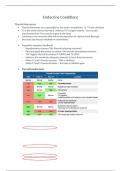
Thyroid function tests
, Hyperthyroidism: Grave’s Disease
Definition The overactivity of thyroid gland = excess thyroid hormone production
Epidemiology
Aetiology Autoimmune disorder
- Antibodies stimulate TSH receptors
= hyperproliferation of thyroid hormones
= hyperplasia of the thyroid gland
Risk Factors - Family history/past medical history of autoimmune disorder
Symptoms - Weight loss
- Palpitations
- Fatigue
- Insomnia
- Irritability
- Tremors/muscle weakness
- Heat intolerance/sweating
- Enlarged thyroid = goitre
- Diarrhoea
Signs - Lid lag – upper eye lid remains higher than normal during
downward gaze
- Nail clubbing
- Bulging eyes (proptosis)
Investigations Bloods:
- TFTs: ↑ T4 and T3 + ↓ TSH
- Thyroid antibodies: TSIAb or TRAb*
Ultrasonography of thyroids
Radioiodine uptake test: diffuse uptake in Grave’s
Management 1. Carbimazole (preferred) OR propylthiouracil (preferred in first
trimester)
*12-18m course
2. Beta blockers (symptomatic relief from sympathetic activity)
3. Radio-iodine (definitive treatment) – damages thyroid tissue >
reduces ability to produce TSH
4. Thyroidectomy
Hyperthyroidism: Thyroid Storm
, Definition Rare but life-threatening medical emergency due to untreated or
uncontrolled hyperthyroidism
Epidemiology
Aetiology
Risk Factors
Symptoms - Restlessness/agitation
- High-output heart failure
- Profound tachycardia
- Fever
- Delirium/altered mental state
- Abdominal pain
Signs
Investigations
Management 1. IV propranolol/digoxin
2. Propylthiouracil + Lugol’s iodine (reduce thyroid hormone
production)
3. Steroids (inhibits conversion of T4 to T3)
4. Supportive care: IV fluids, cooling measures for fever, underlying
factors addressed
Hypothyroidism
Definition Insufficient production of thyroid hormones
Epidemiology
Aetiology - Iodine deficiency
- Surgical removal of thyroid
- Congenital diseases
Risk Factors
Symptoms - Brittle hair
- Dry/thick skin
- Loss of outer 1/3 eyebrow (Queen Anne’s sign)
- Cold intolerances
- Puffy face
- Goitre
- Fatigue
- Depression
- Constipation
- Weight gain
- Mental slowness
Signs
Investigations Bloods:
Thyroid Hormones
Thyroid hormones are responsible for the body’s metabolism: T3, T4 and calcitonin
T3 is the active thyroid hormone, whereas T4 is largely inactive – but can get
transformed into T3 by certain organs in the body
Calcitonin is the hormone that aids in the regulation of calcium levels (through
decrease) but impact metabolism nevertheless
Regulation (negative-feedback)
- Hypothalamus releases TRH (thyroid releasing hormone)
- Pituitary gland stimulated to release TSH (thyroid stimulating hormone)
- TSH triggers thyroid to produce T4 (80%) and T3 (20%)
- Iodine is also needed in adequate amounts to form these hormones
- When T3 and T4 levels increase – TRH is inhibited
- When T3 and T4 levels decrease – the loop is initiated again
Thyroid function tests
, Hyperthyroidism: Grave’s Disease
Definition The overactivity of thyroid gland = excess thyroid hormone production
Epidemiology
Aetiology Autoimmune disorder
- Antibodies stimulate TSH receptors
= hyperproliferation of thyroid hormones
= hyperplasia of the thyroid gland
Risk Factors - Family history/past medical history of autoimmune disorder
Symptoms - Weight loss
- Palpitations
- Fatigue
- Insomnia
- Irritability
- Tremors/muscle weakness
- Heat intolerance/sweating
- Enlarged thyroid = goitre
- Diarrhoea
Signs - Lid lag – upper eye lid remains higher than normal during
downward gaze
- Nail clubbing
- Bulging eyes (proptosis)
Investigations Bloods:
- TFTs: ↑ T4 and T3 + ↓ TSH
- Thyroid antibodies: TSIAb or TRAb*
Ultrasonography of thyroids
Radioiodine uptake test: diffuse uptake in Grave’s
Management 1. Carbimazole (preferred) OR propylthiouracil (preferred in first
trimester)
*12-18m course
2. Beta blockers (symptomatic relief from sympathetic activity)
3. Radio-iodine (definitive treatment) – damages thyroid tissue >
reduces ability to produce TSH
4. Thyroidectomy
Hyperthyroidism: Thyroid Storm
, Definition Rare but life-threatening medical emergency due to untreated or
uncontrolled hyperthyroidism
Epidemiology
Aetiology
Risk Factors
Symptoms - Restlessness/agitation
- High-output heart failure
- Profound tachycardia
- Fever
- Delirium/altered mental state
- Abdominal pain
Signs
Investigations
Management 1. IV propranolol/digoxin
2. Propylthiouracil + Lugol’s iodine (reduce thyroid hormone
production)
3. Steroids (inhibits conversion of T4 to T3)
4. Supportive care: IV fluids, cooling measures for fever, underlying
factors addressed
Hypothyroidism
Definition Insufficient production of thyroid hormones
Epidemiology
Aetiology - Iodine deficiency
- Surgical removal of thyroid
- Congenital diseases
Risk Factors
Symptoms - Brittle hair
- Dry/thick skin
- Loss of outer 1/3 eyebrow (Queen Anne’s sign)
- Cold intolerances
- Puffy face
- Goitre
- Fatigue
- Depression
- Constipation
- Weight gain
- Mental slowness
Signs
Investigations Bloods:


