

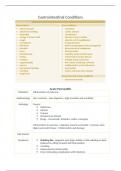
Gastrointestinal Conditions
Acute Pancreatitis
Definition Inflammation of pancreas
Epidemiology Very common – late diagnosis = high mortality and morbidity
Aetiology Causes:
Gallstones
Alcohol
Trauma
Autoimmune disease
Drugs – furosemide, thiazides, statins, estrogens
Inflammation in pancreas > digestive enzymes activated > enzymes auto-
digest pancreatic tissue = inflammation and damage
Risk Factors
Symptoms Stabbing-like, epigastric pain (high middle or left) radiating to back
Relieved by sitting forward and fetal position
Vomiting
Hypovolaemia (tachycardia)
Fever (indicating complication with infection)
, PMH of alcohol and gallstones suggestive
Signs Grey-Turner’s sign (bruising along flanks) – indicates retroperitoneal
bleed
Cullen’s sign (bruising around umbilical area – below belly button)
Investigations Diagnostic:
FBC and U&Es (elevated WBC – necrotising pancreatitis)
LFT (abnormalities – gall-stone related pancreatitis)
Lipase
Amylase (three-fold elevation strongly indicative)
Imaging:
Ultrasound of abdomen – gallstone detection
MRCP (magnetic) – obstructive pancreatitis
ERCP (endoscopic) – diagnostic and therapeutic
CT – complications
Management Aim: to maintain electrolyte balance and compensate fluid loss
Aggressive fluid resus with crystalloids (maintain urine output
>30mL/hr)
Catheterisation
Analgesia (strong opioids)
Antinausea
Supplemental oxygen
Antibiotics – only necessary in necrotising pancreatitis
Severity Glasgow Criteria – done at admission and 48 hours (true score)
P: PaO2 <8kPa
A: Age >55
N: Neutrophils WBC >15 x 109
C: Calcium <2
R: Renal function >16
E: Enzymes AST/ALT >200 (or LDH > 600)
A: Albumin <32
S: Sugar >10
*3 or more positive factors = ITU/HDU admission for monitoring and
fluid resus
Chronic Pancreatitis
Definition Persistent inflammation and fibrosis of exocrine and endocrine
components of pancreas
Epidemiology
Aetiology Primarily caused by alcohol excess (80%)
Other causes: genetics (CF), obstruction (cancer), metabolic (elevated
, trigacylglycerides)
Risk Factors
Symptoms Epigastric pain (exacerbated by fatty food consumption + alleviated
by sitting forward)
Exocrine dysfunction: malabsorption (abdominal discomfort),
steatorrhea (fat excretion in stool)
Endocrine dysfunction: diabetes (thirst and polyuria)
Signs Epigastric tenderness
Investigations Abdominal X-ray (calcifications)
CT scan (calcifications)
Faecal elastase (exocrine dysfunction)
Fasting glucose (endocrine dysfunction)
*Amylase and lipase not typically raised
Management Management of diet and alcohol
Pain control
Insulin (if diabetic)
Pancreatic enzyme replacement therapy (Creon)
If ^^ fail – invasive procedures like pancreatectomy and celiac
plexus block (nerve block to ease abdominal pain)
Pancreatic Cancer
Definition Malignancy in the pancreas – most common being pancreatic
adenocarcinoma
Epidemiology 5th most common cancer in UK – poor 5-year survival rate <5%
Aetiology
Risk Factors Age – elder
Smoking
Obesity
Diabetes
Chronic pancreatitis
Family history
Genetic mutations
Symptoms Early signs (non-specific):
Malaise
Abdominal pain
Nausea
Weight loss
Jaundice (no pain) with palpable gallbladder (Courvoisier’s sign)
Advanced signs:
, Obstructive jaundice
Diabetes
Pancreatic infiltration
Pancreoplastic syndromes
Disseminated intravascular coagulation
*Often metastasises early to lung, liver and bowel
Signs
Investigations Refer using suspected cancer pathway referral (within two weeks)
for pancreatic cancer IF 1. Aged above 40 and 2. Have jaundice
Consider urgent CT or ultrasound scan (within two weeks) if 1. Aged
over 60 WITH weight loss and 2. ANY OF: diarrhoea, back pain,
abdominal pain, nausea, vomiting, constipation, new-onset diabetes
Abdominal ultrasound – detect tumours >2cm > liver metastases >
dilation of common bile duct
(Endoscopic ultrasound for small lesions + biopsy if needed)
CT scan – disease staging and prediction of surgical resectability
MRCP – investigation of bile ducts
Management Only curative treatment is surgical resection – only 15-20% as late diagnosis
- No evidence of superior mesenteric artery or celiac involvement
- No evidence of metastases
Palliative therapy:
Endoscopic stent insertion in common bile duct > palliative surgery
if failed
Chemotherapy
Radiotherapy (localised advanced disease only)
Acute Liver Failure
Definition Sudden onset of liver dysfunction that causes encephalopathy within 8
weeks
- Absence of prior liver disease
*Encephalopathy – brain function is affected due to accumulation of
ammonia (greatly increases mortality rate)
Epidemiology
Aetiology Main cause of ALF is paracetamol overdose
Non-paracetamol aetiologies include: viral, ischemia, pregnancy,
malignancy
Acute Pancreatitis
Definition Inflammation of pancreas
Epidemiology Very common – late diagnosis = high mortality and morbidity
Aetiology Causes:
Gallstones
Alcohol
Trauma
Autoimmune disease
Drugs – furosemide, thiazides, statins, estrogens
Inflammation in pancreas > digestive enzymes activated > enzymes auto-
digest pancreatic tissue = inflammation and damage
Risk Factors
Symptoms Stabbing-like, epigastric pain (high middle or left) radiating to back
Relieved by sitting forward and fetal position
Vomiting
Hypovolaemia (tachycardia)
Fever (indicating complication with infection)
, PMH of alcohol and gallstones suggestive
Signs Grey-Turner’s sign (bruising along flanks) – indicates retroperitoneal
bleed
Cullen’s sign (bruising around umbilical area – below belly button)
Investigations Diagnostic:
FBC and U&Es (elevated WBC – necrotising pancreatitis)
LFT (abnormalities – gall-stone related pancreatitis)
Lipase
Amylase (three-fold elevation strongly indicative)
Imaging:
Ultrasound of abdomen – gallstone detection
MRCP (magnetic) – obstructive pancreatitis
ERCP (endoscopic) – diagnostic and therapeutic
CT – complications
Management Aim: to maintain electrolyte balance and compensate fluid loss
Aggressive fluid resus with crystalloids (maintain urine output
>30mL/hr)
Catheterisation
Analgesia (strong opioids)
Antinausea
Supplemental oxygen
Antibiotics – only necessary in necrotising pancreatitis
Severity Glasgow Criteria – done at admission and 48 hours (true score)
P: PaO2 <8kPa
A: Age >55
N: Neutrophils WBC >15 x 109
C: Calcium <2
R: Renal function >16
E: Enzymes AST/ALT >200 (or LDH > 600)
A: Albumin <32
S: Sugar >10
*3 or more positive factors = ITU/HDU admission for monitoring and
fluid resus
Chronic Pancreatitis
Definition Persistent inflammation and fibrosis of exocrine and endocrine
components of pancreas
Epidemiology
Aetiology Primarily caused by alcohol excess (80%)
Other causes: genetics (CF), obstruction (cancer), metabolic (elevated
, trigacylglycerides)
Risk Factors
Symptoms Epigastric pain (exacerbated by fatty food consumption + alleviated
by sitting forward)
Exocrine dysfunction: malabsorption (abdominal discomfort),
steatorrhea (fat excretion in stool)
Endocrine dysfunction: diabetes (thirst and polyuria)
Signs Epigastric tenderness
Investigations Abdominal X-ray (calcifications)
CT scan (calcifications)
Faecal elastase (exocrine dysfunction)
Fasting glucose (endocrine dysfunction)
*Amylase and lipase not typically raised
Management Management of diet and alcohol
Pain control
Insulin (if diabetic)
Pancreatic enzyme replacement therapy (Creon)
If ^^ fail – invasive procedures like pancreatectomy and celiac
plexus block (nerve block to ease abdominal pain)
Pancreatic Cancer
Definition Malignancy in the pancreas – most common being pancreatic
adenocarcinoma
Epidemiology 5th most common cancer in UK – poor 5-year survival rate <5%
Aetiology
Risk Factors Age – elder
Smoking
Obesity
Diabetes
Chronic pancreatitis
Family history
Genetic mutations
Symptoms Early signs (non-specific):
Malaise
Abdominal pain
Nausea
Weight loss
Jaundice (no pain) with palpable gallbladder (Courvoisier’s sign)
Advanced signs:
, Obstructive jaundice
Diabetes
Pancreatic infiltration
Pancreoplastic syndromes
Disseminated intravascular coagulation
*Often metastasises early to lung, liver and bowel
Signs
Investigations Refer using suspected cancer pathway referral (within two weeks)
for pancreatic cancer IF 1. Aged above 40 and 2. Have jaundice
Consider urgent CT or ultrasound scan (within two weeks) if 1. Aged
over 60 WITH weight loss and 2. ANY OF: diarrhoea, back pain,
abdominal pain, nausea, vomiting, constipation, new-onset diabetes
Abdominal ultrasound – detect tumours >2cm > liver metastases >
dilation of common bile duct
(Endoscopic ultrasound for small lesions + biopsy if needed)
CT scan – disease staging and prediction of surgical resectability
MRCP – investigation of bile ducts
Management Only curative treatment is surgical resection – only 15-20% as late diagnosis
- No evidence of superior mesenteric artery or celiac involvement
- No evidence of metastases
Palliative therapy:
Endoscopic stent insertion in common bile duct > palliative surgery
if failed
Chemotherapy
Radiotherapy (localised advanced disease only)
Acute Liver Failure
Definition Sudden onset of liver dysfunction that causes encephalopathy within 8
weeks
- Absence of prior liver disease
*Encephalopathy – brain function is affected due to accumulation of
ammonia (greatly increases mortality rate)
Epidemiology
Aetiology Main cause of ALF is paracetamol overdose
Non-paracetamol aetiologies include: viral, ischemia, pregnancy,
malignancy


