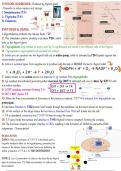
THYROID HORMONES: Produced by thyroid gland
- Depends on iodine capture and storage
1. Triiodothronine (T3)
2. Thyroxine (T4)
3. Calcitonin
SYNTHESIS & USAGE:
1. Hypothalamus produces the release factor TRF.
2. This stimulates anterior pituitary to produce TSH, which
acts on the thyroid gland.
3. Thyroglobulin (high number of amino acid Tyr) is synthesized and stored in the follicular cells of the thyroid.
4. Thyroglobulin is glycosylated and secreted into colloid
5. Iodide ions are uptaken into the thyroid cells via an iodine pump, which is activated by TSH (uptake against the
concentration gradient)
6. Iodine is oxidated (goes from negative ion to positive) with the help of H2O2 (formed in thyroid cells) 7
( ,
7. Iodine travels to the colloid where it is attached to tyr residues from thyroglobulin.
8. Tyr residues are iodinated generating either monoiod-Tyr (MIT) if iodinated with one or diiod-Tyr (DIT) if with
two iodine residues.
→
9. 2 DIT residues connect forming T4
9. DIT + MIT forms T3
10. When the Free concentration of hormones in the plasma is reduced, T3/T4 is released from thyroglobulin via
proteolysis.
11. Hormone Attaches to TBG(protein) and travels through the membrane via the blood stream to target tissues.
12. At the surface of the target tissue the hormone is detached from TBG and travels into the cell.
-> T4 is deiodated, converting into T3 (If T3 then its stays the same)
13. T3 goes inside the nucleus and attaches to THR (thyroid hormone receptor), forming the complex.
14.The hormone receptor complex attaches to DNA, resulting in the formation of mRNA by activating RNA
polymerase. (Transcription)
REGULATION:
TYPE 1: High concentration of T3/T4 in the blood exert a
negatifve feedback effect on the hypothalamus, preventing the
release of the release factors/trophic hormones. (Inhibiting the
further production of T3 & T4) TSH DEPENDENT
TYPE 2: Low Concentration of iodine in the blood forces thyroid
gland to produce more T3. (High concentration of iodine in the
blood inhibits).
- Depends on iodine capture and storage
1. Triiodothronine (T3)
2. Thyroxine (T4)
3. Calcitonin
SYNTHESIS & USAGE:
1. Hypothalamus produces the release factor TRF.
2. This stimulates anterior pituitary to produce TSH, which
acts on the thyroid gland.
3. Thyroglobulin (high number of amino acid Tyr) is synthesized and stored in the follicular cells of the thyroid.
4. Thyroglobulin is glycosylated and secreted into colloid
5. Iodide ions are uptaken into the thyroid cells via an iodine pump, which is activated by TSH (uptake against the
concentration gradient)
6. Iodine is oxidated (goes from negative ion to positive) with the help of H2O2 (formed in thyroid cells) 7
( ,
7. Iodine travels to the colloid where it is attached to tyr residues from thyroglobulin.
8. Tyr residues are iodinated generating either monoiod-Tyr (MIT) if iodinated with one or diiod-Tyr (DIT) if with
two iodine residues.
→
9. 2 DIT residues connect forming T4
9. DIT + MIT forms T3
10. When the Free concentration of hormones in the plasma is reduced, T3/T4 is released from thyroglobulin via
proteolysis.
11. Hormone Attaches to TBG(protein) and travels through the membrane via the blood stream to target tissues.
12. At the surface of the target tissue the hormone is detached from TBG and travels into the cell.
-> T4 is deiodated, converting into T3 (If T3 then its stays the same)
13. T3 goes inside the nucleus and attaches to THR (thyroid hormone receptor), forming the complex.
14.The hormone receptor complex attaches to DNA, resulting in the formation of mRNA by activating RNA
polymerase. (Transcription)
REGULATION:
TYPE 1: High concentration of T3/T4 in the blood exert a
negatifve feedback effect on the hypothalamus, preventing the
release of the release factors/trophic hormones. (Inhibiting the
further production of T3 & T4) TSH DEPENDENT
TYPE 2: Low Concentration of iodine in the blood forces thyroid
gland to produce more T3. (High concentration of iodine in the
blood inhibits).