
Regeneration
EQ1: How and Why do Places Vary?
4.1 Economies can be classified in different ways and vary from place to place.
Place – geographical spaces shaped by individuals and communities over time.
Rural to urban continuum – the unbroken transition from sparsely populated or
unpopulated, remote rural places to densely populated intensively urban places.
An important aspect of place is it’s meaning to individuals and to define
groups of people.
Place boundaries may be perceptual as well as administrative and
functional.
Meaning reflects how people perceive, engage with and form attachments
to particular places.
How might places change?
Smaller or remote places may change socially and economically more
slowly than larger countries.
Villages close to cities will be affected by commuting.
Places may lose or gain attractiveness, value or attributes.
This can lead to different needs for regeneration between places.
These changes may be driven by processes at a local, national and global
level.
Regeneration – the long-term upgrading of existing places or more drastic
renewal schemes or urban residential, retail, industrial and commercial areas as
well as rural areas.
It is connected with rebranding, which centers on places marketing where places
are given a new or enhanced identity to increase their attractiveness.
Rebranding – the way or ways in which a place is re-developed and marketed so
that it gains a new identity. It can then attract new investors and visitors.
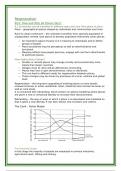
The Clark – Fisher Model:
Pre-Industrial stage:
In this stage the majority of people are employed in primary industries,
agricultural work, fishing and mining.
,Industrial Stage:
Lots of jobs are created in factories and industries e.g. textiles and engineering
goods.
Post – industrial stage:
the tertiary sector, providing services to the population, become the most
important sector and continues to grow. The quaternary sector begins to grow,
perhaps quinary too.
Employment Sectors:
Primary – this sector involves extracting and working with natural resources.
Examples include agriculture and fishing.
Secondary – this sector involves making new things. Examples include car
manufacturing and construction.
Tertiary – this sector provides services for the population. Examples include
commercial services, social services etc.
Quaternary – this sector involves high tech, research and design. Examples
include programmers, IT specialists and technology developers.
Quinary – this is the highest level of decision making in an economy. Examples
include CEOs of businesses and government officials.
Over time the primary sector has decreased, the secondary sector has remained
mostly continuous whilst the tertiary, quinary and quaternary sectors have all
increased, especially throughout the development of the 21 st century.
Employment Types:
Self-employed – this is where you work for yourself either as a freelancer or the
owner of a business.
Employed – this is where you work under an employment contract.
Part time – this type of employment means that you work less than 35 hours a
week.
Full time – this type of employment means that you work 35 hours per week.
permanent– this is where you have regular and on-going hours.
Temporary – this is where you are required to work on a flexible basis e.g.
covering maternity, illness. Often only for a fixed time period.
SOCIO-ECONOMIC INEQUALITIES
Regional inequalities in pay:
Incomes vary regionally. Incomes in London are the UKs highest. 58% of jobs in
London occur in the three highest sectors. Only 22% of jobs are in the lowest
three categories.
Variations in quality of life:
Do higher wages increase happiness? Workers in London and southeast England
have different incomes. GIS mapping found that housing affordability is more
important to happiness.
, Occupation and life expectancy:
A person’s occupation has social consequences. Life expectancy affects the
highest and lowest occupation groups. There is a 5–6-year difference between
life expectancy.
Income and Health:
The same relationship occurs between income inequality and health. Those on
the lowest income are the most deprived. There is a clear link between income,
deprivation and health.
Variations in educational achievement:
The relationship is linked to employment – those with the highest qualifications
are more likely to work in London. Their kids are more likely to pass their GCSEs.
4.2 Places have changed their function and characteristics over time.
Functions – the role a place plays for its community and surrounding area. Some,
usually larger places offer regional, national or global functions.
Examples of functions:
Tourism
Trade
Fishing
Governance
Characteristics – the physical and human aspects that help distinguish one place
from another.
Land Use Function:
Retail – a town or city with attractive retail facilities – markets, shopping centers,
unique shops. The retail industry is the main source of income and employment
for locals.
Administrative – places that make decisions about how to organize infrastructure
and economic activity for the surrounding areas.
Industrial – a location whose economy and reputation are predominantly based
on its industrial capacity.
Commercial – a location with strong business influence: many TNCs may have
bases here and there is a large volume of small- and large-scale businesses.
Demographic Changes:
Age Structure:
For the young, you would expect a town to have good facilities such as clubs and
bars as well as good transport. A working population may want good coffee
shops and schools for their children and old people may be more interested in
green spaces and public transport.
Ethnic Consumption:
Functional changes may have helped to encourage migration through the
formation of clusters of migrants who come together due to these functions
where they have all the facilities they may need nearby.
EQ1: How and Why do Places Vary?
4.1 Economies can be classified in different ways and vary from place to place.
Place – geographical spaces shaped by individuals and communities over time.
Rural to urban continuum – the unbroken transition from sparsely populated or
unpopulated, remote rural places to densely populated intensively urban places.
An important aspect of place is it’s meaning to individuals and to define
groups of people.
Place boundaries may be perceptual as well as administrative and
functional.
Meaning reflects how people perceive, engage with and form attachments
to particular places.
How might places change?
Smaller or remote places may change socially and economically more
slowly than larger countries.
Villages close to cities will be affected by commuting.
Places may lose or gain attractiveness, value or attributes.
This can lead to different needs for regeneration between places.
These changes may be driven by processes at a local, national and global
level.
Regeneration – the long-term upgrading of existing places or more drastic
renewal schemes or urban residential, retail, industrial and commercial areas as
well as rural areas.
It is connected with rebranding, which centers on places marketing where places
are given a new or enhanced identity to increase their attractiveness.
Rebranding – the way or ways in which a place is re-developed and marketed so
that it gains a new identity. It can then attract new investors and visitors.
The Clark – Fisher Model:
Pre-Industrial stage:
In this stage the majority of people are employed in primary industries,
agricultural work, fishing and mining.
,Industrial Stage:
Lots of jobs are created in factories and industries e.g. textiles and engineering
goods.
Post – industrial stage:
the tertiary sector, providing services to the population, become the most
important sector and continues to grow. The quaternary sector begins to grow,
perhaps quinary too.
Employment Sectors:
Primary – this sector involves extracting and working with natural resources.
Examples include agriculture and fishing.
Secondary – this sector involves making new things. Examples include car
manufacturing and construction.
Tertiary – this sector provides services for the population. Examples include
commercial services, social services etc.
Quaternary – this sector involves high tech, research and design. Examples
include programmers, IT specialists and technology developers.
Quinary – this is the highest level of decision making in an economy. Examples
include CEOs of businesses and government officials.
Over time the primary sector has decreased, the secondary sector has remained
mostly continuous whilst the tertiary, quinary and quaternary sectors have all
increased, especially throughout the development of the 21 st century.
Employment Types:
Self-employed – this is where you work for yourself either as a freelancer or the
owner of a business.
Employed – this is where you work under an employment contract.
Part time – this type of employment means that you work less than 35 hours a
week.
Full time – this type of employment means that you work 35 hours per week.
permanent– this is where you have regular and on-going hours.
Temporary – this is where you are required to work on a flexible basis e.g.
covering maternity, illness. Often only for a fixed time period.
SOCIO-ECONOMIC INEQUALITIES
Regional inequalities in pay:
Incomes vary regionally. Incomes in London are the UKs highest. 58% of jobs in
London occur in the three highest sectors. Only 22% of jobs are in the lowest
three categories.
Variations in quality of life:
Do higher wages increase happiness? Workers in London and southeast England
have different incomes. GIS mapping found that housing affordability is more
important to happiness.
, Occupation and life expectancy:
A person’s occupation has social consequences. Life expectancy affects the
highest and lowest occupation groups. There is a 5–6-year difference between
life expectancy.
Income and Health:
The same relationship occurs between income inequality and health. Those on
the lowest income are the most deprived. There is a clear link between income,
deprivation and health.
Variations in educational achievement:
The relationship is linked to employment – those with the highest qualifications
are more likely to work in London. Their kids are more likely to pass their GCSEs.
4.2 Places have changed their function and characteristics over time.
Functions – the role a place plays for its community and surrounding area. Some,
usually larger places offer regional, national or global functions.
Examples of functions:
Tourism
Trade
Fishing
Governance
Characteristics – the physical and human aspects that help distinguish one place
from another.
Land Use Function:
Retail – a town or city with attractive retail facilities – markets, shopping centers,
unique shops. The retail industry is the main source of income and employment
for locals.
Administrative – places that make decisions about how to organize infrastructure
and economic activity for the surrounding areas.
Industrial – a location whose economy and reputation are predominantly based
on its industrial capacity.
Commercial – a location with strong business influence: many TNCs may have
bases here and there is a large volume of small- and large-scale businesses.
Demographic Changes:
Age Structure:
For the young, you would expect a town to have good facilities such as clubs and
bars as well as good transport. A working population may want good coffee
shops and schools for their children and old people may be more interested in
green spaces and public transport.
Ethnic Consumption:
Functional changes may have helped to encourage migration through the
formation of clusters of migrants who come together due to these functions
where they have all the facilities they may need nearby.


