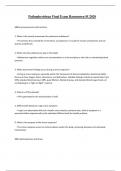
Pathophysiology Final Exam Rasmussen SU2020
### Key Assessments and Functions
1. What is the priority assessment for potassium imbalance?
- The primary focus should be on the heart, as potassium is crucial for muscle contractions and can
lead to arrhythmias.
2. What role does aldosterone play in the body?
- Aldosterone regulates sodium ion concentrations in urine and plays a vital role in maintaining blood
pressure.
3. What assessment findings occur during a stress response?
- During a stress response, especially within the framework of General Adaptation Syndrome (GAS),
there are three stages: Alarm, Resistance, and Exhaustion. Notable findings include increased heart rate
(HR), elevated blood pressure (BP), pupil dilation, dilated airways, and elevated blood sugar levels, all
contributing to a “fight or flight” reaction.
4. Where is ATP produced?
- ATP is generated in the mitochondria of cells.
5. Differentiate between a sign and a symptom.
- A sign is an observable effect of a health issue noted by someone else, while a symptom is a
perceived effect experienced by the individual afflicted with the health problem.
6. What is the purpose of the stress response?
- The stress response serves to restore balance within the body, achieving allostasis and ultimately
homeostasis.
### Catecholamines and Stress
,7. What effects do catecholamines have during a stress response?
- Catecholamines, which are neurotransmitters including epinephrine and norepinephrine, increase
heart rate, constrict blood vessels, relax bronchial smooth muscle (improving airflow), inhibit insulin
secretion (raising glucose levels), dilate pupils, decrease gastrointestinal (GI) motility, and elevate blood
pressure.
### Immunity and Cancer
8. How do vaccines enhance immunity?
- Vaccines simulate an infection, prompting the immune system to produce antibodies that can later
target the genuine pathogens, effectively training the immune response.
- Passive immunity involves the transfer of pre-formed antibodies through mechanisms like breast milk
or the placenta, while active immunity develops after exposure to a disease or vaccination.
9. What are examples of malignant cells?
- Types of malignant cells include:
- Carcinomas (epithelial origin)
- Sarcomas (nerve, bone, and muscle origin)
- Leukemias (white blood cells)
- Lymphomas (lymph nodes)
- Melanomas (skin)
- Hepatomas (liver)
10. What characteristics define benign tumors?
- Benign tumors typically do not pose an immediate threat to life, do not invade surrounding tissues or
metastasize, are well-encapsulated, closely resemble the tissue of origin, and tend to grow slowly.
### Immune Response and Inflammation
11. What are phagocytic monocytes known as?
- Phagocytic monocytes are referred to as macrophages.
, 12. What risk factors are associated with cancer?
- Nonmodifiable factors include genetics, age, a compromised immune system, and abnormalities in
tumor suppressor genes.
- Modifiable factors encompass tobacco use, obesity, excessive sun exposure (leading to skin cancer),
and sexual exposure to human papillomavirus (HPV) which can lead to cervical cancer.
13. What are prostaglandins?
- Prostaglandins are hormones that promote vasodilation and increased permeability at injury sites.
They regulate critical processes, including inflammation, blood flow, blood clot formation, and labor
induction, and they can intensify pain by increasing the sensitivity of pain receptors.
14. Where are prostaglandins synthesized?
- Prostaglandins are usually produced within tissues and act locally, arising from the cyclooxygenase
(COX) pathway, which converts arachidonic acid to prostaglandins.
15. What effects do prostaglandins have on the body?
- They cause vasodilation and enhanced vascular permeability at injury sites, regulate inflammation,
facilitate blood flow and clotting, promote labor, and heighten pain sensitivity.
### Signs of Inflammation and Allergies
16. What assessment findings characterize inflammation?
- Indicators of inflammation include:
- Redness due to increased blood flow
- Swelling (edema) resulting from fluid and protein accumulation
- Heat, also from increased blood flow
- Pain
- Loss of function
17. What causes elevated levels of IgE?
### Key Assessments and Functions
1. What is the priority assessment for potassium imbalance?
- The primary focus should be on the heart, as potassium is crucial for muscle contractions and can
lead to arrhythmias.
2. What role does aldosterone play in the body?
- Aldosterone regulates sodium ion concentrations in urine and plays a vital role in maintaining blood
pressure.
3. What assessment findings occur during a stress response?
- During a stress response, especially within the framework of General Adaptation Syndrome (GAS),
there are three stages: Alarm, Resistance, and Exhaustion. Notable findings include increased heart rate
(HR), elevated blood pressure (BP), pupil dilation, dilated airways, and elevated blood sugar levels, all
contributing to a “fight or flight” reaction.
4. Where is ATP produced?
- ATP is generated in the mitochondria of cells.
5. Differentiate between a sign and a symptom.
- A sign is an observable effect of a health issue noted by someone else, while a symptom is a
perceived effect experienced by the individual afflicted with the health problem.
6. What is the purpose of the stress response?
- The stress response serves to restore balance within the body, achieving allostasis and ultimately
homeostasis.
### Catecholamines and Stress
,7. What effects do catecholamines have during a stress response?
- Catecholamines, which are neurotransmitters including epinephrine and norepinephrine, increase
heart rate, constrict blood vessels, relax bronchial smooth muscle (improving airflow), inhibit insulin
secretion (raising glucose levels), dilate pupils, decrease gastrointestinal (GI) motility, and elevate blood
pressure.
### Immunity and Cancer
8. How do vaccines enhance immunity?
- Vaccines simulate an infection, prompting the immune system to produce antibodies that can later
target the genuine pathogens, effectively training the immune response.
- Passive immunity involves the transfer of pre-formed antibodies through mechanisms like breast milk
or the placenta, while active immunity develops after exposure to a disease or vaccination.
9. What are examples of malignant cells?
- Types of malignant cells include:
- Carcinomas (epithelial origin)
- Sarcomas (nerve, bone, and muscle origin)
- Leukemias (white blood cells)
- Lymphomas (lymph nodes)
- Melanomas (skin)
- Hepatomas (liver)
10. What characteristics define benign tumors?
- Benign tumors typically do not pose an immediate threat to life, do not invade surrounding tissues or
metastasize, are well-encapsulated, closely resemble the tissue of origin, and tend to grow slowly.
### Immune Response and Inflammation
11. What are phagocytic monocytes known as?
- Phagocytic monocytes are referred to as macrophages.
, 12. What risk factors are associated with cancer?
- Nonmodifiable factors include genetics, age, a compromised immune system, and abnormalities in
tumor suppressor genes.
- Modifiable factors encompass tobacco use, obesity, excessive sun exposure (leading to skin cancer),
and sexual exposure to human papillomavirus (HPV) which can lead to cervical cancer.
13. What are prostaglandins?
- Prostaglandins are hormones that promote vasodilation and increased permeability at injury sites.
They regulate critical processes, including inflammation, blood flow, blood clot formation, and labor
induction, and they can intensify pain by increasing the sensitivity of pain receptors.
14. Where are prostaglandins synthesized?
- Prostaglandins are usually produced within tissues and act locally, arising from the cyclooxygenase
(COX) pathway, which converts arachidonic acid to prostaglandins.
15. What effects do prostaglandins have on the body?
- They cause vasodilation and enhanced vascular permeability at injury sites, regulate inflammation,
facilitate blood flow and clotting, promote labor, and heighten pain sensitivity.
### Signs of Inflammation and Allergies
16. What assessment findings characterize inflammation?
- Indicators of inflammation include:
- Redness due to increased blood flow
- Swelling (edema) resulting from fluid and protein accumulation
- Heat, also from increased blood flow
- Pain
- Loss of function
17. What causes elevated levels of IgE?