Unit 4 – Learning Aim A Date: 07/01/2019
Programming – Assignment 1
Introduction:
In this assignment I will be examining and learning about computational skills and the principles of
computer programs. Subsequently, I will apply these computational skills to design, develop, test,
refine and review computer programs for a given range of purposes. Also, I will be analysing
problems and processes, in order to identify solutions that can possibly be developed into software
applications.
Identifying the four computation skills required:
I will now indicate the four useful computational skills that is strongly required when planning to
design, develop, test and review. These skills are highly considered and required to ensure that
problems are analysed and being able to identify and express solutions for further development on
software applications such as Adobe visual studio which would help make it effortless. Furthermore,
the computational thinking skills can be understood in four interlocking stages to boost the
awareness of how each of these works seamlessly.
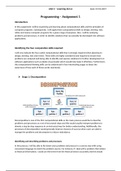
Stage 1: Decomposition
Decomposition is one of the first computational skills as the main process would be to describe
problems and processes as a set of structured steps and this would usually interpret problems to
denote a step by step sequence in an instructed way for better understanding. Additionally, the
processes of decomposition would generally improve chances of success when users are able to
manage the problems and decompose to reduce redundancy.
Identifying and describing problems and processes:
In this process, I will be able to list down every problem and process in a concise way with using
convenient language to match the problem source. For instance, if I deal with a problem that relates
to financial information, I could use the terms from the financial sector accurately and this would
, Unit 4 – Learning Aim A Date: 07/01/2019
imply that there will be familiarity of using the technical language used in the business sector that is
relevant to the main problem.
Breaking down problem and processes into distinct steps:
In addition, the next process when it comes to the process of decomposition is break complex ideas
down into smaller and controllable parts to make it easier to tackle when dealing with programming.
Occasionally, the term factoring is also common for this process. An example of the decomposition
process would be searching the sum of all numbers between 1 and 200 and this can be broken down
into smaller equations by adding 200 to 1 or 199 to 2 and the answer would always equal to 201.
Describing problems and processes as a set of structured steps:
Thirdly, the problems will be documented once they have been decomposed in structural steps. In
addition to this, this can be straightforward enough to be followed by others.
Communicating the key features of problems and processes to others:
Over here, the problems and processes will be further discussed with others. Additionally, this may
include other programmers or the client which they may be more into programming than beginners
and this would help develop knowledge. Once a complex problem is broken down, it will be much
more possible to start looking to see if there are any repeating patterns.
Stage 2: Pattern recognition
The next computational skill is pattern recognition and this process will have the ability to identify
and detect arrangements of data that produce information about systems or data sets. Besides, in
technological context, the ability of this thinking skill is that the attributes are seen to be recurred
within the same problem and between different problems that have been encounter and solved
earlier or before.
This process is based on five key steps.
- Diagnosing common features in systems: This step involves examining problems along with
arranging and listing each existent elements. Moreover, it also consists of selecting those
which already exist in multiple places and automatically recognizes these as pattern
sequences.
- Identifying and interpreting common differences between processes or problems: At this
stage, the process will involve examining problems and processes and listing elements or
features that exist in each process along with highlighting those that can be unique to each.
After, these will be recognized as differences.
Programming – Assignment 1
Introduction:
In this assignment I will be examining and learning about computational skills and the principles of
computer programs. Subsequently, I will apply these computational skills to design, develop, test,
refine and review computer programs for a given range of purposes. Also, I will be analysing
problems and processes, in order to identify solutions that can possibly be developed into software
applications.
Identifying the four computation skills required:
I will now indicate the four useful computational skills that is strongly required when planning to
design, develop, test and review. These skills are highly considered and required to ensure that
problems are analysed and being able to identify and express solutions for further development on
software applications such as Adobe visual studio which would help make it effortless. Furthermore,
the computational thinking skills can be understood in four interlocking stages to boost the
awareness of how each of these works seamlessly.
Stage 1: Decomposition
Decomposition is one of the first computational skills as the main process would be to describe
problems and processes as a set of structured steps and this would usually interpret problems to
denote a step by step sequence in an instructed way for better understanding. Additionally, the
processes of decomposition would generally improve chances of success when users are able to
manage the problems and decompose to reduce redundancy.
Identifying and describing problems and processes:
In this process, I will be able to list down every problem and process in a concise way with using
convenient language to match the problem source. For instance, if I deal with a problem that relates
to financial information, I could use the terms from the financial sector accurately and this would
, Unit 4 – Learning Aim A Date: 07/01/2019
imply that there will be familiarity of using the technical language used in the business sector that is
relevant to the main problem.
Breaking down problem and processes into distinct steps:
In addition, the next process when it comes to the process of decomposition is break complex ideas
down into smaller and controllable parts to make it easier to tackle when dealing with programming.
Occasionally, the term factoring is also common for this process. An example of the decomposition
process would be searching the sum of all numbers between 1 and 200 and this can be broken down
into smaller equations by adding 200 to 1 or 199 to 2 and the answer would always equal to 201.
Describing problems and processes as a set of structured steps:
Thirdly, the problems will be documented once they have been decomposed in structural steps. In
addition to this, this can be straightforward enough to be followed by others.
Communicating the key features of problems and processes to others:
Over here, the problems and processes will be further discussed with others. Additionally, this may
include other programmers or the client which they may be more into programming than beginners
and this would help develop knowledge. Once a complex problem is broken down, it will be much
more possible to start looking to see if there are any repeating patterns.
Stage 2: Pattern recognition
The next computational skill is pattern recognition and this process will have the ability to identify
and detect arrangements of data that produce information about systems or data sets. Besides, in
technological context, the ability of this thinking skill is that the attributes are seen to be recurred
within the same problem and between different problems that have been encounter and solved
earlier or before.
This process is based on five key steps.
- Diagnosing common features in systems: This step involves examining problems along with
arranging and listing each existent elements. Moreover, it also consists of selecting those
which already exist in multiple places and automatically recognizes these as pattern
sequences.
- Identifying and interpreting common differences between processes or problems: At this
stage, the process will involve examining problems and processes and listing elements or
features that exist in each process along with highlighting those that can be unique to each.
After, these will be recognized as differences.