6) Obstetrical history
Introduction
1. Introduce yourself to patient and include the name and role.
2. Confirm patients name and DOB.
3. Briefly explain what the examination involves in patient friendly language-
“today I need to examine your stomach, as part of the assessment of your
pregnancy, it will involve me looking at your stomach, in addition to preforming
some measurements. It shouldn’t be uncomfortable so at any point you would
like me to stop please let me know.
- offer a chaperone (accompanies a patient during examination of procedure.
4. gain consent to proceed the examination “do you understand everything I’ve
said, are you happy for me to care.
5. Patient positioned supine with head of the bed raised to 15 degrees.
6. Expose the abdomen from xiphisternum to the pubic symphysis.
7. Patient should have empty bladder.
GENERAL INSPECTION
- PAIN
- if patient appears uncomfortable, ask
where the pain is and if they are
happy for them to be examined.
- OBVIOUS SCARS
- May provide clues regarding previous
abdominal surgery(c-section)
- Pallor
- A pale colour of the skin that can
suggest underlying anaemia,
- Jaundice
- A yellowish pigmentation of the skin and whites of the eyes due to high
bilirubin levels (obstetric cholestasis)
- Oedema
- Small amount of oedema is normal in the later stages of pregnancy however if
widespread of oedema effecting the arms, legs, face, consider the possibility
of pre-eclampsia.
OBSTETRIC CHOLESTASIS= Multifactorial conduction characterised by abnormal liver
functioning test, jaundice and intense pruritis (typically affecting the palms and soals
of the feet), usually occurs in the third trimester and is associated with increased risk
of intrauterine death and premature delivery
HANDS
Inspect the hands for
- colour= pale hands suggest poor peripheral perfusion
- Peripheral oedema= may be normal finding in late pregnancy, but if
widespread consider pre-eclampsia, if suspect pre-eclampsia, check patients’
blood pressure and check urine analysis (check for proteinuria)
- Palmar erythema= redness involving heel of palm
Temperature
, - place dorsal aspect of your hand onto patient to assess temp.
- If healthy individual then hands should be symmetrically warm suggesting
adequate perfusion, if cool hands may suggest poor peripheral perfusion.
Capillary refill time
- Measure refill time in hands is a good way of checking peripheral perfusion.
1. apply 5 second of pressure to distal phalanx of one of patient’s fingers and
then release.
2. In healthy induvial, the area that you compress should return to normal colour
in less than two seconds.
3. A CRT of X>2 suggests poor peripheral perfusion.
RADIAL PULSE
- Palpate the patient’s radial pulse, located at the radial side of the wrist, once
located radial artery assess rate and rhythm.
Heart rate
Assessing heart rate:
- You can calculate the heart rate in several ways, including measuring for 60
seconds, measuring for 30 seconds and multiplying by 2 or measuring for 15
seconds and multiplying by 4.
- For irregular rhythms, you should measure the pulse for a full 60 seconds to
improve accuracy.
- Women typically have a higher baseline heart rate during pregnancy (80-90
beats per minute).
Face
Inspect the patient’s face for relevant clinical signs:
- Jaundice: superior portion of the sclera (ask the patient to look downwards as
you lift their upper eyelid). In the context of an obstetric abdominal
examination, it is most likely secondary to obstetric cholestasis.
- Melasma: benign dark and irregular hyperpigmented macules which are
normal in pregnancy.
- Oedema: may be a normal finding in late pregnancy, but if widespread
consider pre-eclampsia.
- Conjunctival pallor: ask the patient to gently pull down their lower eyelid to
allow you to inspect the conjunctiva for pallor. Conjunctival pallor is
associated with anaemia.
Abdominal inspection
Position the patient.
The recommended positioning for a patient during pregnancy varies, depending on
the current gestation:
- Early pregnancy: position the patient supine on the couch, with the head end
of the bed elevated to 15-30°.
- Late pregnancy: position the patient in the left lateral position (tilted 15° to
the horizontal level) to avoid compression of the abdominal aorta and inferior
vena cava by the gravid uterus (known as aortocaval compression).
Closely inspect the abdomen
Expose the abdomen appropriately, from the xiphisternum to the pubic symphysis
and inspect for relevant clinical signs:
- Abdominal shape: this may give an initial indication of the fetal lie.
- foetal movements: these are typically visible from 24 weeks gestation.
- Surgical scars: may provide clues regarding previous abdominal surgery (e.g.
caesarean section).
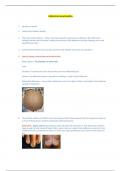
- Linea nigra: a dark line running vertically down the middle of the abdomen (a
normal finding in pregnancy).
- Striae gravidarum: reddish or purple lesions that develop due to
overstretching of the abdominal skin as the gravid uterus expands (commonly
referred to as stretch marks).
2
Introduction
1. Introduce yourself to patient and include the name and role.
2. Confirm patients name and DOB.
3. Briefly explain what the examination involves in patient friendly language-
“today I need to examine your stomach, as part of the assessment of your
pregnancy, it will involve me looking at your stomach, in addition to preforming
some measurements. It shouldn’t be uncomfortable so at any point you would
like me to stop please let me know.
- offer a chaperone (accompanies a patient during examination of procedure.
4. gain consent to proceed the examination “do you understand everything I’ve
said, are you happy for me to care.
5. Patient positioned supine with head of the bed raised to 15 degrees.
6. Expose the abdomen from xiphisternum to the pubic symphysis.
7. Patient should have empty bladder.
GENERAL INSPECTION
- PAIN
- if patient appears uncomfortable, ask
where the pain is and if they are
happy for them to be examined.
- OBVIOUS SCARS
- May provide clues regarding previous
abdominal surgery(c-section)
- Pallor
- A pale colour of the skin that can
suggest underlying anaemia,
- Jaundice
- A yellowish pigmentation of the skin and whites of the eyes due to high
bilirubin levels (obstetric cholestasis)
- Oedema
- Small amount of oedema is normal in the later stages of pregnancy however if
widespread of oedema effecting the arms, legs, face, consider the possibility
of pre-eclampsia.
OBSTETRIC CHOLESTASIS= Multifactorial conduction characterised by abnormal liver
functioning test, jaundice and intense pruritis (typically affecting the palms and soals
of the feet), usually occurs in the third trimester and is associated with increased risk
of intrauterine death and premature delivery
HANDS
Inspect the hands for
- colour= pale hands suggest poor peripheral perfusion
- Peripheral oedema= may be normal finding in late pregnancy, but if
widespread consider pre-eclampsia, if suspect pre-eclampsia, check patients’
blood pressure and check urine analysis (check for proteinuria)
- Palmar erythema= redness involving heel of palm
Temperature
, - place dorsal aspect of your hand onto patient to assess temp.
- If healthy individual then hands should be symmetrically warm suggesting
adequate perfusion, if cool hands may suggest poor peripheral perfusion.
Capillary refill time
- Measure refill time in hands is a good way of checking peripheral perfusion.
1. apply 5 second of pressure to distal phalanx of one of patient’s fingers and
then release.
2. In healthy induvial, the area that you compress should return to normal colour
in less than two seconds.
3. A CRT of X>2 suggests poor peripheral perfusion.
RADIAL PULSE
- Palpate the patient’s radial pulse, located at the radial side of the wrist, once
located radial artery assess rate and rhythm.
Heart rate
Assessing heart rate:
- You can calculate the heart rate in several ways, including measuring for 60
seconds, measuring for 30 seconds and multiplying by 2 or measuring for 15
seconds and multiplying by 4.
- For irregular rhythms, you should measure the pulse for a full 60 seconds to
improve accuracy.
- Women typically have a higher baseline heart rate during pregnancy (80-90
beats per minute).
Face
Inspect the patient’s face for relevant clinical signs:
- Jaundice: superior portion of the sclera (ask the patient to look downwards as
you lift their upper eyelid). In the context of an obstetric abdominal
examination, it is most likely secondary to obstetric cholestasis.
- Melasma: benign dark and irregular hyperpigmented macules which are
normal in pregnancy.
- Oedema: may be a normal finding in late pregnancy, but if widespread
consider pre-eclampsia.
- Conjunctival pallor: ask the patient to gently pull down their lower eyelid to
allow you to inspect the conjunctiva for pallor. Conjunctival pallor is
associated with anaemia.
Abdominal inspection
Position the patient.
The recommended positioning for a patient during pregnancy varies, depending on
the current gestation:
- Early pregnancy: position the patient supine on the couch, with the head end
of the bed elevated to 15-30°.
- Late pregnancy: position the patient in the left lateral position (tilted 15° to
the horizontal level) to avoid compression of the abdominal aorta and inferior
vena cava by the gravid uterus (known as aortocaval compression).
Closely inspect the abdomen
Expose the abdomen appropriately, from the xiphisternum to the pubic symphysis
and inspect for relevant clinical signs:
- Abdominal shape: this may give an initial indication of the fetal lie.
- foetal movements: these are typically visible from 24 weeks gestation.
- Surgical scars: may provide clues regarding previous abdominal surgery (e.g.
caesarean section).
- Linea nigra: a dark line running vertically down the middle of the abdomen (a
normal finding in pregnancy).
- Striae gravidarum: reddish or purple lesions that develop due to
overstretching of the abdominal skin as the gravid uterus expands (commonly
referred to as stretch marks).
2