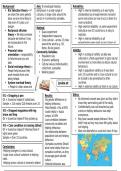
Background Aim: To investigate helping Reliability:
Kin Selection theory = If behaviours in a wide range of High in internal reliability as it was highly
we share the same genetic cultures, in large cities around the standardised as all experimenters received
base, we are more likely to world, in 4 community variables. same instructions on how to act so there it is
help even if it puts us in more consistent.
danger. Method: High external reliability as same experiment
Reciprocal altruism Quasi experiment took place over 23 countries so is easy to
theory = We help someone Independent measures replicate.
because we believe it may Cross cultural – across 23 cities High in internal reliability as all
be reciprocated in the around the world e.g., NY, experimenters were male so less chance of
future. Rome, Rio de Janeiro
Prosocial value Validity:
Community Variables
orientation = responsibility High in ecological validity as data was
Population size
to help because you are collected in a field experiment in ppts natural
Economic wellbeing
able. environment so more likely to obtain natural
Cultural values (individualistic,
Social exchange theory = behaviours.
collectivist, sympatia)
People help because they High in population validity as it was done
Walking speed
want rewards from ones over 23 countries and is cross-cultural so can
being helped. be trusted to be generalised to other
System overload theory Levine et countries.
= People in urban areas are High in external validity as there is no culture
less helpful than people in
IV1 = Dropping a pen Results: Ethics
DV = Scored as helped if called back. -No gender differences in No informed consent was given as they didn’t
Sample = 214 males/ 210 females over 23 helping behaviour. know they were taking part of the study.
countries. -Most helpful = Rio at 93% Confidentiality was not breached as ppts
IV2 = Dropped magazines with leg -Least helpful = Kuala scores on helping behaviour was kept
brace and limp Lumpur at 40% anonymous.
DV = Scored as helped if they picked up -Low correlation between May have caused people distress if they
magazines. community variables and didn’t help as they may have felt guilty about
IV3 = Cane condition at crossing (blind) not helping.
helping behaviour.
DV = Scored as helped if informed them if Were not debriefed so could not check if they
-No relationship between
lights were green. had any psychological harm.
population size and helping
Sample = Over 23 countries.
behaviour.
-Sympatia countries (Brazil)
Conclusions: were more helpful than non-
-Helping strangers is cross-cultural. sympatia countries, as they
-Large cross cultural variations in helping encourage good natured
rates. culture.
-Helping across cultures is inversely related -Helping behaviour was
to economic productivity.
Kin Selection theory = If behaviours in a wide range of High in internal reliability as it was highly
we share the same genetic cultures, in large cities around the standardised as all experimenters received
base, we are more likely to world, in 4 community variables. same instructions on how to act so there it is
help even if it puts us in more consistent.
danger. Method: High external reliability as same experiment
Reciprocal altruism Quasi experiment took place over 23 countries so is easy to
theory = We help someone Independent measures replicate.
because we believe it may Cross cultural – across 23 cities High in internal reliability as all
be reciprocated in the around the world e.g., NY, experimenters were male so less chance of
future. Rome, Rio de Janeiro
Prosocial value Validity:
Community Variables
orientation = responsibility High in ecological validity as data was
Population size
to help because you are collected in a field experiment in ppts natural
Economic wellbeing
able. environment so more likely to obtain natural
Cultural values (individualistic,
Social exchange theory = behaviours.
collectivist, sympatia)
People help because they High in population validity as it was done
Walking speed
want rewards from ones over 23 countries and is cross-cultural so can
being helped. be trusted to be generalised to other
System overload theory Levine et countries.
= People in urban areas are High in external validity as there is no culture
less helpful than people in
IV1 = Dropping a pen Results: Ethics
DV = Scored as helped if called back. -No gender differences in No informed consent was given as they didn’t
Sample = 214 males/ 210 females over 23 helping behaviour. know they were taking part of the study.
countries. -Most helpful = Rio at 93% Confidentiality was not breached as ppts
IV2 = Dropped magazines with leg -Least helpful = Kuala scores on helping behaviour was kept
brace and limp Lumpur at 40% anonymous.
DV = Scored as helped if they picked up -Low correlation between May have caused people distress if they
magazines. community variables and didn’t help as they may have felt guilty about
IV3 = Cane condition at crossing (blind) not helping.
helping behaviour.
DV = Scored as helped if informed them if Were not debriefed so could not check if they
-No relationship between
lights were green. had any psychological harm.
population size and helping
Sample = Over 23 countries.
behaviour.
-Sympatia countries (Brazil)
Conclusions: were more helpful than non-
-Helping strangers is cross-cultural. sympatia countries, as they
-Large cross cultural variations in helping encourage good natured
rates. culture.
-Helping across cultures is inversely related -Helping behaviour was
to economic productivity.