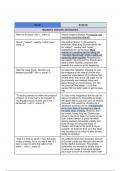
Quote Analysis
Macbeth’s character development
“Nave to th’chops” (Act 1, scene 2) Violent imagery displays his physical and
combative expertise/strength.
“Brave”, “valiant”, “worthy, “noble” (Act 1, The epithet “brave” in this extract is
scene 2) reinforced when King Duncan labels him
as “valiant”, “worthy” and “noble”,
highlighting him as the hero. He is
deemed in a positive light for killing the
“merciless Macdonald” whilst in battle yet
not for his other murders. Respected by
the captain, the king and his friends, and
loyal to them. Society condones and
rewards this violence at the beginning.
“Was the hope drunk, Wherein you LM asks this metaphor, implying he was
dressed yourself?” (Act 1, scene 7) the instigator of the idea of murder and
raised her expectations of the throne first,
not the other way round. LM urges him to
be physically and mentally brave and
follow through on his promises, not “like
the poor cat I’the’adage” - a cat that
wanted fish but didn’t want to get its paws
wet.
“To be king stands not within the prospect It’s only in his imagination that he can be
of belief, no more than to be Cawdor” & king as he thinks it’s impossible as kings
“my thought whose murder yet is but are appointed by god and can’t be forcibly
fantastical” - (Act 1, scene 3) removed. This would be shocking to a
Jacobean audience as it’s a transgressive
act to even think of moving up a step of
the great chain of being. However, from
the outset, being King and Cawdor are
linked in his mind. When he hears he has
been made Cawdor, it gives the weird
sisters prophecy immediate validity and
fuels his ego. As king and thane of
Cawdor are linked in his mind, if one is
possible, he believes then so is the other,
and therefore in his mind he feels he can
justify his ambition.
“That is a step on which I must fall down, His ambition faces two obstacles, Duncan
or else o’erleap, for in my way it lies” & “I & Duncan’s elder son Malcolm who would
have no spur to prick the sides of my be the rightful successor. This phrase
intent” – (Act 1, scene 5) personifies his intention to kill the king as
a horse who needs to be urged forward
(as a spur is worn on a horse riders’ heel
Macbeth’s character development
“Nave to th’chops” (Act 1, scene 2) Violent imagery displays his physical and
combative expertise/strength.
“Brave”, “valiant”, “worthy, “noble” (Act 1, The epithet “brave” in this extract is
scene 2) reinforced when King Duncan labels him
as “valiant”, “worthy” and “noble”,
highlighting him as the hero. He is
deemed in a positive light for killing the
“merciless Macdonald” whilst in battle yet
not for his other murders. Respected by
the captain, the king and his friends, and
loyal to them. Society condones and
rewards this violence at the beginning.
“Was the hope drunk, Wherein you LM asks this metaphor, implying he was
dressed yourself?” (Act 1, scene 7) the instigator of the idea of murder and
raised her expectations of the throne first,
not the other way round. LM urges him to
be physically and mentally brave and
follow through on his promises, not “like
the poor cat I’the’adage” - a cat that
wanted fish but didn’t want to get its paws
wet.
“To be king stands not within the prospect It’s only in his imagination that he can be
of belief, no more than to be Cawdor” & king as he thinks it’s impossible as kings
“my thought whose murder yet is but are appointed by god and can’t be forcibly
fantastical” - (Act 1, scene 3) removed. This would be shocking to a
Jacobean audience as it’s a transgressive
act to even think of moving up a step of
the great chain of being. However, from
the outset, being King and Cawdor are
linked in his mind. When he hears he has
been made Cawdor, it gives the weird
sisters prophecy immediate validity and
fuels his ego. As king and thane of
Cawdor are linked in his mind, if one is
possible, he believes then so is the other,
and therefore in his mind he feels he can
justify his ambition.
“That is a step on which I must fall down, His ambition faces two obstacles, Duncan
or else o’erleap, for in my way it lies” & “I & Duncan’s elder son Malcolm who would
have no spur to prick the sides of my be the rightful successor. This phrase
intent” – (Act 1, scene 5) personifies his intention to kill the king as
a horse who needs to be urged forward
(as a spur is worn on a horse riders’ heel