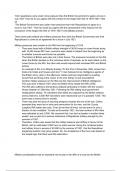
“Irish republicans were under more pressure than the British Government to agree a truce in
July 1921” How far do you agree with this verdict on the Anglo-Irish War of 1919-1921? (35)
Or
“The British Government was under more pressure than Irish Republicans to agree to a
truce in July 1921.” How far would you agree with this assessment of the reasons for the
conclusion of the Anglo-Irish War of 1919–1921? (35) (Modal answer)
There were both political and military pressures from both the British Government and Irish
Republicans to come to an agreement for a truce in July 1921.
Military pressures were evident in the IRA from the beginning of 1919.
- They were faced with a British military strength of 38,00 troops in crown forces along
with 10,000 armed RIC men; concerns were raised in Ireland from the beginning as
to whether success would even be possible.
- The tactics of Britain were also not in their favour. The pressures mounted on the IRA
when the British decided on the victorious tactic of reprisals, as for each attack on the
crown forces by the IRA, the other side would respond with increased RIC and British
activity.
An example of this is on Bloody Sunday. On the 21st of November 1920, armed men
broke into hotels and houses and shot 11 men believed to be intelligence agents of
the British Army. Later in the afternoon, blacks and tans responded by invading
Crook Park and firing at the crowd. In the end, killing 12 and wounded 60.
Another military pressure on the IRA was the improvement of British intelligence.
This was seen in March 1921 when the British Army raided the IRA’s GHQ.
- The IRA also suffered a tremendous setback particularly in Dublin with the Custom
House disaster on 25th May 1921. Following the IRA setting local government
headquarters ablaze, 70 volunteers were killed and captured by the British soldiers,
and by that time, 5,500 IRA Volunteers were imprisoned out of a possible 7,500. This
event was a serious blow to morale.
- There was also the issue of securing weapons towards the end of the war. Collins
assessed they were low in arms and ammunition for his men, and the County
Langford IRA leader also said, “Even at the best of times, we had arms for only a
fraction of men available.” As late as November 1921, the total number of IRA rifles
was estimated at only 3,000. His comment that “you had us beaten in another three
weeks” was no jest but a serious indictment of Republican military strength by the
summer of 1921.
- Therefore, Collins was aware that the military balance was shifting in favour of the
British, with an estimated 3,000 men on active service, facing the combined police
and military force in excess of 40,000 by the summer of 1921, that the Republican
bargaining position may grow weaker. So, his acceptance of the truce was based on
the simple logic that there was little alternative.
Military considerations had an important role to play in the offer of a truce by the British.
July 1921” How far do you agree with this verdict on the Anglo-Irish War of 1919-1921? (35)
Or
“The British Government was under more pressure than Irish Republicans to agree to a
truce in July 1921.” How far would you agree with this assessment of the reasons for the
conclusion of the Anglo-Irish War of 1919–1921? (35) (Modal answer)
There were both political and military pressures from both the British Government and Irish
Republicans to come to an agreement for a truce in July 1921.
Military pressures were evident in the IRA from the beginning of 1919.
- They were faced with a British military strength of 38,00 troops in crown forces along
with 10,000 armed RIC men; concerns were raised in Ireland from the beginning as
to whether success would even be possible.
- The tactics of Britain were also not in their favour. The pressures mounted on the IRA
when the British decided on the victorious tactic of reprisals, as for each attack on the
crown forces by the IRA, the other side would respond with increased RIC and British
activity.
An example of this is on Bloody Sunday. On the 21st of November 1920, armed men
broke into hotels and houses and shot 11 men believed to be intelligence agents of
the British Army. Later in the afternoon, blacks and tans responded by invading
Crook Park and firing at the crowd. In the end, killing 12 and wounded 60.
Another military pressure on the IRA was the improvement of British intelligence.
This was seen in March 1921 when the British Army raided the IRA’s GHQ.
- The IRA also suffered a tremendous setback particularly in Dublin with the Custom
House disaster on 25th May 1921. Following the IRA setting local government
headquarters ablaze, 70 volunteers were killed and captured by the British soldiers,
and by that time, 5,500 IRA Volunteers were imprisoned out of a possible 7,500. This
event was a serious blow to morale.
- There was also the issue of securing weapons towards the end of the war. Collins
assessed they were low in arms and ammunition for his men, and the County
Langford IRA leader also said, “Even at the best of times, we had arms for only a
fraction of men available.” As late as November 1921, the total number of IRA rifles
was estimated at only 3,000. His comment that “you had us beaten in another three
weeks” was no jest but a serious indictment of Republican military strength by the
summer of 1921.
- Therefore, Collins was aware that the military balance was shifting in favour of the
British, with an estimated 3,000 men on active service, facing the combined police
and military force in excess of 40,000 by the summer of 1921, that the Republican
bargaining position may grow weaker. So, his acceptance of the truce was based on
the simple logic that there was little alternative.
Military considerations had an important role to play in the offer of a truce by the British.