

ANIMAL RESPONSES Fight or flight
- Threat detected by autonomic nervous system
Nervous system - Sympathetic pathway = neuronal pathway
Central nervous system = brain, spinal cord - Adrenal-cortical system = hormonal pathway
Peripheral = neuros connect CNS to body (sensory, motor)
> Somatic = conscious control
> Autonomic = subcon, to gland, smooth + cardiac mus
> Sympathetic = outcome ↑ activity (f or f)
> Parasympathetic = outcome ↓ activity
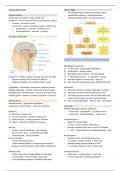
Structure of the brain
Physiological responses:
1) ↑ heart rate – pump oxygenated blood
2) Pupils dilate – improve vision
3) Arterioles in skin constrict – to major organs
Cerebrum = voluntary action, learning, memory, thoughts 4) ↑ blood glucose conc - ↑ respiration + energy
- Receives sensory info, send out to effector 5) Smooth muscles in airway relax – more O2
- Highly convoluted = SA, cerebral cortex = outer 6) Non essential systems shut down, difficulty focusing
Cerebellum = coordinates unconscious, balance, posture Adrenaline
Medulla oblongata = controls autonomic, heart, breathe 1) Adrenaline binds to receptor (hydrophil = surface)
Hypothalamus = blood monitor, hormone, sym/parasymp 2) Activates G protein, activates adenylyl cyclase
Pituitary gland = anterior = produce, posterior = store/rel 3) Activated enzyme converts ATP to cAMP which acts
as second messenger (cascade), protein kinase
Reflex actions 4) Liver cells glycogenolysis – gluc for resp + contraction
Skeletal muscle – rapid short contractions
Involuntary smooth muscle – slow over long time Heart rate
Medulla oblongata controls, autonomic
Reflex arc - ↑ heart rate – sympathetic – accelerator nerve
1) Receptor = stimuli + AP - ↓ heart rate – parasympathetic – vagus nerve
2) Sensory neurone = impulse to spinal cord
3) Relay neurone = connects sensory to motor Chemoreceptors
4) Motor = impulse to effector for response - Detect pH change (CO2)
- ↑ CO2 ↓ pH as carbonic acid formed
Survival - Low pH increases heart rate = more CO2 exhaled
- Reduce severity of damage + not overload - ↓ CO2, ↓ freq impulses to medulla oblongata + SAN
- Don’t have to learn – immediate protection
- Extremely fast – only 2 synapses Baroreceptors
Knew jerk reflex - In wall of aorta, detects blood pressure
- Circuit only to spinal cord - ↑ pressure, impulses to MO ↓ heart rate
- Helps maintain posture + balance subconsciously - Impulses along parasympathetic to SAN
- Extensor muscle contracts, relay inhibits antagonistic - ↓ pressure, impulses to MO ↑ heart rate
Blinking reflex Hormonal control
- Cornea stimulated, foreign bodies, sounds, light - Adrenaline + noradrenaline ↑ heart rate
- Cranial reflex = occurs in brain, consensual - ↑ freq of impulses by SAN (pacemaker)
- Test unconscious patients / whether brain dead
- Threat detected by autonomic nervous system
Nervous system - Sympathetic pathway = neuronal pathway
Central nervous system = brain, spinal cord - Adrenal-cortical system = hormonal pathway
Peripheral = neuros connect CNS to body (sensory, motor)
> Somatic = conscious control
> Autonomic = subcon, to gland, smooth + cardiac mus
> Sympathetic = outcome ↑ activity (f or f)
> Parasympathetic = outcome ↓ activity
Structure of the brain
Physiological responses:
1) ↑ heart rate – pump oxygenated blood
2) Pupils dilate – improve vision
3) Arterioles in skin constrict – to major organs
Cerebrum = voluntary action, learning, memory, thoughts 4) ↑ blood glucose conc - ↑ respiration + energy
- Receives sensory info, send out to effector 5) Smooth muscles in airway relax – more O2
- Highly convoluted = SA, cerebral cortex = outer 6) Non essential systems shut down, difficulty focusing
Cerebellum = coordinates unconscious, balance, posture Adrenaline
Medulla oblongata = controls autonomic, heart, breathe 1) Adrenaline binds to receptor (hydrophil = surface)
Hypothalamus = blood monitor, hormone, sym/parasymp 2) Activates G protein, activates adenylyl cyclase
Pituitary gland = anterior = produce, posterior = store/rel 3) Activated enzyme converts ATP to cAMP which acts
as second messenger (cascade), protein kinase
Reflex actions 4) Liver cells glycogenolysis – gluc for resp + contraction
Skeletal muscle – rapid short contractions
Involuntary smooth muscle – slow over long time Heart rate
Medulla oblongata controls, autonomic
Reflex arc - ↑ heart rate – sympathetic – accelerator nerve
1) Receptor = stimuli + AP - ↓ heart rate – parasympathetic – vagus nerve
2) Sensory neurone = impulse to spinal cord
3) Relay neurone = connects sensory to motor Chemoreceptors
4) Motor = impulse to effector for response - Detect pH change (CO2)
- ↑ CO2 ↓ pH as carbonic acid formed
Survival - Low pH increases heart rate = more CO2 exhaled
- Reduce severity of damage + not overload - ↓ CO2, ↓ freq impulses to medulla oblongata + SAN
- Don’t have to learn – immediate protection
- Extremely fast – only 2 synapses Baroreceptors
Knew jerk reflex - In wall of aorta, detects blood pressure
- Circuit only to spinal cord - ↑ pressure, impulses to MO ↓ heart rate
- Helps maintain posture + balance subconsciously - Impulses along parasympathetic to SAN
- Extensor muscle contracts, relay inhibits antagonistic - ↓ pressure, impulses to MO ↑ heart rate
Blinking reflex Hormonal control
- Cornea stimulated, foreign bodies, sounds, light - Adrenaline + noradrenaline ↑ heart rate
- Cranial reflex = occurs in brain, consensual - ↑ freq of impulses by SAN (pacemaker)
- Test unconscious patients / whether brain dead


