100% satisfaction guarantee Immediately available after payment Both online and in PDF No strings attached 4.2 TrustPilot
logo-home
Exam (elaborations)

AQA GCSE Chemistry - Crude Oil Already Rated A+

Rating
-
Sold
-
Pages
4
Grade
A+
Uploaded on
11-07-2024
Written in
2023/2024

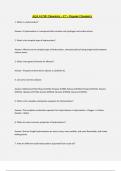
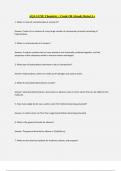
AQA GCSE Chemistry - Crude Oil Already Rated A+ 1. What is crude oil, and what does it consist of? Answer: Crude oil is a mixture of a very large number of compounds, primarily consisting of hydrocarbons. 2. What is a characteristic of a mixture? Answer: A mixture contains two or more elements not chemically combined together, and the properties of the substances within a mixture remain unchanged. 3. What type of hydrocarbons dominate crude oil composition? Answer: Hydrocarbons, which are made up of hydrogen and carbon atoms. 4. What do saturated hydrocarbons contain? Answer: Saturated hydrocarbons, also known as alkanes, have no more atoms that can be added to the molecule. 5. How many single bonds can a carbon atom form before becoming saturated? Answer: A carbon atom can form four single bonds before becoming saturated. 6. What is the general formula for alkenes? Answer: The general formula for alkenes is C(n)H(2n+n). 7. What are the chemical symbols for methane, ethane, and propane? Answer: CH4, C2H6, and C3H8, respectively. 8. How can crude oil be separated? Answer: Crude oil can be separated through fractional distillation. 9. Why does distillation work? Answer: Different molecules have different boiling points, allowing them to be separated through distillation. 10. What is crude oil separated into during distillation? Answer: Crude oil is separated into fractions during distillation. 11. Which part of the distillation column is coolest? Answer: The top part of the distillation column is typically coolest. 12. Which hydrocarbons condense highest up the column? Answer: Those with the smallest molecules condense highest up the column. 13. Which fractions have the lowest boiling points? Answer: Those with the shortest chains have the lowest boiling points. 14. What happens to viscosity and flammability as chain length increases? Answer: As chain length increases, viscosity increases (becomes thicker) and flammability decreases. 15. What two elements do most fuels contain? Answer: Carbon and/or hydrogen, although they may also contain small amounts of sulfur. 16. What reaction occurs during combustion? Answer: The reaction between fuel and oxygen in the air produces oxides and releases energy. 17. What happens to elements in fuel during combustion? Answer: During combustion, the elements in the fuel are converted into their oxides. 18. What happens during the combustion of hydrocarbon fuels? Answer: Energy is released during the combustion of hydrocarbon fuels. What happens to carbon and hydrogen in fuels? (They are) oxidised What gasses are often released during complete combustion? Carbon dioxide, water vapour, sulphur dioxide, nitrogen oxide What gasses are often released during incomplete combustion? Carbon monoxide, water vapour, sulphur dioxide, nitrogen oxide, (particulates) What causes acid rain? Sulphur dioxide (and) nitrogen oxides

Show more Read less


Whoops! We can’t load your doc right now. Try again or contact support.

Document information

Uploaded on
July 11, 2024
Number of pages
4
Written in
2023/2024
Type
Exam (elaborations)
Contains
Questions & answers

Subjects

Content preview

AQA GCSE Chemistry - Crude Oil Already Rated A+
1. What is crude oil, and what does it consist of?


Answer: Crude oil is a mixture of a very large number of compounds, primarily consisting of
hydrocarbons.


2. What is a characteristic of a mixture?


Answer: A mixture contains two or more elements not chemically combined together, and the
properties of the substances within a mixture remain unchanged.


3. What type of hydrocarbons dominate crude oil composition?


Answer: Hydrocarbons, which are made up of hydrogen and carbon atoms.


4. What do saturated hydrocarbons contain?


Answer: Saturated hydrocarbons, also known as alkanes, have no more atoms that can be added to the
molecule.


5. How many single bonds can a carbon atom form before becoming saturated?


Answer: A carbon atom can form four single bonds before becoming saturated.


6. What is the general formula for alkenes?


Answer: The general formula for alkenes is C(n)H(2n+n).


7. What are the chemical symbols for methane, ethane, and propane?
Get to know the seller

Seller avatar
Reputation scores are based on the amount of documents a seller has sold for a fee and the reviews they have received for those documents. There are three levels: Bronze, Silver and Gold. The better the reputation, the more your can rely on the quality of the sellers work.
bestscores1 Kent State University
View profile
Follow You need to be logged in order to follow users or courses
Sold
12
Member since
1 year
Number of followers
0
Documents
1369
Last sold
6 days ago
ReadEase

Welcome to ReadEase, your ultimate resource for exam preparation. At ReadEase, we specialize in providing comprehensive study materials and resources to help you excel in your exams. Whether you're preparing for standardized tests, professional certifications, or academic assessments, our finely curated collection covers a wide range of subjects and levels. From practice tests and study guides to expert tips and strategies, we're here to support your journey to success. ReadEase is committed to availing high-quality educational content, helping you thrive and achieve your academic and professional goals. Have any questions? We're just a message away.

Read more Read less
4.3

4 reviews

5
2
4
1
3
1
2
0
1
0

Recently viewed by you

Why students choose Stuvia

Created by fellow students, verified by reviews

Quality you can trust: written by students who passed their exams and reviewed by others who've used these revision notes.

Didn't get what you expected? Choose another document

No problem! You can straightaway pick a different document that better suits what you're after.

Pay as you like, start learning straight away

No subscription, no commitments. Pay the way you're used to via credit card and download your PDF document instantly.

Student with book image

“Bought, downloaded, and smashed it. It really can be that simple.”

Alisha Student

Frequently asked questions