100% satisfaction guarantee Immediately available after payment Both online and in PDF No strings attached 4.2 TrustPilot
logo-home
Exam (elaborations)

Chemistry- Energy

Rating
-
Sold
-
Pages
3
Grade
A+
Uploaded on
10-07-2024
Written in
2023/2024

Chemistry- Energy Energy Energy is the ability to do work, or the force that moves an object in the direction of the force. There are various forms of energy, including chemical, thermal, electromagnetic, heat, mechanical, and nuclear. Chemical Energy Chemical energy is released or absorbed in a chemical reaction. This energy can be transferred from one substance to another through chemical reactions, such as combustion or oxidation. Electrical Energy Electrical energy is the flow of electrons, or moving electrons. It is a form of energy that is often used to power devices and machines. Forms of Energy There are two main types of energy: potential energy and kinetic energy. Potential energy is stored energy found in objects at rest, while kinetic energy is the energy associated with motion. Nuclear Energy Nuclear energy is released when a nucleus breaks up into smaller nuclei or when smaller nuclei unite to form a larger nucleus. This process involves the conversion of mass into energy, as described by Einstein's famous equation E=mc^2. Thermodynamics Temperature is a measure of the average kinetic energy of molecules. The higher the temperature, the more kinetic energy the molecules have. The lower the temperature, the less kinetic energy they have. Chemical Reactions A chemical reaction is any process that rearranges the atoms of one or more substances to form a new substance. Chemical reactions can release or absorb energy, depending on whether they are exothermic or endothermic. Heat Transfer Heat transfer occurs when there is a temperature difference between two systems. In a laboratory setting, heat flows from a hotter substance to a cooler substance until they reach thermal equilibrium. Measuring Energy Energy is typically measured in joules (1 kilojoule = 1,000 joules). The boiling point and freezing point of water are fixed points on a thermometer and are used as reference points for temperature measurements. What term is defined as a measure of the average kinetic energy of the particles in a sample of matter? ️Temperature Ice (solid) -> water (liquid) -> vapor (gas). This is what type of process? ️An endothermic process (heat is taken in) Energy is measured in what? ️Joules An increase in temperature is an increase in which type of energy? ️Kinetic Solids have the most/least amount of energy? ️Least Heat of what is the amount of heat needed to change the solid (ice) to a liquid (water) at constant temperature. ️Fusion How many Joules per gram does Heat of Fusion use? ️334 J/g How many joules per gram does Heat of Vaporization use? ️2260 J/g What is the formula for Heat of Fusion? ️q=mHf What is the formula for Heat of Vaporization? ️q=mHv Heat of what is the amount of heat needed to change liquid into water vapor at a constant temperature. ️Vaporization In a solid, the particles are very what together, therefore the distance between the particles or molecules (intermolecular distance) is very small ️Very close together In a liquid, the particles are very what together and the intermolecular distance is very small. ️Very close together In a gas, the particles are what, therefore, intermolecular distance is very large. ️A

Show more Read less


Whoops! We can’t load your doc right now. Try again or contact support.

Document information

Uploaded on
July 10, 2024
Number of pages
3
Written in
2023/2024
Type
Exam (elaborations)
Contains
Questions & answers

Content preview

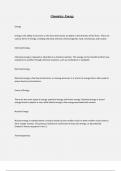
Chemistry- Energy


Energy


Energy is the ability to do work, or the force that moves an object in the direction of the force. There are
various forms of energy, including chemical, thermal, electromagnetic, heat, mechanical, and nuclear.


Chemical Energy


Chemical energy is released or absorbed in a chemical reaction. This energy can be transferred from one
substance to another through chemical reactions, such as combustion or oxidation.


Electrical Energy


Electrical energy is the flow of electrons, or moving electrons. It is a form of energy that is often used to
power devices and machines.


Forms of Energy


There are two main types of energy: potential energy and kinetic energy. Potential energy is stored
energy found in objects at rest, while kinetic energy is the energy associated with motion.


Nuclear Energy


Nuclear energy is released when a nucleus breaks up into smaller nuclei or when smaller nuclei unite to
form a larger nucleus. This process involves the conversion of mass into energy, as described by
Einstein's famous equation E=mc^2.


Thermodynamics
Get to know the seller

Seller avatar
Reputation scores are based on the amount of documents a seller has sold for a fee and the reviews they have received for those documents. There are three levels: Bronze, Silver and Gold. The better the reputation, the more your can rely on the quality of the sellers work.
bestscores1 Kent State University
View profile
Follow You need to be logged in order to follow users or courses
Sold
12
Member since
1 year
Number of followers
0
Documents
1369
Last sold
2 weeks ago
ReadEase

Welcome to ReadEase, your ultimate resource for exam preparation. At ReadEase, we specialize in providing comprehensive study materials and resources to help you excel in your exams. Whether you're preparing for standardized tests, professional certifications, or academic assessments, our finely curated collection covers a wide range of subjects and levels. From practice tests and study guides to expert tips and strategies, we're here to support your journey to success. ReadEase is committed to availing high-quality educational content, helping you thrive and achieve your academic and professional goals. Have any questions? We're just a message away.

Read more Read less
4.3

4 reviews

5
2
4
1
3
1
2
0
1
0

Recently viewed by you

Why students choose Stuvia

Created by fellow students, verified by reviews

Quality you can trust: written by students who passed their exams and reviewed by others who've used these revision notes.

Didn't get what you expected? Choose another document

No problem! You can straightaway pick a different document that better suits what you're after.

Pay as you like, start learning straight away

No subscription, no commitments. Pay the way you're used to via credit card and download your PDF document instantly.

Student with book image

“Bought, downloaded, and smashed it. It really can be that simple.”

Alisha Student

Frequently asked questions