
• Wrong document? Swap it for free
  • Written by students who passed
  • Immediately available after payment
  • Read online or as PDF
Sell
Where do you study
Your language
Start selling Create your account
Document preview thumbnail
Preview 2 out of 7 pages
Exam (elaborations)

Physics IGCSE – Electricity Complete Answers

Document preview thumbnail
Preview 2 out of 7 pages

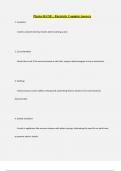
Physics IGCSE – Electricity Complete Answers 1. Insulation - Used to prevent electrical shocks when touching a wire. 2. Circuit Breakers - Break the circuit if the current exceeds a safe limit, using an electromagnet to trip a mechanism. 3. Earthing - Directs excess current safely to the ground, preventing electric shocks if a live wire becomes disconnected. 4. Double Insulation - Found in appliances like vacuum cleaners with plastic casings, eliminating the need for an earth wire to prevent electric shocks. 5. Current - Defined as the rate of flow of electric charge. 6. Current in Metals - Involves the flow of negatively charged electrons. 7. Measurement of Current - Measured in Amperes (A) using an ammeter. 8. Conductors - Materials that allow electric current to flow through them. 9. Equation for Charge - Charge equals current multiplied by time. 10. Voltage - Represents the energy transferred per unit charge. 11. Potential Difference - Another term for voltage. 12. Measurement of Voltage - Measured in Volts (V) using a voltmeter. 13. Relation between Coulombs and Voltage

Content preview

Physics IGCSE – Electricity Complete Answers
1. Insulation


- Used to prevent electrical shocks when touching a wire.


2. Circuit Breakers


- Break the circuit if the current exceeds a safe limit, using an electromagnet to trip a mechanism.


3. Earthing


- Directs excess current safely to the ground, preventing electric shocks if a live wire becomes


disconnected.


4. Double Insulation


- Found in appliances like vacuum cleaners with plastic casings, eliminating the need for an earth wire


to prevent electric shocks.

, 5. Current


- Defined as the rate of flow of electric charge.


6. Current in Metals


- Involves the flow of negatively charged electrons.


7. Measurement of Current


- Measured in Amperes (A) using an ammeter.


8. Conductors


- Materials that allow electric current to flow through them.


9. Equation for Charge

Document information

Uploaded on
July 9, 2024
Number of pages
7
Written in
2023/2024
Type
Exam (elaborations)
Contains
Questions & answers
£8.06

Wrong document? Swap it for free Within 14 days of purchase and before downloading, you can choose a different document. You can simply spend the amount again.
Written by students who passed
Immediately available after payment
Read online or as PDF

Seller avatar
Reputation scores are based on the amount of documents a seller has sold for a fee and the reviews they have received for those documents. There are three levels: Bronze, Silver and Gold. The better the reputation, the more your can rely on the quality of the sellers work.
bestscores1
4.4
(5)
Sold
20
Followers
0
Items
1369
Last sold
1 month ago


Why students choose Stuvia

Created by fellow students, verified by reviews

Quality you can trust: written by students who passed their exams and reviewed by others who've used these revision notes.

Didn't get what you expected? Choose another document

No problem! You can straightaway pick a different document that better suits what you're after.

Pay as you like, start learning straight away

No subscription, no commitments. Pay the way you're used to via credit card and download your PDF document instantly.

Student with book image

“Bought, downloaded, and smashed it. It really can be that simple.”

Alisha Student

Working on your references?

Create accurate citations in APA, MLA and Harvard with our free citation generator.

Working on your references?

Frequently asked questions
