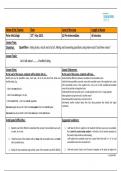
Name of the Teacher Date Level of the class Length of lesson
Peter McCullagh 25th, May 2023. A2 Pre-Intermediate. 60 minutes.
Lesson Type:
Grammar. Quantifiers - Using many, much and a lot of. Asking and answering questions using How much? and How many?
Lesson Topic:
Let’s talk about …………Healthy Eating.
Lesson Aims: Lesson Outcomes:
By the end of the lesson, students will be better able to… By the end of the lesson, students will have…
Identify and use the quantifiers many, much and a lot of to talk about food, drinks and Understood the difference between countable and uncountable nouns.
healthy eating. E.g. Used the three quantifiers correctly: many with countable nouns in the negative form, much
with uncountable nouns in the negative form, and a lot of with countable/uncountable
- I don’t eat many biscuits. nouns in the positive and negative forms.
Understood that not many/not much = a small quantity and a lot of = a large quantity
- I don’t have much sugar in my tea. Asked questions using How much? and how many?
Answered questions using many, much and a lot of.
+ I drink a lot of milk. - I don’t eat a lot of vegetables.
Interviewed another student about their diet using questions that include the target
How many apples do you eat? I don’t eat many apples/I don’t eat a lot of apples. vocabulary.
How much juice do you drink? I don’t drink much juice. I drink a lot of juice.
Anticipated difficulties: Suggested solutions:
1. Students may find it difficult to understand the concept of uncountable nouns such 1. I will take the time to explain to the students that these nouns are uncountable,
as water, air or sand. they cannot be counted using numbers. I will write a list of common examples on
the board to help reinforce understanding.
2. I think that some of the students will use many with uncountable nouns, and much I will explain that countable nouns have a plural form that ends in ‘s’ or ‘es’ and
with countable nouns. uncountable nouns have no plural form.
3. During the free production stage activity, some of the students may find it difficult 2. I will write several ‘correct’ and ‘incorrect’ examples on the board to explain the
1 Lesson Plan
, to construct questions and answers. rules. E.g., many water, much apples. I will use the board and the picture cards to
reinforce the many + countable noun and the much + uncountable noun rules.
3. I will work closely with any struggling students. I will direct their attention to the
example questions and answers on the board. I will show the student how to form a
question by breaking it down into parts. E.g., How many …….. do you …….. every
day? Do you eat a lot of ……. ? No, I don’t eat a lot of …….. . I will explain to the
students that they can use the vocabulary on the picture cards, (water, pizza,
sweets etc) to help form their questions and answers. I will encourage students to
work together and help each other. During the production stage I will be going
around the class and providing help and support, and plenty of praise when the
students form correct questions and answers.
Target language analysis:
1. What is the use or function of this language? Many, much and a lot of are quantifiers. They are used to talk about a small/large number of something, and a small/large
(Include a timeline if appropriate) amount of something. For example, ‘I don’t have many friends’ means ‘I have a small number of friends’ or ‘I don’t have a
large number of friends.’
2. In which context are you introducing the I am introducing the target language in the context of healthy eating. I want the students to think, read and write about which
language? foods and drinks are healthy and which are unhealthy.
2 Lesson Plan
, 3. Which concept checking questions will you ask Many
to ensure students understand the meaning? Sentence with many. ‘There aren’t many biscuits in the cupboard.’
CCQ1. Is this a positive or a negative sentence? (Negative)
CCQ2. Do I need to get more biscuits? (Yes)
CCQ3. Can we count the number of biscuits? (Yes)
Much
Sentence with much. ‘There isn’t much juice in the fridge.’
CCQ1. Is this a positive or a negative sentence? (Negative)
CCQ2. Do I need to buy more juice? (Yes)
CCQ3. Can we count the amount of juice? (No)
A lot of. Sentence with a lot of? (Positive form)
‘Luca eats a lot of burgers.’
CCQ1. Is this a positive or a negative sentence. (Positive)
CCQ2. Does Luca eat a small or large number of burgers? (Large)
CCQ3. Does Luca need to eat more burgers? (No)
A lot of. Sentence with a lot of (Negative form)
‘Paolo doesn’t drink a lot of water.’
CCQ1. Is this a positive or a negative sentence? (Negative)
CCQ2. Does Paolo drink a small or a large amount of water) (Small?
CCQ3. Does Paolo need to drink more water? (Yes)
4. What is the form of the target language? Negative form ‘not many’ + countable noun, ‘not much’ + uncountable noun.
(Include positive, negative and question forms Positive form ‘a lot of’ + countable noun, ‘a lot of’ + uncountable noun.
if appropriate) Negative form ‘a lot of’ + countable noun, ‘a lot of’ + uncountable noun.
Question form. “How many” + countable nouns, “How much” + uncountable noun.
5. How will your students work out the rules for I will use a deductive approach to enable students to work out and internalize the grammar rules. I will use the board and
the structure? picture cards (Fig. 1) to explain the concept of countable and uncountable nouns.
I will again use the board and the picture cards as props to introduce the quantifiers and how they link with countable and
uncountable nouns. During the presentation stage I will demonstrate how to correctly form sentences that include the target
vocabulary. E.g., I don’t eat much fruit. I will use my voice to emphasize the TV. I will elicit similar sentences from the students.
The students will complete a range of speaking and writing activities to help them learn and internalise the grammar rules.
3 Lesson Plan
Peter McCullagh 25th, May 2023. A2 Pre-Intermediate. 60 minutes.
Lesson Type:
Grammar. Quantifiers - Using many, much and a lot of. Asking and answering questions using How much? and How many?
Lesson Topic:
Let’s talk about …………Healthy Eating.
Lesson Aims: Lesson Outcomes:
By the end of the lesson, students will be better able to… By the end of the lesson, students will have…
Identify and use the quantifiers many, much and a lot of to talk about food, drinks and Understood the difference between countable and uncountable nouns.
healthy eating. E.g. Used the three quantifiers correctly: many with countable nouns in the negative form, much
with uncountable nouns in the negative form, and a lot of with countable/uncountable
- I don’t eat many biscuits. nouns in the positive and negative forms.
Understood that not many/not much = a small quantity and a lot of = a large quantity
- I don’t have much sugar in my tea. Asked questions using How much? and how many?
Answered questions using many, much and a lot of.
+ I drink a lot of milk. - I don’t eat a lot of vegetables.
Interviewed another student about their diet using questions that include the target
How many apples do you eat? I don’t eat many apples/I don’t eat a lot of apples. vocabulary.
How much juice do you drink? I don’t drink much juice. I drink a lot of juice.
Anticipated difficulties: Suggested solutions:
1. Students may find it difficult to understand the concept of uncountable nouns such 1. I will take the time to explain to the students that these nouns are uncountable,
as water, air or sand. they cannot be counted using numbers. I will write a list of common examples on
the board to help reinforce understanding.
2. I think that some of the students will use many with uncountable nouns, and much I will explain that countable nouns have a plural form that ends in ‘s’ or ‘es’ and
with countable nouns. uncountable nouns have no plural form.
3. During the free production stage activity, some of the students may find it difficult 2. I will write several ‘correct’ and ‘incorrect’ examples on the board to explain the
1 Lesson Plan
, to construct questions and answers. rules. E.g., many water, much apples. I will use the board and the picture cards to
reinforce the many + countable noun and the much + uncountable noun rules.
3. I will work closely with any struggling students. I will direct their attention to the
example questions and answers on the board. I will show the student how to form a
question by breaking it down into parts. E.g., How many …….. do you …….. every
day? Do you eat a lot of ……. ? No, I don’t eat a lot of …….. . I will explain to the
students that they can use the vocabulary on the picture cards, (water, pizza,
sweets etc) to help form their questions and answers. I will encourage students to
work together and help each other. During the production stage I will be going
around the class and providing help and support, and plenty of praise when the
students form correct questions and answers.
Target language analysis:
1. What is the use or function of this language? Many, much and a lot of are quantifiers. They are used to talk about a small/large number of something, and a small/large
(Include a timeline if appropriate) amount of something. For example, ‘I don’t have many friends’ means ‘I have a small number of friends’ or ‘I don’t have a
large number of friends.’
2. In which context are you introducing the I am introducing the target language in the context of healthy eating. I want the students to think, read and write about which
language? foods and drinks are healthy and which are unhealthy.
2 Lesson Plan
, 3. Which concept checking questions will you ask Many
to ensure students understand the meaning? Sentence with many. ‘There aren’t many biscuits in the cupboard.’
CCQ1. Is this a positive or a negative sentence? (Negative)
CCQ2. Do I need to get more biscuits? (Yes)
CCQ3. Can we count the number of biscuits? (Yes)
Much
Sentence with much. ‘There isn’t much juice in the fridge.’
CCQ1. Is this a positive or a negative sentence? (Negative)
CCQ2. Do I need to buy more juice? (Yes)
CCQ3. Can we count the amount of juice? (No)
A lot of. Sentence with a lot of? (Positive form)
‘Luca eats a lot of burgers.’
CCQ1. Is this a positive or a negative sentence. (Positive)
CCQ2. Does Luca eat a small or large number of burgers? (Large)
CCQ3. Does Luca need to eat more burgers? (No)
A lot of. Sentence with a lot of (Negative form)
‘Paolo doesn’t drink a lot of water.’
CCQ1. Is this a positive or a negative sentence? (Negative)
CCQ2. Does Paolo drink a small or a large amount of water) (Small?
CCQ3. Does Paolo need to drink more water? (Yes)
4. What is the form of the target language? Negative form ‘not many’ + countable noun, ‘not much’ + uncountable noun.
(Include positive, negative and question forms Positive form ‘a lot of’ + countable noun, ‘a lot of’ + uncountable noun.
if appropriate) Negative form ‘a lot of’ + countable noun, ‘a lot of’ + uncountable noun.
Question form. “How many” + countable nouns, “How much” + uncountable noun.
5. How will your students work out the rules for I will use a deductive approach to enable students to work out and internalize the grammar rules. I will use the board and
the structure? picture cards (Fig. 1) to explain the concept of countable and uncountable nouns.
I will again use the board and the picture cards as props to introduce the quantifiers and how they link with countable and
uncountable nouns. During the presentation stage I will demonstrate how to correctly form sentences that include the target
vocabulary. E.g., I don’t eat much fruit. I will use my voice to emphasize the TV. I will elicit similar sentences from the students.
The students will complete a range of speaking and writing activities to help them learn and internalise the grammar rules.
3 Lesson Plan