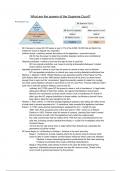
What are the powers of the Supreme Court?
- SC chooses to review 80-100 cases a year (<1% of the 9,000-10,000 that are filed); this
makes the Court of Appeal very important
- Judicial review = judiciary reviews the actions of the legislative + executive branch
- US SC has the power to determine whether laws/govt actions are constitutional
- This power is implied by the Constitution
- Original jurisdiction = where a court has the right to hear a case first
- SC has original jurisdiction over cases involving ambassadors/between 2 states/
where citizens sue their state
- Appellate jurisdiction = where a court has the power to review a lower court’s decision
- SC has appellate jurisdiction on almost any case involving federal/constitutional law
- Marbury v. Madison (1803): William Marbury was appointed Justice of the Peace by Pres.
John Adams after he lost the 1800 election (before the end of his term), but there wasn’t
enough time to send out the ‘commission’ (legal documents) needed to make him a judge;
new SoS James Madison refused to send them to him b/c new Pres. Thomas Jefferson didn’t
want him to hold this position; Marbury went to the SC
- Judiciary Act (1789): gave SC the power to issue a ‘writ of mandamus’ (= legal order
telling govt officials to fulfil their duties); SC agreed that Madison should send
Marbury his commission but they couldn’t issue a writ of mandamus b/c Article III
didn’t give the SC original jurisdiction in these matters (so Marbury shouldn’t have
been able to take this case straight to the SC)
- Fletcher v. Peck (1810): in 1795 the Georgia legislature passed a law selling 35 million acres
of state land to private spectators for 1.5 cents/acre; later revealed the legislators had been
bribed + in 1796, newly elected representatives repealed the Act + voided the sale
- 1800: John Peck acquired some of the land sold in 1795 + sold it on to Robert
Fletcher in 1803; Fletcher sued for breach of contract, claiming Peck hadn’t owned
the land when he sold it (b/c the legislature had voided the original sale)
- SC ruled unanimously that the repeal of the 1795 Act was unconstitutional b/c the
sale was a binding contract (despite the bribery) + couldn’t be invalidated under the
Contract Clause
- 1st time the SC had struck down a state (rather than federal) law; expanded the
parameters of judicial review
- SC terms begin on 1st Monday in October + finishes in the next June/July
- Stage 1: Conference; private meeting where the 9 justices meet to discuss which
cases to take (4 votes needed); several factors influence which cases are selected:
- Whether it raises interesting/important constitutional Qs that need resolving
- If federal courts/state SCs made conflicting interpretations
- Stage 2: filing briefs; both parties involved in the case file briefs outlining their
argument; interested pressure groups can also file ‘amicus curiae’ (‘friend of the
court’) briefs if granted permission by the justices
, - Stage 3: oral arguments; lawyers representing each side are given time to make their
case while the Justices ask Qs; transcripts of these proceedings (cameras aren’t
allowed at this stage) are studied by the media as they can hint at how the justices
might be leaning on the case
- Stage 4: Conference/written decisions’ the justice meet again to discuss the case +
vote in order of seniority on how they’d decide it; 1 justice writes the majority opinion
explaining the opinion of the majority of the justices (other justices in the majority can
write a concurring opinion + judges in the minority opinion can write a dissenting
opinion)
- SC chooses to review 80-100 cases a year (<1% of the 9,000-10,000 that are filed); this
makes the Court of Appeal very important
- Judicial review = judiciary reviews the actions of the legislative + executive branch
- US SC has the power to determine whether laws/govt actions are constitutional
- This power is implied by the Constitution
- Original jurisdiction = where a court has the right to hear a case first
- SC has original jurisdiction over cases involving ambassadors/between 2 states/
where citizens sue their state
- Appellate jurisdiction = where a court has the power to review a lower court’s decision
- SC has appellate jurisdiction on almost any case involving federal/constitutional law
- Marbury v. Madison (1803): William Marbury was appointed Justice of the Peace by Pres.
John Adams after he lost the 1800 election (before the end of his term), but there wasn’t
enough time to send out the ‘commission’ (legal documents) needed to make him a judge;
new SoS James Madison refused to send them to him b/c new Pres. Thomas Jefferson didn’t
want him to hold this position; Marbury went to the SC
- Judiciary Act (1789): gave SC the power to issue a ‘writ of mandamus’ (= legal order
telling govt officials to fulfil their duties); SC agreed that Madison should send
Marbury his commission but they couldn’t issue a writ of mandamus b/c Article III
didn’t give the SC original jurisdiction in these matters (so Marbury shouldn’t have
been able to take this case straight to the SC)
- Fletcher v. Peck (1810): in 1795 the Georgia legislature passed a law selling 35 million acres
of state land to private spectators for 1.5 cents/acre; later revealed the legislators had been
bribed + in 1796, newly elected representatives repealed the Act + voided the sale
- 1800: John Peck acquired some of the land sold in 1795 + sold it on to Robert
Fletcher in 1803; Fletcher sued for breach of contract, claiming Peck hadn’t owned
the land when he sold it (b/c the legislature had voided the original sale)
- SC ruled unanimously that the repeal of the 1795 Act was unconstitutional b/c the
sale was a binding contract (despite the bribery) + couldn’t be invalidated under the
Contract Clause
- 1st time the SC had struck down a state (rather than federal) law; expanded the
parameters of judicial review
- SC terms begin on 1st Monday in October + finishes in the next June/July
- Stage 1: Conference; private meeting where the 9 justices meet to discuss which
cases to take (4 votes needed); several factors influence which cases are selected:
- Whether it raises interesting/important constitutional Qs that need resolving
- If federal courts/state SCs made conflicting interpretations
- Stage 2: filing briefs; both parties involved in the case file briefs outlining their
argument; interested pressure groups can also file ‘amicus curiae’ (‘friend of the
court’) briefs if granted permission by the justices
, - Stage 3: oral arguments; lawyers representing each side are given time to make their
case while the Justices ask Qs; transcripts of these proceedings (cameras aren’t
allowed at this stage) are studied by the media as they can hint at how the justices
might be leaning on the case
- Stage 4: Conference/written decisions’ the justice meet again to discuss the case +
vote in order of seniority on how they’d decide it; 1 justice writes the majority opinion
explaining the opinion of the majority of the justices (other justices in the majority can
write a concurring opinion + judges in the minority opinion can write a dissenting
opinion)