

100% satisfaction guarantee Immediately available after payment Both online and in PDF No strings attached 4.6 TrustPilot
logo-home
Exam (elaborations)

TCIS Review With Verified Solutions

Rating
-
Sold
-
Pages
9
Grade
A+
Uploaded on
08-07-2024
Written in
2023/2024

TCIS Review With Verified Solutions In therapeutic crisis interventions with children and young people, what is the most important tool adults have? ️ Ourselves 5 Components/Domains of Successful TCI Implementation ️ 1. Leadership & Administrative Support 2. Social Work & Clinical Services Participation 3. Supervision & Post-Crisis Response 4. Training & Competency Standards 5. Data-Driven Incident Monitoring & Feedback Setting Condition ️ Anything that makes challenging behavior more or less likely to occur. 5 Categories of Setting Conditions ️ 1. Organizational Culture (e.g., control-oriented, poor communication) 2. Environmental (e.g., hot, crowded, too noisy) 3. Instruction, Activity, Routine (e.g., staffing, quality of instruction) 4. Personal (e.g., illness, trauma, feeling unsafe) 5. Relationship-Based (e.g., lack of caring, "us versus them" culture)Self regulation of emotions Ability to control and manage emotion while maintaining focus and attention. Baseline Behavior Behavior recognized as "typical" for a particular student in the Stress Model of Crisis. Phases of the Stress Model of Crisis and observed behaviors 1. Pre-crisis (baseline) 2. Triggering event - Agitation 3. Escalation Phase - Aggression 4. Outburst Crisis - Violence 5. Recovery Two goals of crisis intervention (TCIS) 1. Support: environmentally and emotionally to reduce stress and risk 2. Teach: students better ways to cope with stress. 3 Possible Outcomes During Recovery Phase of the Stress Model of Crisis 1. Lower - Abuser (Makes the problem worse) 2. No Change - Fire fighter (Dean puts out fires) 3. Higher - Educateur (Teaches coping skills & strategies) 4 Questions We Ask Ourselves In a Crisis Situation (Self Awareness) 1. What am I feeling now? 2. What does this student feel, need, or want? 3. How is the environment affecting the student? 4. How do I best respond? All behavior has ___________ therefore, ___________ reflects needs. meaning / behavior Bullying repeated acts of aggression, intimidation, or coercion against a victim who is weaker than the perpetrator in terms of physical size, psychological/social power, or other factors that might result in notable power differential. 4 Stages of Power Struggle 1. Stressful situation / incident 2. Student's feelings 3. Student's behavior 4. Adult's response A crisis occurs when... a student's inability to cope results in a change in behavior. 4 Phases of Power Struggle 55% Facial Expression 38% Tone of Voice 7% Actual Words Baseline, Triggering Event, Escalation Phase, Outburst Crisis, Recovery In dealing with a potential crisis situation, asking the question _______________________________________________ can lead us to a discovery of what the child's goals are or what purpose the aggression or challenging behavior serves for the young person. "What does the student feel, need or want?" Pain based behavior includes... 1. Impulsive outburst 2. Aggression 3. Running away 4. Self injury 5. Defiance 6. Inability to regulate emotion 7. Trauma School-wide programs to reduce bullying should begin with development of a Caring Co

Show more Read less


Whoops! We can’t load your doc right now. Try again or contact support.

Document information

Uploaded on
July 8, 2024
Number of pages
9
Written in
2023/2024
Type
Exam (elaborations)
Contains
Questions & answers

Subjects

Content preview

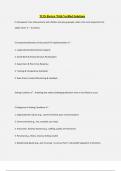
TCIS Review With Verified Solutions
In therapeutic crisis interventions with children and young people, what is the most important tool

adults have? ✔️ Ourselves


5 Components/Domains of Successful TCI Implementation ✔️


1. Leadership & Administrative Support


2. Social Work & Clinical Services Participation


3. Supervision & Post-Crisis Response


4. Training & Competency Standards


5. Data-Driven Incident Monitoring & Feedback


Setting Condition ✔️ Anything that makes challenging behavior more or less likely to occur.


5 Categories of Setting Conditions ✔️


1. Organizational Culture (e.g., control-oriented, poor communication)


2. Environmental (e.g., hot, crowded, too noisy)


3. Instruction, Activity, Routine (e.g., staffing, quality of instruction)


4. Personal (e.g., illness, trauma, feeling unsafe)


5. Relationship-Based (e.g., lack of caring, "us versus them" culture)Self regulation of emotions

, Ability to control and manage emotion while maintaining focus and attention.


Baseline Behavior


Behavior recognized as "typical" for a particular student in the Stress Model of Crisis.


Phases of the Stress Model of Crisis and observed behaviors


1. Pre-crisis (baseline)

2. Triggering event - Agitation

3. Escalation Phase - Aggression

4. Outburst Crisis - Violence

5. Recovery


Two goals of crisis intervention (TCIS)


1. Support: environmentally and emotionally to reduce stress and risk

2. Teach: students better ways to cope with stress.


3 Possible Outcomes During Recovery Phase of the Stress Model of Crisis


1. Lower - Abuser (Makes the problem worse)

2. No Change - Fire fighter (Dean puts out fires)

3. Higher - Educateur (Teaches coping skills & strategies)


4 Questions We Ask Ourselves In a Crisis Situation (Self Awareness)


1. What am I feeling now?

2. What does this student feel, need, or want?

3. How is the environment affecting the student?

4. How do I best respond?

Get to know the seller

Seller avatar
Reputation scores are based on the amount of documents a seller has sold for a fee and the reviews they have received for those documents. There are three levels: Bronze, Silver and Gold. The better the reputation, the more your can rely on the quality of the sellers work.
bestscores1 Kent State University
View profile
Follow You need to be logged in order to follow users or courses
Sold
12
Member since
1 year
Number of followers
0
Documents
1369
Last sold
1 month ago
ReadEase

Welcome to ReadEase, your ultimate resource for exam preparation. At ReadEase, we specialize in providing comprehensive study materials and resources to help you excel in your exams. Whether you're preparing for standardized tests, professional certifications, or academic assessments, our finely curated collection covers a wide range of subjects and levels. From practice tests and study guides to expert tips and strategies, we're here to support your journey to success. ReadEase is committed to availing high-quality educational content, helping you thrive and achieve your academic and professional goals. Have any questions? We're just a message away.

Read more Read less
4.3

4 reviews

5
2
4
1
3
1
2
0
1
0

Recently viewed by you

Why students choose Stuvia

Created by fellow students, verified by reviews

Quality you can trust: written by students who passed their exams and reviewed by others who've used these revision notes.

Didn't get what you expected? Choose another document

No problem! You can straightaway pick a different document that better suits what you're after.

Pay as you like, start learning straight away

No subscription, no commitments. Pay the way you're used to via credit card and download your PDF document instantly.

Student with book image

“Bought, downloaded, and smashed it. It really can be that simple.”

Alisha Student

Frequently asked questions
