

Written by students who passed Immediately available after payment Read online or as PDF Wrong document? Swap it for free 4.6 TrustPilot
logo-home
Document preview thumbnail
Preview 3 out of 17 pages
Exam (elaborations)

TCI (Therapeutic Crisis Intervention) Created for MPA Paraphrase A+

Document preview thumbnail
Preview 3 out of 17 pages

TCI (Therapeutic Crisis Intervention) Created for MPA Paraphrase A+ TCI ️Therapeutic Crisis Intervention AOD ️Administrator on Duty Report IR ️Incident Report TCI Theory of Change ️ 1. Supervisors 2. Caregivers 3. Children 4. Child Outcomes TCI: The Six Domains ️ 1. Child & Family Inclusion 2. Clinical Participation 3. Supervision & Post-Crisis Response 4. Training & Competency Standards 5. Documentation, Incident Monitoring & Feedback 6. Leadership & Program Support Therapeutic Milieu ️A safe, nurturing environment where children can heal and continually learn and practice important life skills. Milieu ️Consists of people, emotions, attitudes, and physical objects, encompassing the physical, social, cultural, emotional, and ideological space where children and staff live and work. Setting Conditions ️Factors that make challenging behavior and traumatic stress responses more or less likely to occur: - Social: Programs and activities (e.g., boredom, over-stimulation, inadequate staffing, change in routine) - Physical: The physical environment (e.g., room too hot or crowded) - Ideological: The culture and climate of the organization (e.g., valuing control over relationships, unrealistic expectations of management or staff) - Cultural - Emotional: Factors such as traumatic stress the child has experienced, medication-related issues, physical discomfort SUDs ️Subjective units of distress scale 5 Therapeutic Milieu Spaces ️1) (S) Social 2) (P) Physical 3) (I) Ideological 4) (C) Cultural 5) (E) Emotional Asphyxia ️the deprivation of oxygen to living cells Self-Awareness ️An understanding of how one's values, beliefs, perceptions, and thoughts influence one's interactions with children. Self-Regulation ️The ability to regulate one's behavior, emotions, and thoughts in order to achieve a longer-term goal. Skills we Need to Self-Regulate ️1) The ability to consciously focus attention 2) Awareness of one's own physical and emotional state 3) The ability to manage one's own emotions and behaviors 4) The ability to draw on memory and experience to adapt effectively in the present situation What is the foundation for helping a child grow, develop, and thrive? ️A warm, trusting, responsive, developmental relationship. What do we need to develop warm, trusting, responsive, developmental relationships? ️1) Listen and engage the child 2) "Tune in" to what the child is saying and feeling 3) Be aware of the feelings that are being evoked 4) Respond to the child 5) Be attuned to how the child is experiencing us Attunement ️Being aware of a child's emotions and responding with words and actions based on the child's emotional state. Self-Care ️Monitor our own levels of stress, maintain a healthy lifestyle, use reflective supervision to keep our professional perspective. Stress Reduction Techniques ️Methods that promote physiologic comfort and emotional well-being. Exercise, cry, relax, problem solve, listen to music, and talk to friends. What is the Triune Brain? ️1) Survival Brain (Brain Stem) 2) Emotional Brain (Limbic System / Amygdala) 3) Thinking Brain (Neocortex) Pain Based Behaviors ️1) Impulsive outbursts 2) Aggression 3) Running away 4) Self-injury 5) Defiance 6) Withdrawal 7) Inflexibility What often triggers a pain based behavior? ️1) When a child feels a loss of control 2) Is reminded of a traumatic event 3) Is afraid 4) Feels threatened or vulnerable 5) Is frustrated 6) Is overwhelmed Reactive Aggression ️When children are unable to regulate their emotions and become aggressive. Aggression triggered by a stress response. Emergency Response System of the Body ️Fight, Flight, Freeze The 2 Aims of Intervening in Crisis ️1) Safety & Support 2) Growth, Learning, Practice How is the outcome of a crisis greatly influenced by how we handle it? ️It is our perceptions, attitudes, relationship with the child, and skills that influence how a child responds. What are the Phases of The Stress Model of Crisis? ️1) Baseline 2) Triggering Event 3) Escalation a. Agitation b. Aggression c. Violence 4) Outburst 5) Recovery What are the 3 Possible Outcomes in all Crisis Situations? ️1) Higher 2) No Change 3) Lower What are the 4 Questions we ask Ourselves Before Intervening? ️1) What am I feeling now? How do I want the child to experience me in this moment? 2) What does this child feel, need expect or want? 3) How is the environment affecting the situation? (SPICE) 4) How do I best respond? How can I use my relationship to comfort the child? What are the tasks in dealing with a potentially volatile situation? ️1) Exercise self control over feelings the situation may evoke (stay in control) 2) Engage the child and defuse the pain-based behavior (provide emotional support) 3) Manage the environment to neutralize potential triggers (provide environmental support) 4) Stay flexible in your approach What are Caring Relationships Built On? ️1) Trust 2) Empathy 3) Validation 4) Respect What are Nonverbal Techniques? ️1) Silence 2) Nods 3) Physical Closeness 4) Facial Expression 5) Eye Contact 6) Body Language 7) Tone of Voice 8) Gestures What are Encouraging and Eliciting Techniques? ️They are verbal techniques

Content preview

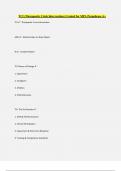
TCI (Therapeutic Crisis Intervention) Created for MPA Paraphrase A+

TCI ✔️Therapeutic Crisis Intervention


AOD ✔️Administrator on Duty Report


IR ✔️Incident Report


TCI Theory of Change ✔️


1. Supervisors


2. Caregivers


3. Children


4. Child Outcomes


TCI: The Six Domains ✔️


1. Child & Family Inclusion


2. Clinical Participation


3. Supervision & Post-Crisis Response


4. Training & Competency Standards

,5. Documentation, Incident Monitoring & Feedback


6. Leadership & Program Support


Therapeutic Milieu ✔️A safe, nurturing environment where children can heal and continually learn and

practice important life skills.


Milieu ✔️Consists of people, emotions, attitudes, and physical objects, encompassing the physical,

social, cultural, emotional, and ideological space where children and staff live and work.


Setting Conditions ✔️Factors that make challenging behavior and traumatic stress responses more or

less likely to occur:


- Social: Programs and activities (e.g., boredom, over-stimulation, inadequate staffing, change in routine)


- Physical: The physical environment (e.g., room too hot or crowded)


- Ideological: The culture and climate of the organization (e.g., valuing control over relationships,

unrealistic expectations of management or staff)


- Cultural


- Emotional: Factors such as traumatic stress the child has experienced, medication-related issues,

physical discomfort


SUDs ✔️Subjective units of distress scale

, 5 Therapeutic Milieu Spaces ✔️1) (S) Social


2) (P) Physical


3) (I) Ideological


4) (C) Cultural


5) (E) Emotional


Asphyxia ✔️the deprivation of oxygen to living cells


Self-Awareness ✔️An understanding of how one's values, beliefs, perceptions, and thoughts influence

one's interactions with children.


Self-Regulation ✔️The ability to regulate one's behavior, emotions, and thoughts in order to achieve a

longer-term goal.


Skills we Need to Self-Regulate ✔️1) The ability to consciously focus attention


2) Awareness of one's own physical and emotional state


3) The ability to manage one's own emotions and behaviors


4) The ability to draw on memory and experience to adapt effectively in the present situation

Document information

Uploaded on
July 8, 2024
Number of pages
17
Written in
2023/2024
Type
Exam (elaborations)
Contains
Questions & answers
£9.16

Wrong document? Swap it for free Within 14 days of purchase and before downloading, you can choose a different document. You can simply spend the amount again.
Written by students who passed
Immediately available after payment
Read online or as PDF

Seller avatar
Reputation scores are based on the amount of documents a seller has sold for a fee and the reviews they have received for those documents. There are three levels: Bronze, Silver and Gold. The better the reputation, the more your can rely on the quality of the sellers work.
bestscores1
4.4
(5)
Sold
18
Followers
0
Items
1369
Last sold
1 month ago


Why students choose Stuvia

Created by fellow students, verified by reviews

Quality you can trust: written by students who passed their exams and reviewed by others who've used these revision notes.

Didn't get what you expected? Choose another document

No problem! You can straightaway pick a different document that better suits what you're after.

Pay as you like, start learning straight away

No subscription, no commitments. Pay the way you're used to via credit card and download your PDF document instantly.

Student with book image

“Bought, downloaded, and smashed it. It really can be that simple.”

Alisha Student

Working on your references?

Create accurate citations in APA, MLA and Harvard with our free citation generator.

Working on your references?

Frequently asked questions
