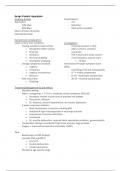
Benign Prostatic Hyperplasia
Anatomy & Risks Complications
Risk factors - UTI
- 50% 50yo - Retention
- 80% 80yo - Obstructive uropathy
Most common ethnicities
black>white>Asian
Symptoms & Complications
Lower urinary tract symptoms Investigations
- Voiding symptoms (obstructive) - Urine dip (caution in >65)
o Weak/intermittent stream - U&Es if chronic retention
o Straining suspected
o Hesitancy - PSA if obstructive Sx/pt concern
o Terminal dribbling - Urine frequency-volume chart
o Incomplete emptying o ≥3 days
- Storage symptoms (irritative) International Prostate Symptom Score
o Urgency (IPSS)
o Frequency - Classifying LUTS and assessing QoL
o Urgency incontinence - 0-7 = mildly symptomatic
o Nocturia - 8-19 = moderately symptomatic
- Post-micturition - 20-35 = severely symptomatic
o Dribbling
Treatment/Management & Side effects
- Watchful waiting
- Alpha-1 antagonists = 1st line in moderate-severe symptoms (IPSS ≥8)
o Decreases smooth muscle tone of prostate and bladder
o Tamsulosin, alfuzosin
o SE: dizziness, postural hypotension, dry mouth, depression
- 5-alpha-reductase inhibitors
o Block testosterone conversion inducing BPH
o Indicated if high risk progression in very large prostate
o Improvement minimal until 6mths
o Finasteride
o SE: erectile dysfunction, reduced libido, ejaculation problems, gynaecomastia
- Combination therapy considered if high score and very large prostate
- Surgery = transurethral resection of prostate (TURP)
2ww
- Based solely on DRE findings
- Consider PSA and DRE if:
o Any LUTS
o Erectile dysfunction
o Visible haematuria
- PSA above age specific range
,Prostatitis
Definition & DDx
Chronic form normally >3wks
DDx
- UTI
- Epididymitis
- BPH
Anatomy & Risks
Bacterial cause normally -ve via urethra (E. coli most common)
Risk factors:
- Recent UTI
- Urogenital instrumentation
- Intermittent bladder catheterisation
- Recent prostate biopsy
Symptoms & Complications
- Pain radiating varies
o Perineum
o Penis
o Rectum
o Back
- Obstructive/voiding Sx
- Fever/rigors
Investigations
- DRE: tender, boggy prostate gland
Treatment/Management & Side effects
- 14/7 (fluoro)quinolone
- Screen for STI
- Analgesia
- Temporary catheterisation if in urinary retention
, Prostate Cancer
Definition & DDx
Gleason grading
- 1st score for most dominant grade (1-5)
- 2nd score for second most dominant grade (1-5)
- Add together to get Gleason score
- 2 = best prognosis, 10 = worst
Anatomy & Risks
Adenocarcinoma
Risk factors
- Increasing age
- Obesity
- FHx
- Afro-Caribbean ethnicity
Symptoms & Complications
Few symptoms early
- Mets can present as bone pain
- Pelvic pain/urinary symptoms
- Haematuria/haematospermia
Investigations
- PSA
o Normal upper limit = 4
- DRE
o Asymmetrical, hard, nodular enlargement
o Loss of median sulcus
- MRI/CT +/- bone scan for staging
o Multiparametric MRI = 1st line
o If Likert scale ≥3 = biopsy offered
- TURP +/- biopsy
- Transrectal ultrasound guided (TRUS) biopsy
o Complications: sepsis; pain; fever; haematuria/rectal bleeding
Treatment/Management & Side effects
Watch and wait in elderly with multiple co-morbidities and low Gleason score
- Radiotherapy/brachytherapy can be curative/palliative
o SE: proctitis; bladder/colon/rectal cancer risk
- Surgery = radical prostatectomy for localised disease
o SE: erectile dysfunction; haemorrhage; electrolyte disturbances
- Hormonal therapy e.g., anti-androgens, GnRH agonists
Active surveillance for low-risk men
Anatomy & Risks Complications
Risk factors - UTI
- 50% 50yo - Retention
- 80% 80yo - Obstructive uropathy
Most common ethnicities
black>white>Asian
Symptoms & Complications
Lower urinary tract symptoms Investigations
- Voiding symptoms (obstructive) - Urine dip (caution in >65)
o Weak/intermittent stream - U&Es if chronic retention
o Straining suspected
o Hesitancy - PSA if obstructive Sx/pt concern
o Terminal dribbling - Urine frequency-volume chart
o Incomplete emptying o ≥3 days
- Storage symptoms (irritative) International Prostate Symptom Score
o Urgency (IPSS)
o Frequency - Classifying LUTS and assessing QoL
o Urgency incontinence - 0-7 = mildly symptomatic
o Nocturia - 8-19 = moderately symptomatic
- Post-micturition - 20-35 = severely symptomatic
o Dribbling
Treatment/Management & Side effects
- Watchful waiting
- Alpha-1 antagonists = 1st line in moderate-severe symptoms (IPSS ≥8)
o Decreases smooth muscle tone of prostate and bladder
o Tamsulosin, alfuzosin
o SE: dizziness, postural hypotension, dry mouth, depression
- 5-alpha-reductase inhibitors
o Block testosterone conversion inducing BPH
o Indicated if high risk progression in very large prostate
o Improvement minimal until 6mths
o Finasteride
o SE: erectile dysfunction, reduced libido, ejaculation problems, gynaecomastia
- Combination therapy considered if high score and very large prostate
- Surgery = transurethral resection of prostate (TURP)
2ww
- Based solely on DRE findings
- Consider PSA and DRE if:
o Any LUTS
o Erectile dysfunction
o Visible haematuria
- PSA above age specific range
,Prostatitis
Definition & DDx
Chronic form normally >3wks
DDx
- UTI
- Epididymitis
- BPH
Anatomy & Risks
Bacterial cause normally -ve via urethra (E. coli most common)
Risk factors:
- Recent UTI
- Urogenital instrumentation
- Intermittent bladder catheterisation
- Recent prostate biopsy
Symptoms & Complications
- Pain radiating varies
o Perineum
o Penis
o Rectum
o Back
- Obstructive/voiding Sx
- Fever/rigors
Investigations
- DRE: tender, boggy prostate gland
Treatment/Management & Side effects
- 14/7 (fluoro)quinolone
- Screen for STI
- Analgesia
- Temporary catheterisation if in urinary retention
, Prostate Cancer
Definition & DDx
Gleason grading
- 1st score for most dominant grade (1-5)
- 2nd score for second most dominant grade (1-5)
- Add together to get Gleason score
- 2 = best prognosis, 10 = worst
Anatomy & Risks
Adenocarcinoma
Risk factors
- Increasing age
- Obesity
- FHx
- Afro-Caribbean ethnicity
Symptoms & Complications
Few symptoms early
- Mets can present as bone pain
- Pelvic pain/urinary symptoms
- Haematuria/haematospermia
Investigations
- PSA
o Normal upper limit = 4
- DRE
o Asymmetrical, hard, nodular enlargement
o Loss of median sulcus
- MRI/CT +/- bone scan for staging
o Multiparametric MRI = 1st line
o If Likert scale ≥3 = biopsy offered
- TURP +/- biopsy
- Transrectal ultrasound guided (TRUS) biopsy
o Complications: sepsis; pain; fever; haematuria/rectal bleeding
Treatment/Management & Side effects
Watch and wait in elderly with multiple co-morbidities and low Gleason score
- Radiotherapy/brachytherapy can be curative/palliative
o SE: proctitis; bladder/colon/rectal cancer risk
- Surgery = radical prostatectomy for localised disease
o SE: erectile dysfunction; haemorrhage; electrolyte disturbances
- Hormonal therapy e.g., anti-androgens, GnRH agonists
Active surveillance for low-risk men