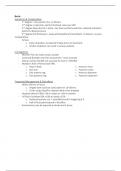
Burns
Symptoms & Complications
- 1st degree = red, painful, dry, no blisters
- 2nd degree = pale pink, painful, blistered, slow cap refill
- 2nd degree deep dermal = white, may have erythema patches; reduced sensation;
painful to deep pressure
- 3rd degree (full thickness) = waxy white/leathery brown/black, no blisters, no pain
Complications
- Airway
o Early intubation considered if deep burns to face/neck
o Smoke inhalation can result in airway oedema
Investigations
- Monitor PCV, Na, base excess, lactate
- Lund and Browder chart for assessment = most accurate
- Palmar surface 1% BSA not accurate for burns >15% BSA
- Wallace’s Rule of Nines (each 9%)
o Head + Neck o Anterior chest
o One arm o Posterior chest
o One anterior leg o Anterior abdomen
o One posterior leg o Posterior abdomen
Treatment/Management & Side effects
- Within 20mins of injury
o Irrigate with cool (not iced) water for 10-30mins
o Cover using cling film, layered rather than wrapped
- Hospital referral if BSA >3% in adults or >2% in children
- IV fluids if children BSA >10% pr adults >15%
o Parkland formula: vol. = total BSA burn% X weight Kg X 4
o Half of fluid administered in first 8hrs
- Escharotomy may be required to divide burnt tissue
, Dehydration (Fluid Therapy)
Definition & DDx
Maintenance fluid for adults
- 25-30ml/kg/day of water
- 1mmol/kg/day of K, Na, Cl
- 50-100g/day glucose
NICE recommendation for sole maintenance
- 25-30ml/kg/day NaCl 0.18% in 4% glucose with 27mmol/L K on day 1
Maintenance fluid for children
- 100ml/kg/day for first 10kg
- 50ml/kg/day for second 10kg
- Remaining bodyweight at 20ml/kg/day
Normally 0.9% saline + 5% dextrose; K added based on U&Es
- 2-4mmol/kg/day Na
- 1-2mmol/kg/day K
Symptoms & Complications
- Dry mucous membranes
- Loss of skin turgor
- Sunken eyes
- Tachycardia
- Hypotension
- Delirium
Complications
- If large volumes 0.9% saline used = increased risk hyperchloraemic metabolic acidosis
- Hartmann’s contains K – CI in hyperkalaemic patients
Investigations
- A-E approach
- Assess ability to meet fluid requirements orally
Paediatric fluid deficit
- % Dehydration = ((normal weight-current weight)/normal weight) x 100
- Fluid deficit = %dehydration x weight (kg) x 10
- Given in addition to normal maintenance fluids
Treatment/Management & Side effects
Fluid Resus in adults
- 500ml fluid of choice per guidelines
- 250ml if cardiac disease/elderly
o Increased risk pulmonary oedema 2º to excessive fluid resus
- If no response after 2L fluid
o Considered fluid non-responsive
Fluid Resus in children
- Boluses 10-20ml/kg at a time 0.9% saline
- Senior support if no response to 2 boluses
Dextrose/saline combinations not recommended for surgical patients
Symptoms & Complications
- 1st degree = red, painful, dry, no blisters
- 2nd degree = pale pink, painful, blistered, slow cap refill
- 2nd degree deep dermal = white, may have erythema patches; reduced sensation;
painful to deep pressure
- 3rd degree (full thickness) = waxy white/leathery brown/black, no blisters, no pain
Complications
- Airway
o Early intubation considered if deep burns to face/neck
o Smoke inhalation can result in airway oedema
Investigations
- Monitor PCV, Na, base excess, lactate
- Lund and Browder chart for assessment = most accurate
- Palmar surface 1% BSA not accurate for burns >15% BSA
- Wallace’s Rule of Nines (each 9%)
o Head + Neck o Anterior chest
o One arm o Posterior chest
o One anterior leg o Anterior abdomen
o One posterior leg o Posterior abdomen
Treatment/Management & Side effects
- Within 20mins of injury
o Irrigate with cool (not iced) water for 10-30mins
o Cover using cling film, layered rather than wrapped
- Hospital referral if BSA >3% in adults or >2% in children
- IV fluids if children BSA >10% pr adults >15%
o Parkland formula: vol. = total BSA burn% X weight Kg X 4
o Half of fluid administered in first 8hrs
- Escharotomy may be required to divide burnt tissue
, Dehydration (Fluid Therapy)
Definition & DDx
Maintenance fluid for adults
- 25-30ml/kg/day of water
- 1mmol/kg/day of K, Na, Cl
- 50-100g/day glucose
NICE recommendation for sole maintenance
- 25-30ml/kg/day NaCl 0.18% in 4% glucose with 27mmol/L K on day 1
Maintenance fluid for children
- 100ml/kg/day for first 10kg
- 50ml/kg/day for second 10kg
- Remaining bodyweight at 20ml/kg/day
Normally 0.9% saline + 5% dextrose; K added based on U&Es
- 2-4mmol/kg/day Na
- 1-2mmol/kg/day K
Symptoms & Complications
- Dry mucous membranes
- Loss of skin turgor
- Sunken eyes
- Tachycardia
- Hypotension
- Delirium
Complications
- If large volumes 0.9% saline used = increased risk hyperchloraemic metabolic acidosis
- Hartmann’s contains K – CI in hyperkalaemic patients
Investigations
- A-E approach
- Assess ability to meet fluid requirements orally
Paediatric fluid deficit
- % Dehydration = ((normal weight-current weight)/normal weight) x 100
- Fluid deficit = %dehydration x weight (kg) x 10
- Given in addition to normal maintenance fluids
Treatment/Management & Side effects
Fluid Resus in adults
- 500ml fluid of choice per guidelines
- 250ml if cardiac disease/elderly
o Increased risk pulmonary oedema 2º to excessive fluid resus
- If no response after 2L fluid
o Considered fluid non-responsive
Fluid Resus in children
- Boluses 10-20ml/kg at a time 0.9% saline
- Senior support if no response to 2 boluses
Dextrose/saline combinations not recommended for surgical patients