Gina Brown Strand 2 Unit 2
MITOSIS – REVISION
- Division of somatic cells
- New cells, with the same chromosome number are formed during growth, repair of
damaged tissues, and asexual reproduction
- Two daughter cells produced from the mother cell during mitosis have the same no.
of chromosomes as mother cell and are identical to each other and to original mother
cell
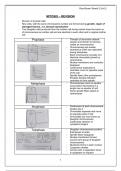
Prophase - Threads of chromatin network
shorten and thicken to become
visible as chromosomes
- Chromosomes are double
stranded as DNA was replicated
during Interphase
- Each chromosome consists of 2
identical chromatids (joined by
centromere)
- Nuclear membrane and nucleolus
disappear
- Centrosome duplicates &
centrioles move to opposite poles
of the cell
- Spindle fibers (fine protoplasmic
threads) develop between
centrioles to form spindle
Metaphase - Chromosomes move to equator
and position themselves in a
single row on equator of cell
- Some spindle fibers attach to
centromeres
Anaphase - Centromere of each chromosome
divides into 2
- Chromatids separate and move
to opposite poles of cell
- Chromatids are now known as
daughter chromosomes
- Cytokinesis (division of
cytoplasm) begins
Telophase - Daughter chromosomes position
themselves at poles
- Spindle fibers disappear
- Nuclear membrane formed
around each group of daughter
chromosomes
- Nucleolus forms in each nucleus
- Cytoplasm divides
- Animal cells: invagination forms
in cytoplasm on equator
1
, Gina Brown Strand 2 Unit 2
- Plant cells: cell plate forms in
cytoplasm on equator
- Cytokinesis is now complete and
2 identical daughter cells have
been formed
MEISOIS
A reduction division where the chromosome number in each cell is halved, from
diploid to haploid number. In animals and plants, it results in the production of
gametes and spores
- Takes place during formation of gametes in animals/spores in plants
- Chromosome number in nucleus is halved from the diploid (2n) to the haploid (n)
number
- Division is also known as reduction division
- Daughter cells formed from meiosis have only 1 set of chromosomes (n) and are not
identical to each other or mother cell
Process:
- 2 distinct stages:
1. Meiosis | (chromosome number halved and genetic material exchanged)
2. Meiosis || (proceeds like normal mitosis where daughter chromosomes (chromatids)
separate from each other
1st Meiotic division
Prophase 1 - Chromatin network condenses,
threads shorten and thicken to
2
MITOSIS – REVISION
- Division of somatic cells
- New cells, with the same chromosome number are formed during growth, repair of
damaged tissues, and asexual reproduction
- Two daughter cells produced from the mother cell during mitosis have the same no.
of chromosomes as mother cell and are identical to each other and to original mother
cell
Prophase - Threads of chromatin network
shorten and thicken to become
visible as chromosomes
- Chromosomes are double
stranded as DNA was replicated
during Interphase
- Each chromosome consists of 2
identical chromatids (joined by
centromere)
- Nuclear membrane and nucleolus
disappear
- Centrosome duplicates &
centrioles move to opposite poles
of the cell
- Spindle fibers (fine protoplasmic
threads) develop between
centrioles to form spindle
Metaphase - Chromosomes move to equator
and position themselves in a
single row on equator of cell
- Some spindle fibers attach to
centromeres
Anaphase - Centromere of each chromosome
divides into 2
- Chromatids separate and move
to opposite poles of cell
- Chromatids are now known as
daughter chromosomes
- Cytokinesis (division of
cytoplasm) begins
Telophase - Daughter chromosomes position
themselves at poles
- Spindle fibers disappear
- Nuclear membrane formed
around each group of daughter
chromosomes
- Nucleolus forms in each nucleus
- Cytoplasm divides
- Animal cells: invagination forms
in cytoplasm on equator
1
, Gina Brown Strand 2 Unit 2
- Plant cells: cell plate forms in
cytoplasm on equator
- Cytokinesis is now complete and
2 identical daughter cells have
been formed
MEISOIS
A reduction division where the chromosome number in each cell is halved, from
diploid to haploid number. In animals and plants, it results in the production of
gametes and spores
- Takes place during formation of gametes in animals/spores in plants
- Chromosome number in nucleus is halved from the diploid (2n) to the haploid (n)
number
- Division is also known as reduction division
- Daughter cells formed from meiosis have only 1 set of chromosomes (n) and are not
identical to each other or mother cell
Process:
- 2 distinct stages:
1. Meiosis | (chromosome number halved and genetic material exchanged)
2. Meiosis || (proceeds like normal mitosis where daughter chromosomes (chromatids)
separate from each other
1st Meiotic division
Prophase 1 - Chromatin network condenses,
threads shorten and thicken to
2