PAG 2.2 the Dissection of A Stem Questions and Answers | Latest Version | 100% Pass
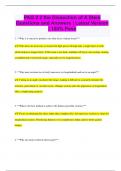
PAG 2.2 the Dissection of A Stem Questions and Answers | Latest Version | 100% Pass 1. **Why is it crucial to produce very thin slices of plant tissue?** Thin slices are necessary to ensure that light passes through only a single layer of cells, which improves image clarity. If the tissue is too thick, multiple cell layers can overlap, creating a muddled and overlayered image, especially at low magnifications. 2. **Why must sections be cut truly transverse (or longitudinal) and not at an angle?** Cutting at an angle can distort the image, making it difficult to accurately interpret the structure, particularly in vascular tissues. Oblique sections alter the appearance of longitudinal tubes, complicating analysis. 3. **What is the best method to achieve the thinnest possible sections?** Focus on obtaining thin slices rather than complete discs for transverse sections or strips for longitudinal sections. Prioritizing thinness over completeness helps achieve better quality images. 4. **Why are stains useful in microscopy?** Stains are essential because they allow transparent structures to be identified. Differential staining helps distinguish between different cell structures and contents, enhancing the overall detail and contrast of the microscopic image. 5. **Why is Toluidine blue a beneficial stain in this case?** Toluidine blue is a differential stain, enabling the distinction of various cell types. It is also safe and inexpensive, making it a practical choice
Written for
- Institution
- PAG 2.2 the Dissection of A Stem
- Module
- PAG 2.2 the Dissection of A Stem
Document information
- Uploaded on
- July 4, 2024
- Number of pages
- 2
- Written in
- 2023/2024
- Type
- Exam (elaborations)
- Contains
- Questions & answers
Subjects
-
pag 22 the dissection of a stem questions and ans

Also available in package deal