
excretion
·
excretion -
removal of toxic substances ,
waste products of metabolism processes and substances in excess of
requirements in the body -
defecation excretion
·
skin -
removes substances through sweat / containing water , urea and salts (
lungs removes CO2 & water vapour
removal of amine
groups
·
liver assimilation of amino acids /amino acids -
> proteins)
·
deamination (break down of the
nitrogen-containing parts of excess amino acids) to produce urea
·
urea is excreted in the form of urine/mineral salts and urea dissolved in H2O
breaks down alcohol to form acetaldehyde
·
alcohol dehydrogenase
breaks down acetalhyde to form acetate
·
aldehyde dehydrogenase
factors affecting vol . and conc . of urine-
·
temperature and exercise
·
not temperatures and exercise leads to increased dehydration :
higher conc . and lower vol.
me
·
water Intake
-
·
higher hydration : lower conc . and higher vol .
of the blood
kidney regulate water content
·
·
excrete urea and other waste materials
·
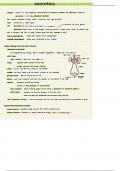
ureter -
carries vrine from the kidney to the bladder
·
bladder-sac that stores urine and allows urination to be controlled
·
sphincter muscle -
used to control exit of urine
-
-return-cust that transmits crine from the bloder to
·
nephrons functional unit of the Kidney
·
consists of renal corpuscle and renal tubules
·
renal corpuscle blood-filtering system of the Kidney (glomerulus and Bowman's capsule (
·
renal tubules
Conveys urine from the glomerull to the renal pelvis
·
water and salts are reabsorbed into the blood along the way
·
ADH (antidiuretic hormone) -
a hormone produced in the brain that makes the collecting duct more permeable to water
reactions that take place in the cells
larger molecules from smaller constituent parts
·
anabolic reaction -
Synthesizes
catabolic reactions breakdown of molecules for energy (liver
organic organ (
-
is an example
·
·
excretion -
removal of toxic substances ,
waste products of metabolism processes and substances in excess of
requirements in the body -
defecation excretion
·
skin -
removes substances through sweat / containing water , urea and salts (
lungs removes CO2 & water vapour
removal of amine
groups
·
liver assimilation of amino acids /amino acids -
> proteins)
·
deamination (break down of the
nitrogen-containing parts of excess amino acids) to produce urea
·
urea is excreted in the form of urine/mineral salts and urea dissolved in H2O
breaks down alcohol to form acetaldehyde
·
alcohol dehydrogenase
breaks down acetalhyde to form acetate
·
aldehyde dehydrogenase
factors affecting vol . and conc . of urine-
·
temperature and exercise
·
not temperatures and exercise leads to increased dehydration :
higher conc . and lower vol.
me
·
water Intake
-
·
higher hydration : lower conc . and higher vol .
of the blood
kidney regulate water content
·
·
excrete urea and other waste materials
·
ureter -
carries vrine from the kidney to the bladder
·
bladder-sac that stores urine and allows urination to be controlled
·
sphincter muscle -
used to control exit of urine
-
-return-cust that transmits crine from the bloder to
·
nephrons functional unit of the Kidney
·
consists of renal corpuscle and renal tubules
·
renal corpuscle blood-filtering system of the Kidney (glomerulus and Bowman's capsule (
·
renal tubules
Conveys urine from the glomerull to the renal pelvis
·
water and salts are reabsorbed into the blood along the way
·
ADH (antidiuretic hormone) -
a hormone produced in the brain that makes the collecting duct more permeable to water
reactions that take place in the cells
larger molecules from smaller constituent parts
·
anabolic reaction -
Synthesizes
catabolic reactions breakdown of molecules for energy (liver
organic organ (
-
is an example
·


