Cells To Systems - Cell Sorting
Cell Sorting - Endocytosis & Exocytosis
Location:
Right protein, right place, right time is essential to properly function
Being in the wrong location does not allow it to fulfil its functions
Location of organs/organ system within the body is essential for function
Location within the cell e.g. right protein in the right organelle is essential for function
Eukaryotes have multiple sub-cellular organelles, where each have specific functions, so it is important to have the
correct proteins
Specialised function requires proteins
- Nucleus needs nuclear proteins as it has all the nuclear functions to replicate e.g. DNA needs DNA polymerase
- ER needs ER proteins
‘Roadmap’ Of Protein Traffic:
A lot of trafficking in the cell
3 Mechanisms Of Protein Transport:
1. Gated transport
2. Transmembrane transport
3. Vesicular transport
Gated Transport:
Occurs in both directions
Changes molecules between the cytosol and the nucleus
Transmembrane Transport:
Occurs in 1 direction
From cell cytosol to different organelles but selects certain organelles e.g. peroxisomes, plastids, endoplasmic
reticulum, mitochondria
Vesicular Transport:
Occurs in 1 and both directions
Traffic of molecules between Golgi and other organelles in the cell surface
All proteins are translated in ribosomes and cell cytosol, and have to reach the final destination
e.g. Golgi enzyme in Golgi, whether it’s a secreted protein, or if it has to stay in the ER, or go to the nucleus (needs
to know where it’s going and how to get there)
Direction:
Proteins know where to go as it is encoded in the protein structure
Destination depends on amino acid sequence, some part of it will encode an address (sorting signal) or where
destination proteins need to go
Most proteins lack sorting signal/address added, meaning they will remain in cytosol
If a protein needs to go to a specific organelle, it will have a specific signal sequence or sorting signal that directs it
to its final destination
Topological Relationship Between Compartments:
1
, Cells To Systems - Cell Sorting
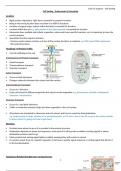
If a eukaryotic cell is injected with a dye, it fills the cytosol and nucleus
Extracellular space is the same colour as/connects with lumen of some organelles that
are membrane bound e.g. ER, Golgi, vesicles, lysosomes, perinuclear space
Cytosol connects with inside of the nucleus and lumen of certain organelles
is the same as the extracellular space
Eukaryotic Cell
Signal Sequences:
Signal Sequence/Address - Tells proteins where to go
Sequences that are encoded in amino acid structural protein are recognised
by complementary receptor proteins (address will be recognised by certain receptor and will guide it to where it
needs to go)
Can be continuous (either 1 or other side of protein) or discontinuous
Signal is removed after sorting by enzymes
Signal may or may not be part of the final protein
Can Be In The Middle:
Consists of several patches of the protein
Protein folds together in the final confirmation and makes a 3D structure
The signal parts are coming together and forming a signal patch
Localised in 1 location
Can be recognised by the receptor and guide the protein to its final destination
Import = Charged
Export = Hydrophobic
What Happens When The Address Is Changed?
Make mutations to these signal sequences
Protein will localise in the nucleus
Has positively charged amino acid stretch
Change 1 amino acid (Thr)
Localisation of proteins becomes very different
2
Cell nuclei hasn’t gone to the nucleus, but has
stayed in the cell cytosol
Address has been changed, can’t reach its final
destination so stays in the cell cytosol
Cell Sorting - Endocytosis & Exocytosis
Location:
Right protein, right place, right time is essential to properly function
Being in the wrong location does not allow it to fulfil its functions
Location of organs/organ system within the body is essential for function
Location within the cell e.g. right protein in the right organelle is essential for function
Eukaryotes have multiple sub-cellular organelles, where each have specific functions, so it is important to have the
correct proteins
Specialised function requires proteins
- Nucleus needs nuclear proteins as it has all the nuclear functions to replicate e.g. DNA needs DNA polymerase
- ER needs ER proteins
‘Roadmap’ Of Protein Traffic:
A lot of trafficking in the cell
3 Mechanisms Of Protein Transport:
1. Gated transport
2. Transmembrane transport
3. Vesicular transport
Gated Transport:
Occurs in both directions
Changes molecules between the cytosol and the nucleus
Transmembrane Transport:
Occurs in 1 direction
From cell cytosol to different organelles but selects certain organelles e.g. peroxisomes, plastids, endoplasmic
reticulum, mitochondria
Vesicular Transport:
Occurs in 1 and both directions
Traffic of molecules between Golgi and other organelles in the cell surface
All proteins are translated in ribosomes and cell cytosol, and have to reach the final destination
e.g. Golgi enzyme in Golgi, whether it’s a secreted protein, or if it has to stay in the ER, or go to the nucleus (needs
to know where it’s going and how to get there)
Direction:
Proteins know where to go as it is encoded in the protein structure
Destination depends on amino acid sequence, some part of it will encode an address (sorting signal) or where
destination proteins need to go
Most proteins lack sorting signal/address added, meaning they will remain in cytosol
If a protein needs to go to a specific organelle, it will have a specific signal sequence or sorting signal that directs it
to its final destination
Topological Relationship Between Compartments:
1
, Cells To Systems - Cell Sorting
If a eukaryotic cell is injected with a dye, it fills the cytosol and nucleus
Extracellular space is the same colour as/connects with lumen of some organelles that
are membrane bound e.g. ER, Golgi, vesicles, lysosomes, perinuclear space
Cytosol connects with inside of the nucleus and lumen of certain organelles
is the same as the extracellular space
Eukaryotic Cell
Signal Sequences:
Signal Sequence/Address - Tells proteins where to go
Sequences that are encoded in amino acid structural protein are recognised
by complementary receptor proteins (address will be recognised by certain receptor and will guide it to where it
needs to go)
Can be continuous (either 1 or other side of protein) or discontinuous
Signal is removed after sorting by enzymes
Signal may or may not be part of the final protein
Can Be In The Middle:
Consists of several patches of the protein
Protein folds together in the final confirmation and makes a 3D structure
The signal parts are coming together and forming a signal patch
Localised in 1 location
Can be recognised by the receptor and guide the protein to its final destination
Import = Charged
Export = Hydrophobic
What Happens When The Address Is Changed?
Make mutations to these signal sequences
Protein will localise in the nucleus
Has positively charged amino acid stretch
Change 1 amino acid (Thr)
Localisation of proteins becomes very different
2
Cell nuclei hasn’t gone to the nucleus, but has
stayed in the cell cytosol
Address has been changed, can’t reach its final
destination so stays in the cell cytosol