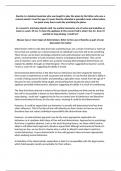
, QUARKS LEPTONS
Q Q
us
-
t e 1
M -
1 x
d- S b Ve o VuO Ve
T T
t
HADRONS are made of quarks
↓ -
MESON-quark & anti-quark Pair
BARYONS- made of 3 quarks
-
Proton- und u nd
neutron :
Udd -
I =
-
3
-
5
*
, THE STANDARD MODEL
All particles of matter are made
from QUARKS and/or LEPTONS -
categorised by &
charge mass
interact with other
>
Interact with
-
>
- Particles via EM
HADRONS the strong
nuclear force LEPTONS or
gravitational
interactions
are made of quarks fundamental particles (not made
↓ I of particles
quarks or other
electron (e)
(Ve)
On
electron Neutrino
3 quarks quark antiquark Pair muon (mt
· PROTONS (p) ·
PIONS (n )
+
muon neutrino (Vm)
(n) KAONS (k )
*
·
NEUTRONS ·
↓ muons are 200 x bigger than electrons
,
P : und -- : nd both le
have
charges of
n : upd
Neutrinos have zero charge
↑ negligible mass
ANTI-HADRONS
↓ Y
YOU CAN'T HAVE A
A-BARYONS ANTI-MESON
COMBINATION Of QUARKS
#
·
anti-protons (P) ·
anti-pions (r)
·
anti-neutrons (n) · anti-Kaons (K) AND ANTI-QUARKS
PHOTONS are GROUPS of particles
zero mass
& The EXCHANGE PARTICLE
·
for the EM force
·
medidate one of the fundamental forces (EM)
il : electrostatic repulsion
=
exchanging photons
Then
, all matter particles have antimatter counterparts
↓ IDENTICAL except they are the OPPOSITE CHARGE
THE SYMMETRY OF THE STANDARD MODEL
The first 4 guarks
discovered were Up
7
: ·
·
down The symmetry of U +
ze( + 2 + +
e
.
Strange
· these
properties predicted
the 3rd ot
generation
·
charm
Particles (too bottom)
d "e Steb- Ye
beach have a
corresponding
antiparticle i with
.
eg
the opposite charge
Q Q
us
-
t e 1
M -
1 x
d- S b Ve o VuO Ve
T T
t
HADRONS are made of quarks
↓ -
MESON-quark & anti-quark Pair
BARYONS- made of 3 quarks
-
Proton- und u nd
neutron :
Udd -
I =
-
3
-
5
*
, THE STANDARD MODEL
All particles of matter are made
from QUARKS and/or LEPTONS -
categorised by &
charge mass
interact with other
>
Interact with
-
>
- Particles via EM
HADRONS the strong
nuclear force LEPTONS or
gravitational
interactions
are made of quarks fundamental particles (not made
↓ I of particles
quarks or other
electron (e)
(Ve)
On
electron Neutrino
3 quarks quark antiquark Pair muon (mt
· PROTONS (p) ·
PIONS (n )
+
muon neutrino (Vm)
(n) KAONS (k )
*
·
NEUTRONS ·
↓ muons are 200 x bigger than electrons
,
P : und -- : nd both le
have
charges of
n : upd
Neutrinos have zero charge
↑ negligible mass
ANTI-HADRONS
↓ Y
YOU CAN'T HAVE A
A-BARYONS ANTI-MESON
COMBINATION Of QUARKS
#
·
anti-protons (P) ·
anti-pions (r)
·
anti-neutrons (n) · anti-Kaons (K) AND ANTI-QUARKS
PHOTONS are GROUPS of particles
zero mass
& The EXCHANGE PARTICLE
·
for the EM force
·
medidate one of the fundamental forces (EM)
il : electrostatic repulsion
=
exchanging photons
Then
, all matter particles have antimatter counterparts
↓ IDENTICAL except they are the OPPOSITE CHARGE
THE SYMMETRY OF THE STANDARD MODEL
The first 4 guarks
discovered were Up
7
: ·
·
down The symmetry of U +
ze( + 2 + +
e
.
Strange
· these
properties predicted
the 3rd ot
generation
·
charm
Particles (too bottom)
d "e Steb- Ye
beach have a
corresponding
antiparticle i with
.
eg
the opposite charge