1. FORCES AND MOTION
A – Units:
1.1 – use the following units: kilogram (kg), metre (m), metre/second (m/s), metre/second 2 (m/s2), newton
(N), seconds (s), newton/kilogram (N/kg)
1.2 – use the following units: newton metre (Nm), kilogram metre/second (Kg m/s)
B – Movement and position:
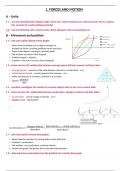
1.3 – plot and explain distance-time graphs
o Shows how the distance of an object moving in a
straight line (from a starting positions) varies over time
o Shows if the object is moving at constant speed
o Flat sections are where it has stopped
o Gradient (slope) = velocity
o Gradient = rise/run (if a curve, draw a tangent)
1.4 – know and use the relationship between average speed, distance moved, and time taken
o Average Speed – measure of the total distance covered in a certain time – m/s
o Instantaneous Speed – certain speed at that moment – m/s
o Make sure distance is in metres, and time is in seconds
distance
o Speed=
time
1.5 – practical: investigate the motion of everyday objects such as toy cars or tennis balls
1.6 – know and use the relationship between acceleration, change in velocity and time taken
o Acceleration – rate of change of velocity – m/s 2
o Negative value = deceleration
o
change∈velocity final velocity ( v ) −initial velocity ( u )
Acceleration ( a )= =
timetaken time taken ( t )
1.7 – plot and explain velocity-time graphs
o Shows how the velocity of a moving object varies with time
o Gradient = acceleration
o Flat sections = no acceleration, constant velocity
o Steeper the graph, the greater the acceleration/deceleration
1.8 – determine the acceleration from the gradient of a velocity time graph
, 1. FORCES AND MOTION
o Acceleration (in each section of the graph) = gradient =
rise/run (if a curve, draw a tangent)
1.9 – determine the distance travelled from the area
between a velocity-time graph and the time axis
o The area underneath the line of the graph represents the
displacement/distance travelled
o Split the graph into squares and triangles
o For squares: area = base x height
o For triangles: area = ½ x base x height
o Add up all the areas calculated to get overall distance
1.10 – use the relationship between final speed, initial speed, acceleration and distance moved
o ¿
o V 2=u 2+2( as)
C – Forces, movement, shape and momentum:
1.11 – describe the effects of forces between bodies such as changes in speed, shape or direction
Forces can affect bodies in a variety of ways:
1. Changes in speed – forces can cause bodies to speed up or slow down
2. Changes in direction – forces can cause bodies to change their direction of travel
3. Changes in shape – forces can cause bodies to stretch, compress or deform
1.12 – identify different types of force such as gravitational or electrostatic
Non-contact (work in fields):
o Electrostatic field – force between two objects with charge direction depends on type of charge (repel/attract)
o Proton and electrons
o Gravitational field – the force between any two objects with mass
o Earth and the Moon
o Magnetic field – the force around a magnetic material or moving electric
charge within the force of magnetism
o Magnets, a compass
Contact:
o Air resistance (or drag) – the force of frictions between objects falling
through the air
o Skydiver in a freefall
o Weight – force between two objects with mass caused by pull of gravity
o Earth and the Moon
o Upthrust – the upward force on any object in a fluid
o Boat on the surface of a river
o Thrust – the force pushing a vehicle
o Push from rocket engines on the shuttle
o Compression – force that squeezes an object
o Squeezing a spring
A – Units:
1.1 – use the following units: kilogram (kg), metre (m), metre/second (m/s), metre/second 2 (m/s2), newton
(N), seconds (s), newton/kilogram (N/kg)
1.2 – use the following units: newton metre (Nm), kilogram metre/second (Kg m/s)
B – Movement and position:
1.3 – plot and explain distance-time graphs
o Shows how the distance of an object moving in a
straight line (from a starting positions) varies over time
o Shows if the object is moving at constant speed
o Flat sections are where it has stopped
o Gradient (slope) = velocity
o Gradient = rise/run (if a curve, draw a tangent)
1.4 – know and use the relationship between average speed, distance moved, and time taken
o Average Speed – measure of the total distance covered in a certain time – m/s
o Instantaneous Speed – certain speed at that moment – m/s
o Make sure distance is in metres, and time is in seconds
distance
o Speed=
time
1.5 – practical: investigate the motion of everyday objects such as toy cars or tennis balls
1.6 – know and use the relationship between acceleration, change in velocity and time taken
o Acceleration – rate of change of velocity – m/s 2
o Negative value = deceleration
o
change∈velocity final velocity ( v ) −initial velocity ( u )
Acceleration ( a )= =
timetaken time taken ( t )
1.7 – plot and explain velocity-time graphs
o Shows how the velocity of a moving object varies with time
o Gradient = acceleration
o Flat sections = no acceleration, constant velocity
o Steeper the graph, the greater the acceleration/deceleration
1.8 – determine the acceleration from the gradient of a velocity time graph
, 1. FORCES AND MOTION
o Acceleration (in each section of the graph) = gradient =
rise/run (if a curve, draw a tangent)
1.9 – determine the distance travelled from the area
between a velocity-time graph and the time axis
o The area underneath the line of the graph represents the
displacement/distance travelled
o Split the graph into squares and triangles
o For squares: area = base x height
o For triangles: area = ½ x base x height
o Add up all the areas calculated to get overall distance
1.10 – use the relationship between final speed, initial speed, acceleration and distance moved
o ¿
o V 2=u 2+2( as)
C – Forces, movement, shape and momentum:
1.11 – describe the effects of forces between bodies such as changes in speed, shape or direction
Forces can affect bodies in a variety of ways:
1. Changes in speed – forces can cause bodies to speed up or slow down
2. Changes in direction – forces can cause bodies to change their direction of travel
3. Changes in shape – forces can cause bodies to stretch, compress or deform
1.12 – identify different types of force such as gravitational or electrostatic
Non-contact (work in fields):
o Electrostatic field – force between two objects with charge direction depends on type of charge (repel/attract)
o Proton and electrons
o Gravitational field – the force between any two objects with mass
o Earth and the Moon
o Magnetic field – the force around a magnetic material or moving electric
charge within the force of magnetism
o Magnets, a compass
Contact:
o Air resistance (or drag) – the force of frictions between objects falling
through the air
o Skydiver in a freefall
o Weight – force between two objects with mass caused by pull of gravity
o Earth and the Moon
o Upthrust – the upward force on any object in a fluid
o Boat on the surface of a river
o Thrust – the force pushing a vehicle
o Push from rocket engines on the shuttle
o Compression – force that squeezes an object
o Squeezing a spring