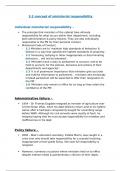
3.2 concept of ministerial responsibility
individual ministerial responsibility –
The principle that ministers of the cabinet take ultimate
responsibility for what occurs within their department, including
both administrative & policy failures. They are also individually
responsible to the PM for their personal conduct.
Ministerial Code of Conduct:
- 1:1 Ministers are to ‘maintain high standards of behaviour &
behave in a way that upholds the highest standards of propriety’.
- 1:2 ‘Harassing, bullying or other inappropriate or discriminating
behaviour… will not be tolerated’.
- 1:3 ‘Ministers have a duty to parliament to account, and to be
held to account, for the policies, decisions and actions of their
departments and agencies’.
- 1:3 ‘it is of paramount importance that ministers give accurate
and truthful information to parliament… ministers who knowingly
mislead parliament will be expected to offer their resignation to
the PM’.
- 1:6 ‘Ministers only remain in office for so long as they retain the
confidence of the PM’.
Administrative failure –
1954 – Sir Thomas Dugdale resigned as minister of agriculture over
Crichel Down affair, when his dept failed to return land to its rightful
owner after it had been compulsorily bought for a bombing range
before WWII. Although his civil servants were mostly at fault, he
resigned saying that he must accept responsibility for mistakes and
inefficiencies in his dept.
Policy failure –
2002 – Blair’s education secretary, Estelle Morris, was caught in a
crisis over who should take responsibility for a scandal involving
inappropriate a-level grade fixing. She took full responsibility &
resigned.
However, numerous occasions where ministers held on to office
despite intense media & parliamentary criticism of their depts. –
individual ministerial responsibility –
The principle that ministers of the cabinet take ultimate
responsibility for what occurs within their department, including
both administrative & policy failures. They are also individually
responsible to the PM for their personal conduct.
Ministerial Code of Conduct:
- 1:1 Ministers are to ‘maintain high standards of behaviour &
behave in a way that upholds the highest standards of propriety’.
- 1:2 ‘Harassing, bullying or other inappropriate or discriminating
behaviour… will not be tolerated’.
- 1:3 ‘Ministers have a duty to parliament to account, and to be
held to account, for the policies, decisions and actions of their
departments and agencies’.
- 1:3 ‘it is of paramount importance that ministers give accurate
and truthful information to parliament… ministers who knowingly
mislead parliament will be expected to offer their resignation to
the PM’.
- 1:6 ‘Ministers only remain in office for so long as they retain the
confidence of the PM’.
Administrative failure –
1954 – Sir Thomas Dugdale resigned as minister of agriculture over
Crichel Down affair, when his dept failed to return land to its rightful
owner after it had been compulsorily bought for a bombing range
before WWII. Although his civil servants were mostly at fault, he
resigned saying that he must accept responsibility for mistakes and
inefficiencies in his dept.
Policy failure –
2002 – Blair’s education secretary, Estelle Morris, was caught in a
crisis over who should take responsibility for a scandal involving
inappropriate a-level grade fixing. She took full responsibility &
resigned.
However, numerous occasions where ministers held on to office
despite intense media & parliamentary criticism of their depts. –