

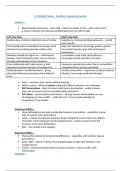
2.1 Political Parties – Functions, Features & Funding
Features –
Representative democracy – elect MPs – held accountable in GEs – voters select from
a choice of parties that represent political spectrum from left to right.
Left wing ideas Right wing ideas
Positive view of state & collectivist view of society. Importance of giving individual autonomy – control
over own life.
Govt should reduce inequality & encourage social Reject LW attempts to encourage greater equality –
cohesion by providing extensive welfare state. free market operates best with minimal govt
interference.
Wealthier should pay higher tax – redistributive Low taxation. Limit trade union influence –
taxation. Govt should play major role in economy encourage smooth operation of market.
through nationalisation of key industries.
Close relationship with trade unions as both Companies operate best when there is competition –
represent economic interests of working class. nationalised firms are best privatised.
Multiculturalism. Socially libertarian – giving Socially conservative – importance of shared national
alternative lifestyles qual status with traditional identity & encourage traditional lifestyles.
ones.
Party – members share similar political ideology.
Within a party – different factions emphasise different elements of its ideology:
RW Conservatives – likely to favour small state & low taxation – unlike Johnson
govt’s tax increase to pay for extended public investment.
LW Labour – represented by Momentum – strongly favours nationalisation & uses
the language of class conflict – unlike Starmer’s more inclusive ideology &
recognition of free market.
Consensus Politics –
Many philosophical and policy similarities between main parties – opposition may be
able to support some govt policies.
1950s – shared commitment of Labour (Hugh Gaitskell) & Conservative (R.A. Butler)
chancellor of the exchequers to full employment & a mixed economy led to the
invention of the term ‘Butskellism’.
Blair – free market & low taxation.
Adversary Politics –
Main parties divided by fundamental differences – opposition will routinely oppose
govt policies.
Early 1980s – Labour’s Michael Foot fundamentally at odds with Thatcher’s free
market reforms.
Corbyn – pursued socialist policies that placed Labour in direct conflict with
Conservative.
Functions –
, Selecting candidates –
To fight in local, regional, mayoral & general elections.
General election – party members go through national selection process to become
an approved candidate.
If they pass – apply to a constituency party that will then choose who it considers
most likely to increase party’s vote share.
Candidate wins seat – claim to have electoral mandate to represent their seat in
Commons.
However, local party not obliged to automatically endorse its MP as candidate for
next GE if their views are too opposed to those of local activists – can open field to
other candidates (RARELY USED).
2022 – Labour MP Sam Tarry, who had been sacked as shadow minister by Starmer
because he was out of touch with leadership, was deselected by his Ilford South
constituency.
Providing government personnel –
By providing candidates for election to public office.
Can be in a local, devolved or national executive.
E.g., in 2010, membership of the parliamentary Conservative & Liberal Democrat
parties provided the membership of the coalition govt.
Electing a leader –
Members play an important role in doing this.
Conservative – party agree on 2 MPs, whose names go forward to members to
decide between.
2022 – party membership voted for Truss (57%) over Sunak (43%).
However, influence of party members can be side-stepped. –
2016 when Andrea Leadsom withdrew from contest so that May would become
party leader and PM unopposed.
2022 – Tory MPs united behind Sunak as party leader, preventing party membership
from electing another leader after Truss.
Features –
Representative democracy – elect MPs – held accountable in GEs – voters select from
a choice of parties that represent political spectrum from left to right.
Left wing ideas Right wing ideas
Positive view of state & collectivist view of society. Importance of giving individual autonomy – control
over own life.
Govt should reduce inequality & encourage social Reject LW attempts to encourage greater equality –
cohesion by providing extensive welfare state. free market operates best with minimal govt
interference.
Wealthier should pay higher tax – redistributive Low taxation. Limit trade union influence –
taxation. Govt should play major role in economy encourage smooth operation of market.
through nationalisation of key industries.
Close relationship with trade unions as both Companies operate best when there is competition –
represent economic interests of working class. nationalised firms are best privatised.
Multiculturalism. Socially libertarian – giving Socially conservative – importance of shared national
alternative lifestyles qual status with traditional identity & encourage traditional lifestyles.
ones.
Party – members share similar political ideology.
Within a party – different factions emphasise different elements of its ideology:
RW Conservatives – likely to favour small state & low taxation – unlike Johnson
govt’s tax increase to pay for extended public investment.
LW Labour – represented by Momentum – strongly favours nationalisation & uses
the language of class conflict – unlike Starmer’s more inclusive ideology &
recognition of free market.
Consensus Politics –
Many philosophical and policy similarities between main parties – opposition may be
able to support some govt policies.
1950s – shared commitment of Labour (Hugh Gaitskell) & Conservative (R.A. Butler)
chancellor of the exchequers to full employment & a mixed economy led to the
invention of the term ‘Butskellism’.
Blair – free market & low taxation.
Adversary Politics –
Main parties divided by fundamental differences – opposition will routinely oppose
govt policies.
Early 1980s – Labour’s Michael Foot fundamentally at odds with Thatcher’s free
market reforms.
Corbyn – pursued socialist policies that placed Labour in direct conflict with
Conservative.
Functions –
, Selecting candidates –
To fight in local, regional, mayoral & general elections.
General election – party members go through national selection process to become
an approved candidate.
If they pass – apply to a constituency party that will then choose who it considers
most likely to increase party’s vote share.
Candidate wins seat – claim to have electoral mandate to represent their seat in
Commons.
However, local party not obliged to automatically endorse its MP as candidate for
next GE if their views are too opposed to those of local activists – can open field to
other candidates (RARELY USED).
2022 – Labour MP Sam Tarry, who had been sacked as shadow minister by Starmer
because he was out of touch with leadership, was deselected by his Ilford South
constituency.
Providing government personnel –
By providing candidates for election to public office.
Can be in a local, devolved or national executive.
E.g., in 2010, membership of the parliamentary Conservative & Liberal Democrat
parties provided the membership of the coalition govt.
Electing a leader –
Members play an important role in doing this.
Conservative – party agree on 2 MPs, whose names go forward to members to
decide between.
2022 – party membership voted for Truss (57%) over Sunak (43%).
However, influence of party members can be side-stepped. –
2016 when Andrea Leadsom withdrew from contest so that May would become
party leader and PM unopposed.
2022 – Tory MPs united behind Sunak as party leader, preventing party membership
from electing another leader after Truss.


